
Table of Contents
Introduction
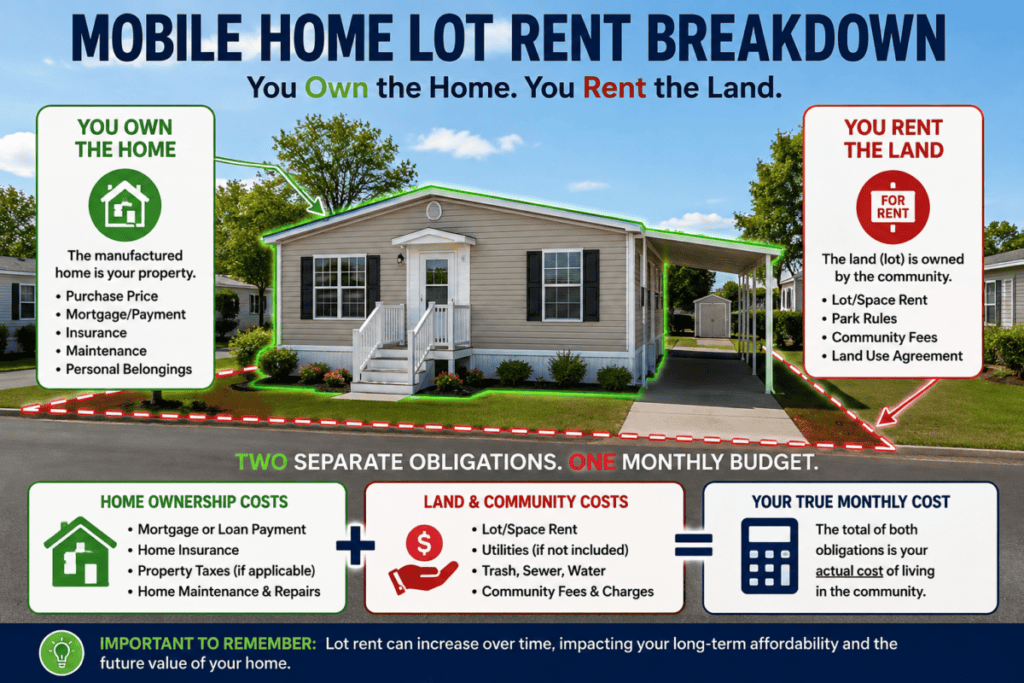
Executive Summary: Mobile home lot rent is the recurring monthly payment made to a park owner for the right to occupy a specific piece of land. Purchasing a manufactured home inside a land-lease community means you own the personal property structure, but you lease the underlying real estate. Buyers frequently miscalculate their true monthly expenditure by analyzing the home purchase price in isolation. Your total housing cost combines loan principal, interest, base lot rent, submetered utilities, pass-through property taxes, and mandatory park assessments. Failing to evaluate historical lot rent increases and utility billing configurations can destroy home equity and cause severe financial hardship.
Note: Local labor rates for mobile home setup, utility connection, and park maintenance change constantly. See our full regional cost table below.
Affiliate Disclosure: MobileHomeFriend.com is reader-supported. When you purchase tools, testing kits, or services through links on our site, we may earn an affiliate commission at no additional cost to you. We only recommend products tested during our 23+ years of field experience flipping and managing manufactured housing.
Video Guide Overview
The “Short” Answer
Buying a mobile home in a land-lease community creates a dual financial structure. You own an asset that depreciates or holds modest equity, while sitting on land owned by a third party. Lot rent is not a static housing fee; it is an ongoing commercial lease obligation that escalates over time. The advertised lot rent rarely reflects your true monthly outlay. Effective lot rent includes base site rent plus mandatory park assessments, submetered water, sewer, trash, storm water management fees, and pass-through property taxes. If you fail to audit the park’s 5-year rent increase history before closing, a cheap $40,000 home purchase can quickly turn into a $1,500 monthly housing obligation. Always evaluate the land lease with greater scrutiny than the physical structure itself.
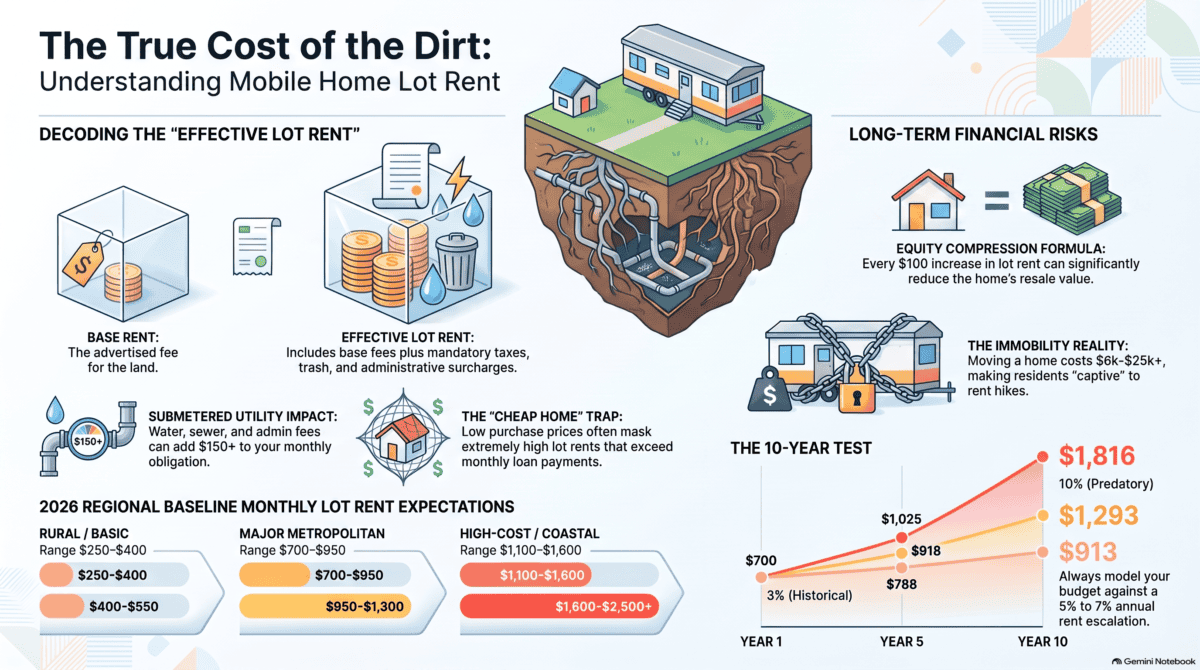
2026 Cost Transparency Table: Regional Lot Rent Overview
Lot rent varies drastically depending on local real estate values, municipal utility arrangements, land availability, and park amenities. The table below outlines baseline expectations for 2026 across major geographic tiers.
| Community / Market Type | DIY / Basic Market Range | Pro / Premium Market Range |
|---|---|---|
| Rural / Basic Community | $250 – $400 / month | $400 – $550 / month |
| Smaller Metropolitan Area | $450 – $650 / month | $650 – $850 / month |
| Major Metropolitan Area | $700 – $950 / month | $950 – $1,300 / month |
| High-Cost / Coastal Market | $1,100 – $1,600 / month | $1,600 – $2,500+ / month |
| Resort / 55+ Lifestyle Park | $800 – $1,200 / month | $1,200 – $2,100 / month |
1. What Is Mobile Home Lot Rent?
Mobile home lot rent (frequently referenced as space rent, site rent, pad rent, or ground rent) is the contractual monthly fee paid by a homeowner to a land owner for the privilege of siting a manufactured home on a designated parcel within a community. Understanding this concept requires stripping away traditional real estate assumptions. In a single-family residential transaction, you buy the dirt and the improvements attached to it. In a mobile home park, you are executing a commercial land lease for real property while holding title to personal property sitting on top of that ground.
This division of ownership creates unique financial dynamics. Even if you pay $100,000 cash for a manufactured home and hold a clear title without any mortgage encumbrance, your monthly cost to occupy that shelter is never zero. You remain subject to ongoing lot rent payments for as long as the home resides in that park. Failing to pay lot rent triggers the same eviction protocols as delinquent apartment rent, placing your multi-thousand-dollar home equity in immediate jeopardy.
Technical Deep Dive: The Mechanics of Personal Property vs. Real Property Chattel Leases
The distinction between real property and personal property (chattel) dictates legal rights, taxation protocols, and enforcement mechanisms in land-lease communities. When a manufactured home is installed inside a mobile home park, it is almost universally classified as personal property, recorded via a state Department of Motor Vehicles or housing authority title, similar to an automobile. The land beneath it remains real property, owned by a limited liability company (LLC) or real estate investment trust (REIT) and recorded in county land registries.
Because your home is personal property sitting on leased real property, your rights are governed by state landlord-tenant statutes specific to manufactured housing, alongside the executed lease agreement. Unlike residential real estate mortgages secured by trust deeds, land lease obligations function under commercial lease logic. If a resident defaults on lot rent, the park operator files for possession of the lot. Upon execution of a writ of possession, the park operator can bar access to the land. The homeowner is then forced to either pay all back rent, legal fees, and storage costs, sell the home to a park-approved buyer under tight timelines, or physically move the home off the property. If the owner fails to accomplish this, state laws often allow the park operator to declare the home abandoned, obtain title through statutory lien foreclosures, and acquire the physical home for pennies on the dollar.
To analyze the impact of this dual structure on your wallet, consider this straightforward financial breakdown comparing an isolated home payment with the actual total monthly housing commitment:
- Home Purchase Loan Payment (Chattel Loan): $650 / month
- Base Lot Rent Charge: $725 / month
- Submetered Water, Sewer, Trash, and Administrative Fees: $175 / month
- Actual Monthly Housing Obligation: $1,550 / month
Buyers who focus exclusively on the $650 loan payment walk into a financial trap. They believe they are purchasing low-cost housing, only to discover that their ongoing site rental expenses outpace their loan obligation. When calculating affordability, you must treat lot rent as a primary housing debt service that will never extinguish.
2. What Does Mobile Home Lot Rent Usually Include?
There is no standard statutory definition regarding what service items must be included within baseline lot rent. Every park operator structures lease agreements according to localized utility setups, municipal infrastructure requirements, and profit margins. A lot rent fee of $600 / month in one park might cover water, sewer, trash, and lawn maintenance, while a $550 / month fee in a neighboring community covers zero services, billing every utility back to the resident on a secondary statement.
To avoid expensive surprises, break down park offerings into baseline physical infrastructure and variable service components:
The Homesite Infrastructure
- Exclusive Occupancy: The right to occupy the specific boundaries of the designated lot.
- Road Access: Use and maintenance of private internal park streets, curbing, and speed bumps.
- Utility Hookup Connections: Access to primary utility risers terminating at the lot pedestal (electrical panel, municipal water riser, sewer drop, gas meter setting).
- Common Area Facilities: Access to shared elements such as street lighting, mail centers, clubhouses, play areas, and visitor parking.
Services That May (or May Not) Be Included
- Solid Waste Pick-up: Curbside trash collection and recycling services.
- Wastewater Processing: On-site private septic system maintenance or municipal sewer line conveyance.
- Potable Water Supply: Bulk municipal water access or private well system testing and distribution.
- Common Grounds Landscaping: Mowing, tree trimming, and weed control in shared spaces and greenbelts.
- Individual Lot Care: Basic lawn mowing or leaf removal (rare in all-age parks, more common in premium 55+ communities).
- Snow Removal: Clearing of main arterial streets and, occasionally, individual driveways in northern climates.
Never assume a service is included simply because another park down the street includes it in their base rent. You must read the written rules and master lease agreement before placing a deposit or signing a purchase contract.
3. Are Utilities Included in Mobile Home Lot Rent?
Utility delivery and billing inside mobile home parks are governed by complex submetering laws, municipal regulations, and aging private infrastructure. How utilities are delivered directly affects your monthly housing budget. Below is an itemized breakdown of how each core utility service is handled in land-lease communities.
Water Systems
Water delivery generally follows one of four structural patterns:
- Included in Base Rent: The park pays a master municipal bill and absorbs the expense into baseline lot rent. (Becoming increasingly rare due to conservation mandates and cost pressures).
- Flat Monthly Fee: Residents pay an unmetered, fixed fee (e.g., $45 / month) added directly to the monthly rent statement.
- Individually Metered: The local water utility owns the underground mains, reads individual home meters directly, and bills the resident directly. This is the cleanest setup for buyers.
- Submetered by Park: The park owns the private underground distribution network and maintains a single master meter with the city. The park installs private submeters at each home, reads them monthly, and bills residents based on usage.
Sewer and Wastewater
Sewer arrangements depend heavily on whether the community utilizes public infrastructure or private systems:
- Municipal Sewer: Charged as a direct pass-through based on water consumption metrics, or billed as a flat municipal utility fee.
- Private Septic Systems / Wastewater Treatment Plants (WWTP): The park operates private septic tanks, drainfields, or an on-site treatment plant. Costs may be rolled into rent, but aging systems often lead to heavy capital improvement pass-through assessments on residents.
Electricity, Gas, and Trash
Electrical service is typically direct-metered by the local electric utility. However, older parks built before 1970 may utilize master-metered electrical systems. In master-metered setups, the park receives high-voltage service, steps it down through private transformers, and submeters electricity to homes at 50-amp to 100-amp capacities. This can limit your ability to run modern HVAC systems and heavy appliances.
Natural gas is generally billed via direct utility accounts, whereas rural parks frequently rely on private propane tanks. Propane setups require individual lease contracts with local fuel suppliers, introducing high seasonal heating spikes during winter months. Solid waste collection is either billed as a mandatory line item ($20 – $40 / month) or wrapped into municipal utility charges.
The Critical Question Every Buyer Must Ask
Stop asking park managers: “What is the lot rent?” That question produces an incomplete number designed to sound affordable. Instead, require the seller and management to answer this exact query in writing:
“What was the total line-item amount billed to this specific homesite during each of the last 12 months, including base rent, submetered utilities, pass-through taxes, trash, and mandatory fees?”
4. How Much Is Normal for Mobile Home Lot Rent?
National average lot rent statistics published online are practically useless for prospective buyers. A national average of $580 / month provides zero actionable insight when evaluating a park in suburban Seattle charging $1,250 / month versus a rural park in Oklahoma charging $320 / month. Lot rent is hyper-local and driven by specific real estate market forces.
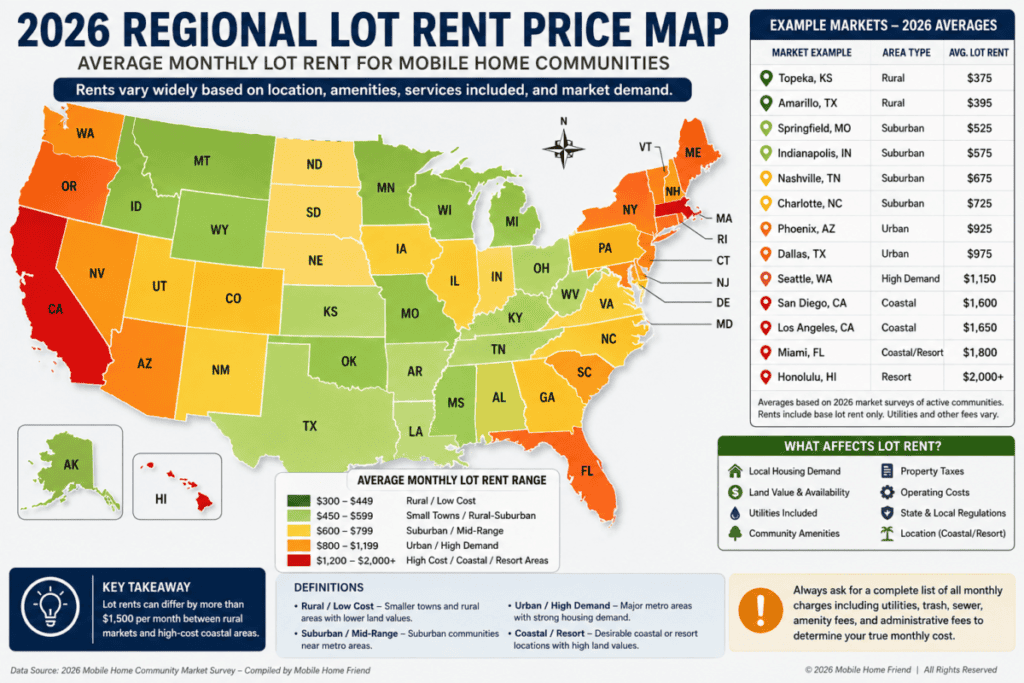
Key drivers that dictate baseline site pricing include:
- Underlying Land Value: Land values in major metropolitan corridors drive higher lot rents as park owners balance land use against commercial developments.
- Density and Lot Sizes: Larger lots with long driveways, private garages, and mature shade trees command higher site fees than tight, high-density layouts.
- Age and Infrastructure Condition: Modern communities with paved roads, underground utilities, and PVC plumbing command higher fees than legacy parks with failing asphalt and galvanized steel piping.
- Community Demographics: Dedicated 55+ active adult communities typically command a 15% to 30% premium over all-age parks due to enhanced amenities and lower physical wear on facilities.
- Amenities Package: Heated pools, security gates, clubhouses, fitness centers, and storage yards add direct overhead to base lot pricing.
Affiliate Comparison Table: Essential Buyer Audit Tools
Evaluating a mobile home and its utility setup before signing a land lease requires specialized diagnostic tools. The table below outlines key equipment for pre-purchase inspections.
| Tool / Equipment | Primary Application | Estimated Cost |
|---|---|---|
| Pro-Grade Infrared Thermal Camera | Identifies subfloor insulation gaps, water leaks, and overheating electrical pedestals before lease execution. | $280 – $450 |
| Non-Contact Submeter Voltage Tester | Verifies park pedestal voltage stability (120V/240V) and identifies dangerous neutral drops under load. | $35 – $65 |
| Digital Water Pressure Gauge Assembly | Tests static and dynamic water pressure at the home’s hose bibb to verify park infrastructure pressure. | $20 – $40 |
5. Why Mobile Home Lot Rent Keeps Going Up
Understanding why lot rent escalates rapidly requires analyzing park operations from a business perspective. Community operators face real inflationary cost pressures across multiple categories:
- Surging Property Taxes: Municipal tax authorities aggressively reassess commercial mobile home parks upon sale or capital upgrades, passing high reassessments straight to residents.
- Commercial Liability and Property Insurance: Environmental hazards, aging trees, and private road liabilities have driven commercial park insurance premiums up substantially over recent years.
- Municipal Utility Rate Hikes: City water, sewer, and waste authorities routinely implement annual rate increases ranging from 5% to 12%, which flow through to site statements.
- Capital Replacement Reserves: Replacing legacy utility mainlines, repaving private roads, or repairing aging septic fields requires significant capital expenditure.
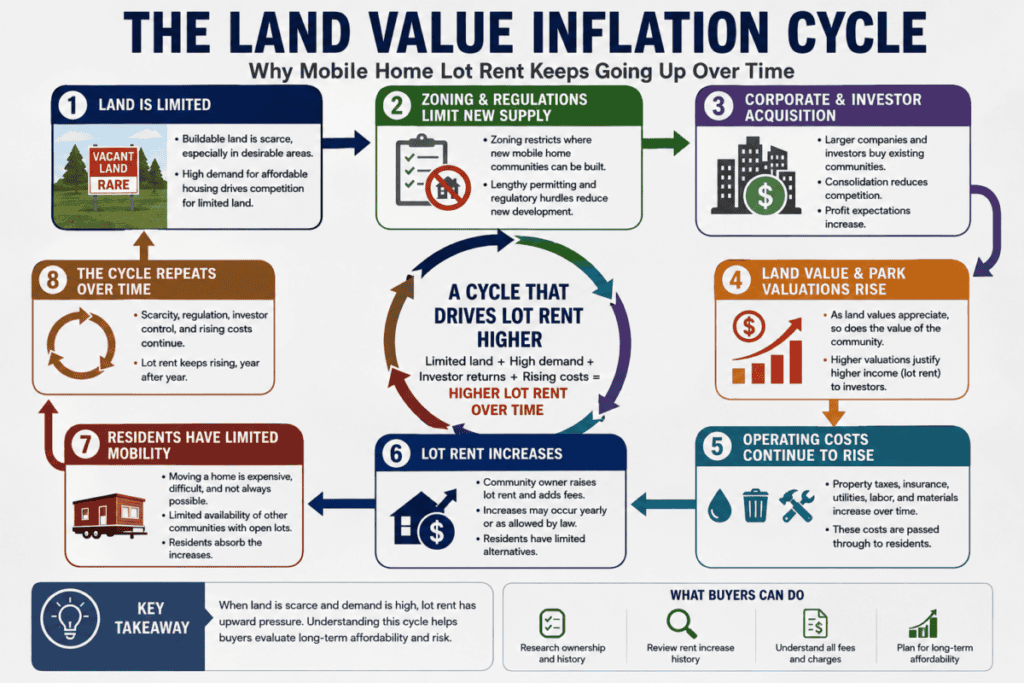
The Real Economic Engine: Structural Supply Constraints and Land Value
Beyond operating inflation, a powerful macroeconomic force drives lot rent increases: absolute supply suppression combined with captive demand.
Municipal zoning boards across the United States rarely approve new mobile home park developments. Zoning restrictions and land-use rules have virtually halted new park construction for decades. Concurrently, existing parks located near urban centers are constantly targeted by commercial developers seeking to rezone the land for apartments, industrial hubs, or retail centers.
As affordable housing demand surges while the total supply of manufactured home lots shrinks, park owners hold immense pricing power. When a conventional apartment tenant faces a 15% rent hike, they can pack their belongings into a rental truck for $500 and move to another building. A manufactured homeowner cannot easily do that. They are bound to the dirt by the physical reality of moving a 20-ton structure. Park owners recognize this leverage, allowing them to raise rents year after year without risking significant occupancy losses.
6. The Problem of Owning the Home but Renting the Land
The core vulnerability of land-lease living stems from a fundamental imbalance: you own a high-cost physical asset situated on real estate owned by someone else. This dynamic separates manufactured housing inside parks from virtually every other real estate asset class.
When lot rent increases beyond what a resident can afford, the logical response would be to move the home to a cheaper park or a private parcel. However, physical and economic realities make moving a home nearly impossible for most residents.
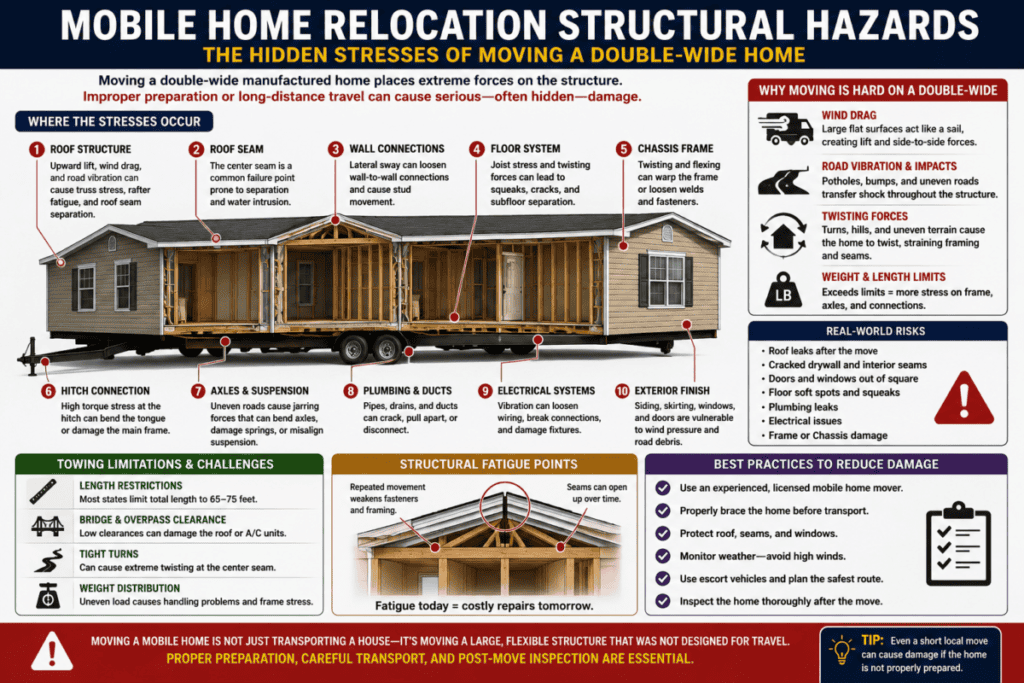
The Immobility Reality Check
The term “mobile home” is a historical misnomer. Modern manufactured homes are built to HUD safety codes, transported from factories to site locations, anchored down to concrete piers, and tied directly into utility infrastructures. Relocating an existing home involves severe logistical and financial barriers:
- Extreme Relocation Expenses: Disconnecting utilities, removing skirting, dismantling porches/carports, unbolting double-wide matrimonials, hiring licensed transport contractors, securing highway permits, re-setting, re-leveling, and reconnecting utilities costs between $6,000 and $15,000 for a single-wide, and upwards of $12,000 to $25,000+ for a double-wide home.
- Park Age Acceptance Restrictions: Most modern, affordable parks enforce strict home-age limits. They frequently reject incoming homes older than 10 to 15 years, regardless of their physical condition. If your home was built in 1995, finding an alternative park with a vacant lot will be extremely difficult.
- Structural Risk During Transport: Aged structural frames, settled floor joists, and weathered roofing systems can suffer catastrophic stress fractures, axle failures, or roof separation during transit across highway speeds.
- Permitting and Zoning Barriers: Moving a home to a private parcel requires zoning compliance, soil compaction testing, septic permit approvals, utility connection fees, and permanent foundation installation (expenses that often exceed the value of an older home).
Because moving the home is rarely viable, homeowners are functionally locked into place. Theoretical mobility does not match practical mobility. This captive relationship requires thorough risk analysis before purchasing a home in any land-lease community.
If you are exploring alternative housing setups for older adults that avoid high commercial park fees, read our strategic guide on senior housing options and land-lease alternatives to evaluate lower-risk housing models.
7. How Often Can Mobile Home Lot Rent Increase?
There is no uniform federal law regulating how often or by how much a mobile home park owner can raise lot rent. Regulations are determined entirely by state statutes, county regulations, municipal rent control ordinances, and the specific terms written into your lot lease agreement.
Legal standards generally fall into three primary regulatory categories across the country:
- Unrestricted States (Free Market): In the majority of states, park owners can increase lot rent as frequently as lease renewal periods allow (typically once every 12 months, or upon 30-to-60 days written notice on month-to-month leases). There are zero caps on percentage increases. The rent can legally jump 5% one year and 25% the next.
- Notice and Disclosure States: Certain states (e.g., Florida, Pennsylvania) do not cap percentage increases but require park owners to provide formal 90-day written notices before rent adjustments. Some states mandate formal meeting protocols between park owners and resident committees to justify major rate increases.
- Rent-Controlled / Stabilized Jurisdictions: Select states and municipalities (e.g., specific jurisdictions in California, New York, New Jersey) enforce manufactured home rent stabilization ordinances. These rules bind annual lot rent increases to local Consumer Price Index (CPI) metrics or cap increases at specific percentages (e.g., 3% to 5% annually).
Mandatory Pre-Purchase Audit Box: Before executing a purchase agreement for a home in a park, verify these five legal points:
- What specific state landlord-tenant statutes govern manufactured housing communities in your state?
- Is the park located within a municipality or county with active mobile home rent stabilization ordinances?
- Does your lease offer a multi-year term (e.g., 3 to 5 years) with fixed escalation caps, or is it an annual/month-to-month agreement?
- What specific written notice window (30, 60, or 90 days) is legally required prior to any lot rent modification?
- Are pass-through capital improvement assessments legally capped or subject to resident veto rights under state law?
8. Lot Rent Isn’t Always the Entire Park Bill
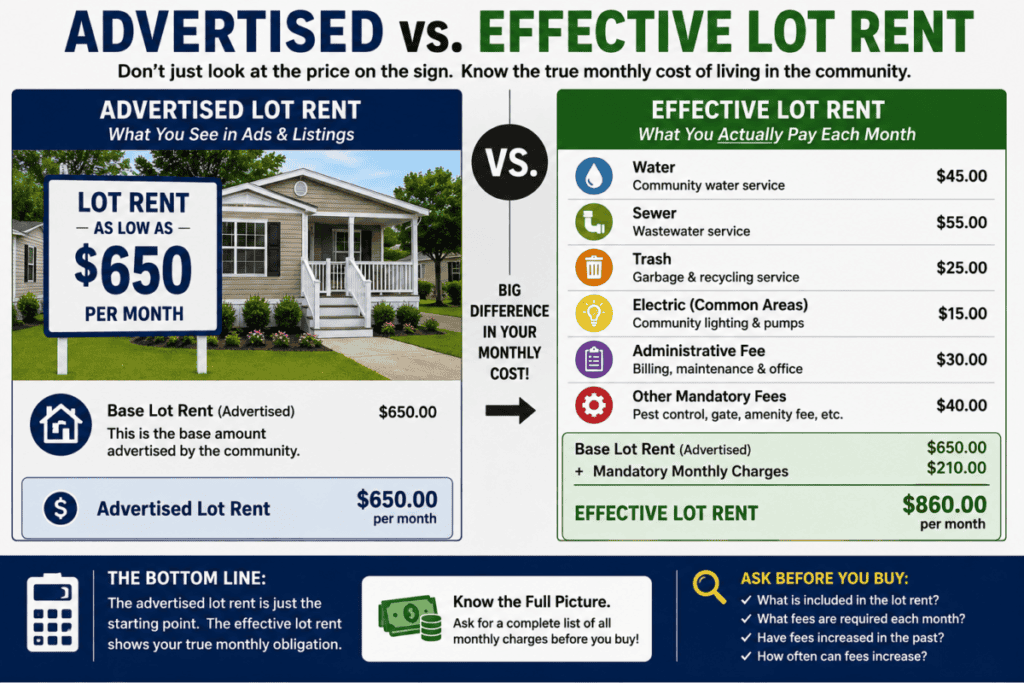
Evaluating a mobile home park solely by its advertised base lot rent is one of the most common financial mistakes buyers make. Park operators frequently utilize unbundled pricing models, advertising a low base lot rent to attract buyers while attaching multiple mandatory monthly fees onto the master billing statement.
To determine your true monthly obligation, you must calculate your Effective Lot Rent. Effective Lot Rent represents the total mandatory dollar amount required each month simply to occupy the lot, excluding your home loan payment.
Effective Lot Rent = Base Lot Rent + Submetered Utilities + Pass-Through Taxes + Mandatory Administrative & Service Fees
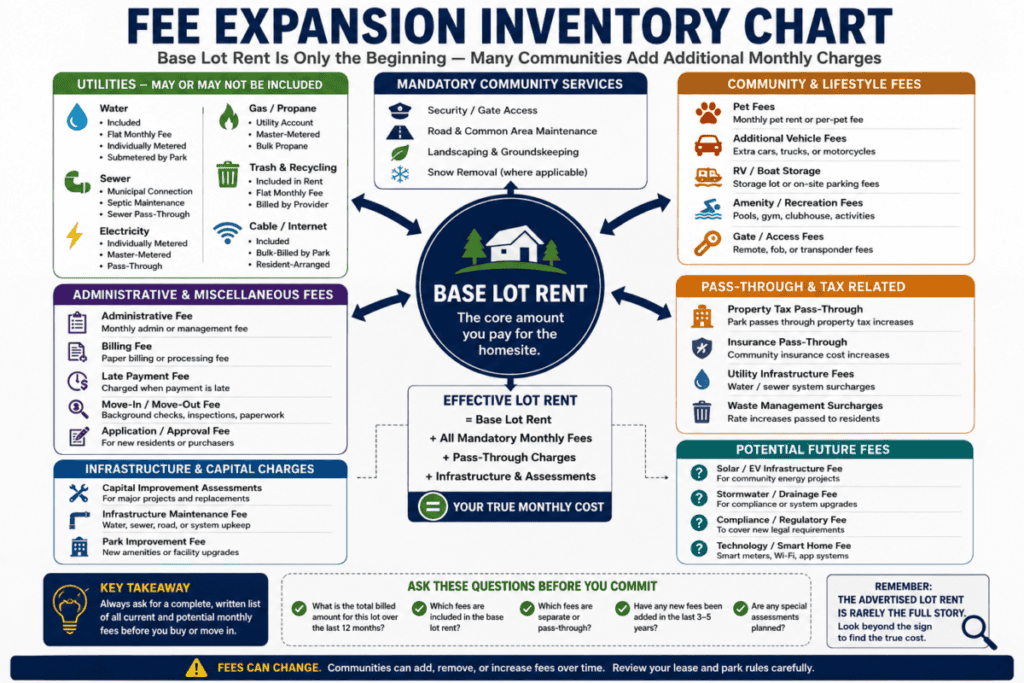
Consider this comprehensive inventory of recurring charges frequently added to park bills:
- Pass-Through Real Estate Taxes: Parks often divide commercial property tax increases among residents as a separate monthly line item ($15 – $45 / month).
- Utility Infrastructure Reserve Fees: Surcharges assessed to fund aging water main repairs or electrical grid upgrades ($20 – $50 / month).
- Administrative and Meter Reading Fees: Third-party processing fees charged simply to read submeters and issue utility statements ($5 – $15 / month).
- Pet Fees: Recurring monthly charges assessed per approved pet occupying the homesite ($15 – $35 / month, per pet).
- Vehicle and Storage Fees: Charges for parking additional vehicles, boats, or work trucks in designated park overflow lots ($30 – $100 / month).
- Stormwater and Environmental Compliance Assessments: Municipal drainage fees passed directly to residents ($10 – $25 / month).
When you add $45 in property tax pass-throughs, $80 in submetered water/sewer, $30 for trash, $10 in submeter admin fees, and $20 for pets to an advertised base rent of $600, your true Effective Lot Rent is actually $785 / month. Always base your budget on Effective Lot Rent, never on the base rent advertised on sales flyers.
9. The Lot-Rent History Matters More Than Today’s Number
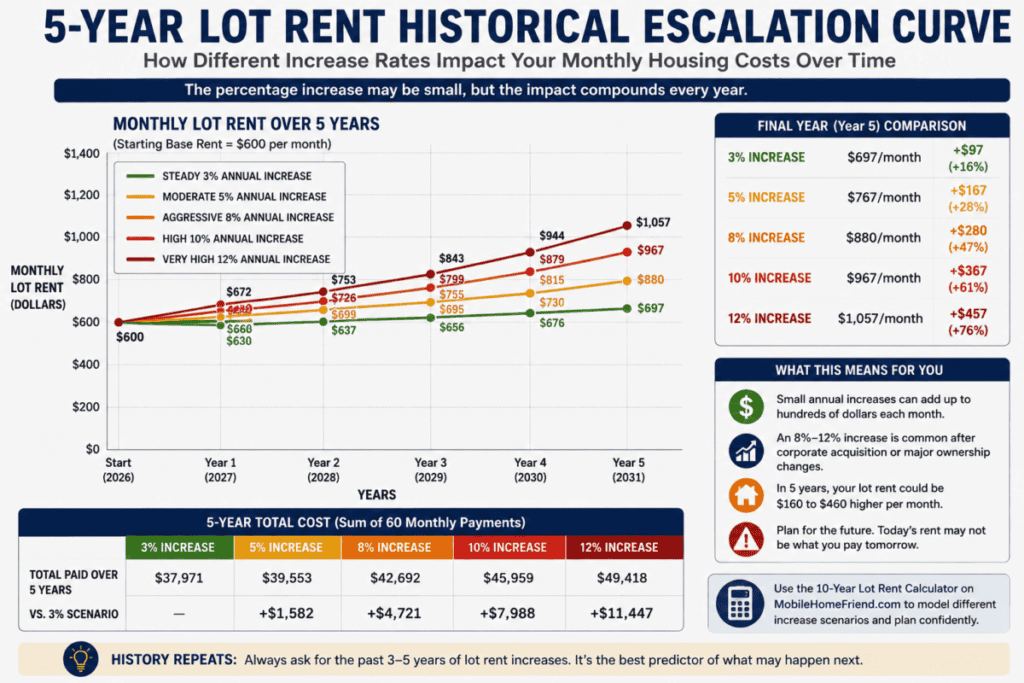
A single snapshot of today’s lot rent tells you very little about your future financial security in a community. A park charging an affordable $500 / month today might seem like a bargain. However, if that same park charged $320 / month three years ago, it is operating on an aggressive compounding escalation path that will quickly destabilize your housing budget.
You must audit the community’s 5-year historical escalation curve before making a purchase decision. Compare two hypothetical communities offering identical homes for sale today:
| Year | Community A (Stable Local Owner) | Community B (Aggressive Corporate REIT) |
|---|---|---|
| 2022 | $500 / month | $450 / month |
| 2023 | $515 / month (3%) | $505 / month (12.2%) |
| 2024 | $530 / month (2.9%) | $570 / month (12.8%) |
| 2025 | $545 / month (2.8%) | $645 / month (13.1%) |
| 2026 | $560 / month (2.75%) | $730 / month (13.1%) |
| 5-Year Escalation | +12% Total Increase | +62.2% Total Increase |
In 2022, Community B looked like the better deal. Five years later, Community B’s aggressive price hikes pushed lot rent far past Community A’s, cutting into home equity and creating severe budget strain for its residents. Always evaluate the escalation trend rather than focusing solely on today’s snapshot price.
10. Why Park Ownership Changes Matter
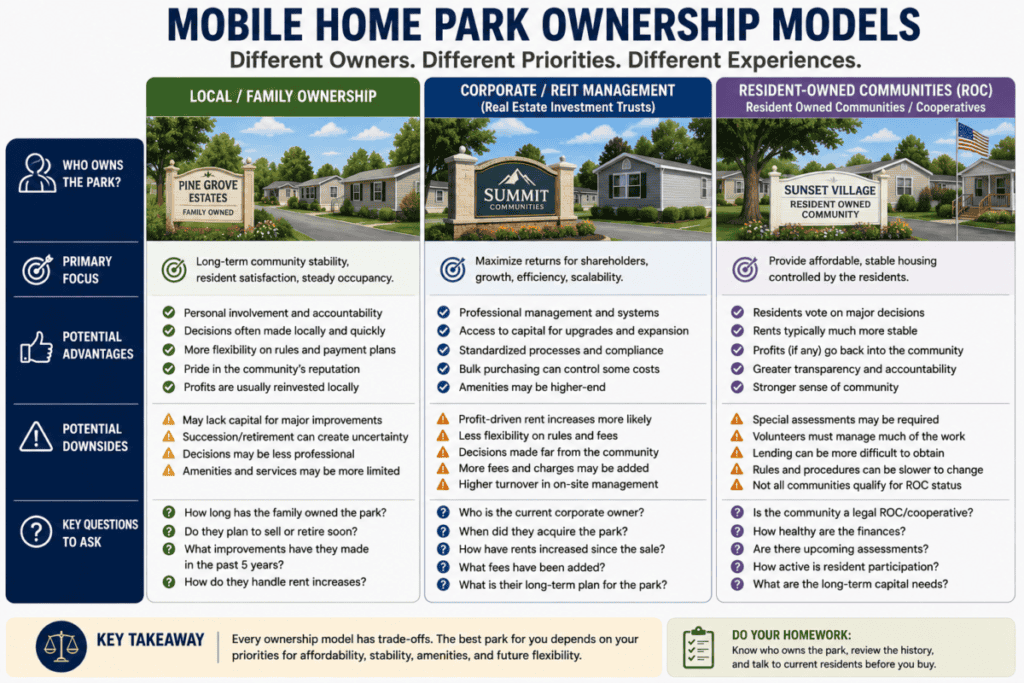
The entity that owns the ground beneath your home dictates your long-term financial stability and overall quality of life. Over the last decade, the manufactured housing sector underwent a massive structural ownership shift. Private equity groups, hedge funds, and multi-state Real Estate Investment Trusts (REITs) have aggressively acquired mom-and-pop manufactured housing communities nationwide.
Understanding the operating profiles of different ownership models helps you anticipate future rent trajectories and park maintenance standards:
- Long-Term Independent / Family Ownership: Historically operated by the original builders or local families. These operators often prioritize high occupancy, community stability, and steady, low rent increases (2% to 4% annually). However, aging mom-and-pop owners may defer major capital repairs on underground utilities.
- Corporate REITs and Private Equity Firms: Institutional investors focused on maximizing net operating income (NOI) for investors. Upon acquisition, corporate operators often implement immediate rent increases (10% to 20%+), bill out previously included utilities, enforce strict rule modifications, and invest in cosmetic upgrades (new signage, clubhouse paint) to justify higher site fees.
- Resident-Owned Communities (ROCs) / Cooperatives: Communities where homeowners form a non-profit cooperative corporation to buy the park land outright. Residents control the board, set lot rents based on actual operating expenses, and eliminate the risk of predatory rent hikes or park redevelopment sales. ROCs represent the most secure land-lease model for buyers.
Before buying, ask management: “How long has the current ownership entity held title to this property, when was the last ownership transition, and are there active listing agreements or redevelopment plans in place?” If ownership changed hands within the past 24 months, expect major rent adjustments as new management implements its return-on-investment strategy.
For buyers considering long-term community living arrangements, review our in-depth audit on affordable housing strategies and community stability models to protect your nest egg.
11. How Rising Lot Rent Can Affect the Value of Your Mobile Home
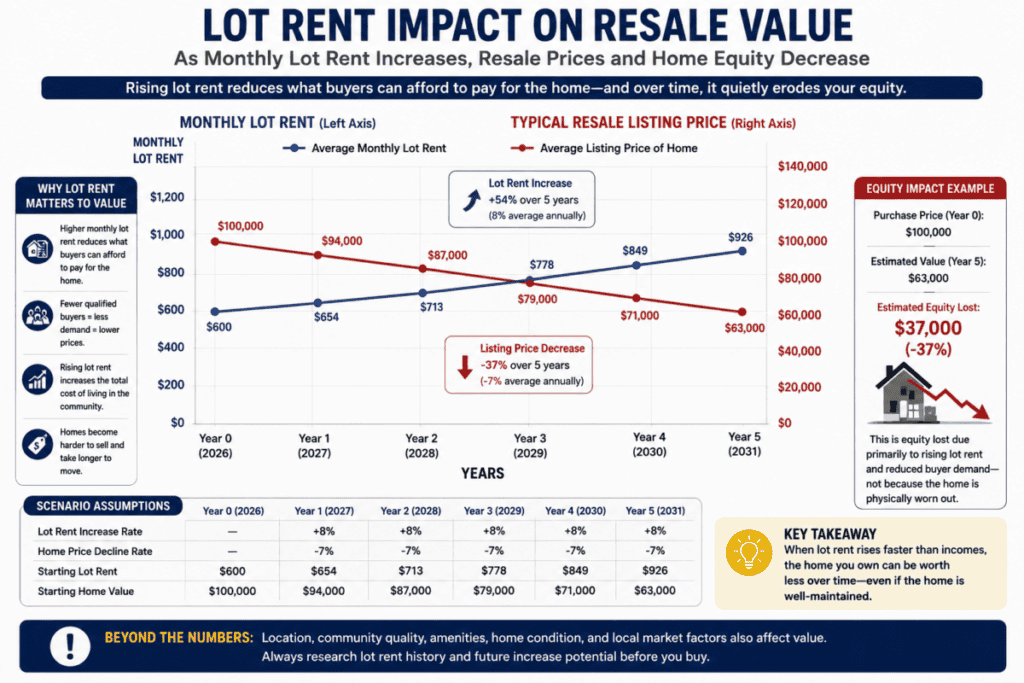
A widespread myth in manufactured housing is that home equity operates completely independently of site rental rates. In land-lease communities, rising lot rent directly depresses home equity and resale values.
This dynamic stems from a fundamental real estate truth: home buyers shop based on their total monthly housing budget. When interest rates and monthly land rents rise, the available pool of capital a buyer can allocate toward purchasing the physical home shrinks.
The Equity Compression Formula
Consider a market where target buyers can comfortably afford a total housing expenditure of $1,300 / month (combining loan principal/interest and effective lot rent):
- Scenario A (Lot Rent at $400/month): The buyer has $900 / month available for debt service. This debt capacity supports a home purchase price of approximately $95,000 using standard chattel financing.
- Scenario B (Lot Rent jumps to $850/month): The buyer now has only $450 / month left for debt service. That reduced payment capacity supports a home purchase price of only $47,000.
The physical structure in Scenario B did not change, deteriorate, or lose functional utility. Yet, the $450 monthly increase in lot rent wiped out nearly $48,000 in home resale value. High lot rent transfers asset value away from the homeowner’s personal equity and into the park owner’s real estate balance sheet. When lot rents outpace market norms, homes sit on the market longer, seller concessions increase, and final sale prices drop significantly.
12. The “Cheap Mobile Home” Trap
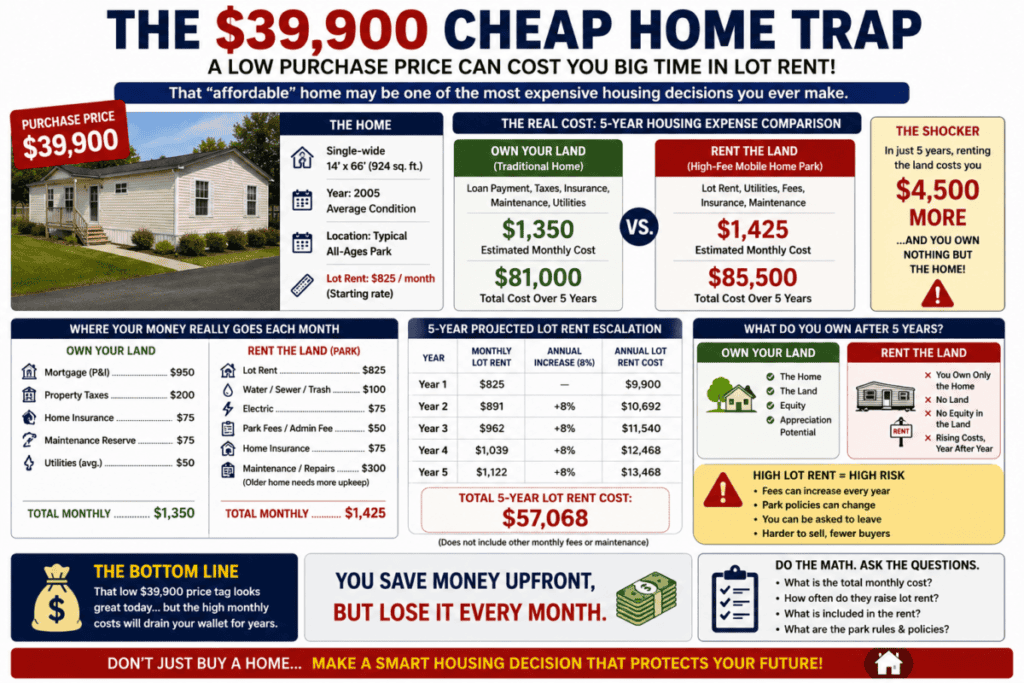
Online real estate portals are filled with listings showcasing mobile homes priced at seemingly unbelievable bargain rates: $25,000, $35,000, or $49,900 in metro markets where median single-family homes exceed $400,000. Unwary buyers view these low purchase prices as an easy entry point into affordable homeownership. This dynamic is frequently a classic setup for the Cheap Home Trap.
Park homes carry low purchase prices precisely because high lot rents and restrictive park rules suppress their market demand. Consider this realistic financial scenario for a cheap listing:
- Advertised Purchase Price: $39,900 (Paid in cash from savings)
- Base Lot Rent Charge: $950 / month
- Submetered Water & Sewer: $125 / month
- Mandatory Trash & Admin Fees: $45 / month
- Pass-Through Property Tax: $35 / month
- Pet & Additional Vehicle Surcharges: $40 / month
- True Monthly Park Obligation: $1,195 / month
Despite paying cash for the home and carrying zero mortgage debt, the buyer faces an unavoidable baseline housing cost of $1,195 / month before adding home insurance, electrical utilities, or structural maintenance reserves. Within four years, the buyer will pay more in lot rent and site fees ($57,360+) than they paid for the home itself. Always analyze purchase price in tandem with recurring site costs.
13. Calculate the Real Monthly Cost Before Buying
Never sign a purchase contract without completing a comprehensive housing expense audit. Use this four-part calculation worksheet to determine your true total monthly outlay across all categories.
Category 1: Home Capital Debt Service
- Chattel Loan Principal & Interest (or Personal Bank Loan): $__________
- Personal Property Taxes (if billed separately by county): $__________
- Homeowners Insurance (HO-7 Manufactured Home Policy): $__________
Category 2: Land-Lease & Park Obligations
- Advertised Base Lot Rent: $__________
- Pass-Through Property Taxes: $__________
- Mandatory Trash & Recycling Charges: $__________
- Submetered Administrative / Billing Charges: $__________
- Mandatory Amenity / Gate / Facility Assessments: $__________
Category 3: Variable Utility Outlays
- Estimated Water & Sewer Usage: $__________
- Electricity (Heating / Cooling / Base Load): $__________
- Natural Gas / Delivered Propane Service: $__________
- High-Speed Internet & Cable Television: $__________
Category 4: Maintenance & Capital Reserves
- Home Maintenance Fund (Roof, HVAC, Skirting, Leveling): $__________ (Minimum $150/mo recommended)
- Lot Landscaping & Tree Trimming Responsibility: $__________
True Monthly Housing Obligation = Category 1 + Category 2 + Category 3 + Category 4
Compare this final combined figure against alternative local housing options (such as condominiums, fee-simple single-family homes, or traditional apartments) to confirm whether the land-lease home delivers genuine long-term financial value.
14. The 10-Year Lot-Rent Test
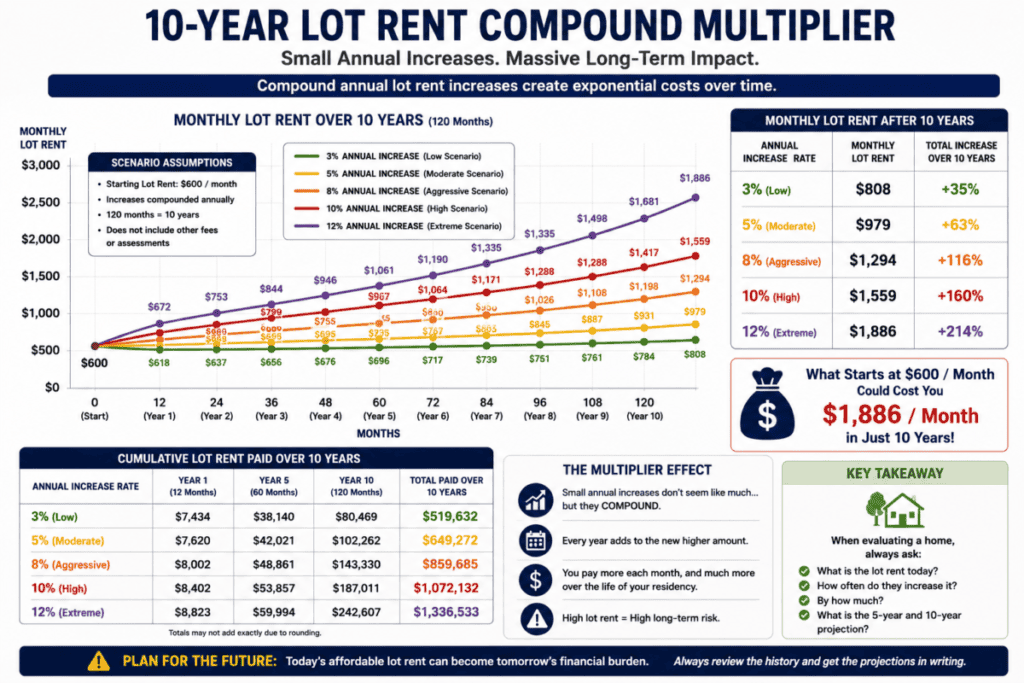
To evaluate long-term financial risk, project your lot rent out over a 10-year horizon across various escalation scenarios. A lot rent that feels comfortable today can easily become unaffordable after a decade of compounding percentage increases.
The matrix below demonstrates the long-term impact of compounding escalation rates starting from a baseline lot rent of $700 / month:
| Escalation Scenario | Year 1 (Base) | Year 3 | Year 5 | Year 7 | Year 10 |
|---|---|---|---|---|---|
| 3% Annual Escalation (Historical Inflation) | $700 | $743 | $788 | $836 | $913 / mo |
| 5% Annual Escalation (Moderate Park Hikes) | $700 | $772 | $851 | $938 | $1,140 / mo |
| 7% Annual Escalation (Aggressive Corporate Rate) | $700 | $802 | $918 | $1,051 | $1,293 / mo |
| 10% Annual Escalation (Predatory / Transition Hikes) | $700 | $847 | $1,025 | $1,240 | $1,816 / mo |
Run these calculations using local market conditions. If your income is fixed (such as Social Security or a pension), a 7% to 10% annual escalation trajectory will rapidly create financial distress. If you cannot comfortably afford the Year 5 and Year 10 numbers under moderate escalation scenarios, do not purchase the home.
15. What Buyers Should Investigate BEFORE Purchasing a Mobile Home in a Park
Protect your capital by completing this comprehensive pre-purchase investigation protocol before handing over earnest money or signing a park lease agreement.
Actionable Buyer Pre-Closing Audit Checklist
- [ ] Obtain Official Written Fee Schedules: Require management to provide a written, signed statement of base rent, utility billing formulas, and all active mandatory fees.
- [ ] Review the Master Lease Agreement: Read the full lease terms, paying close attention to renewal conditions, rent increase notification windows, and escalation clauses.
- [ ] Audit Historical Rent Statements: Request copies of lot rent billing statements for the specific lot across the previous 3 to 5 years from the seller.
- [ ] Examine Complete Community Rules and Regulations: Thoroughly review restrictions regarding pet species/weight caps, vehicle limits, subletting restrictions, architectural modifications, and age limits for future home buyers.
- [ ] Verify Utility Billing Mechanics: Confirm whether water, sewer, electric, and gas are direct-metered by public utilities or submetered by the park owner.
- [ ] Investigate Park Ownership History: Research county property records to identify the park owner entity, purchase date, and historical transaction frequency.
- [ ] Confirm Buyer Approval Requirements: Complete management background checks, credit approvals, and income verification protocols prior to removing purchase contract contingencies.
- [ ] Check Rights of First Refusal: Determine whether park management retains a legal right of first refusal that could complicate future home resales.
- [ ] Inspect Infrastructure Capacity: Verify that the electrical pedestal provides sufficient amperage (100A or 200A service) and inspect water line heat tapes in freezing climates.
- [ ] Review Resale and Age Restrictions: Ask whether the park enforces home-age rules that force older homes to be removed or upgraded upon resale.
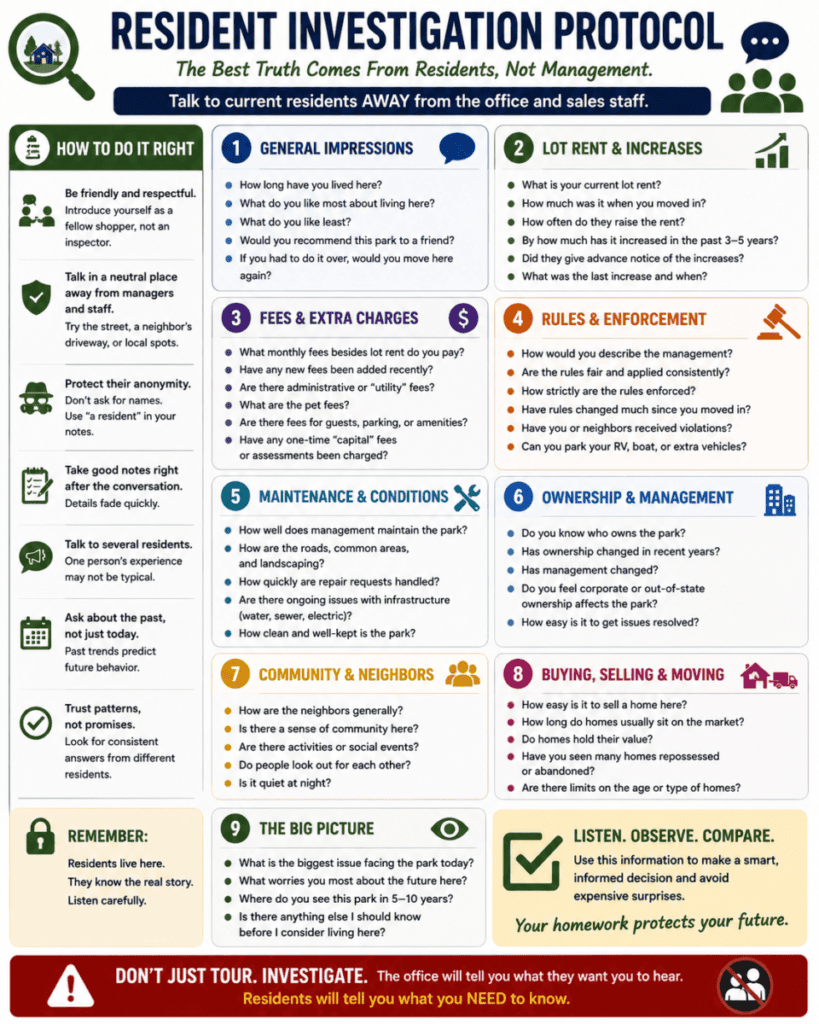
16. Talk to Residents—Not Just Management
Park managers are employed to maintain high occupancy and present the community in the best possible light. They rarely volunteer details about upcoming rent increases, aging infrastructure issues, or management disputes. To uncover the real story, walk the neighborhood and talk directly with long-term residents away from the sales office.
Seek out homeowners who have lived in the park for 5 to 10+ years. Ask these exact, targeted questions:
- “How much has your lot rent gone up per month over the past three to five years?”
- “Have new fees or pass-through charges been added to your bill recently?”
- “How does management respond when major water, sewer, or road repairs are needed?”
- “Has the park been sold recently, or are there rumors of an upcoming sale?”
- “Do you feel you get good value for what you pay in lot rent every month?”
- “If you were shopping for a home today, would you buy into this park again?”
Their responses will provide an honest look at community management, actual cost trajectories, and neighborhood stability that no marketing brochure will ever show.
17. Red Flags Before Buying
If you encounter any of the following warning signs during your pre-purchase investigation, pause the transaction immediately and perform deep-dive due diligence before proceeding:
- Management Refuses Written Documentation: Park operators who refuse to provide written historical fee schedules, full rule books, or utility billing breakdowns before you sign a purchase offer.
- Surge in Sales Listings: A high concentration of homes listed for sale simultaneously within a small community. This often indicates recent rent spikes or poor management driving residents out.
- Unclear Submetering Billing Formulas: Utility billing line items that combine usage charges with vague “administrative,” “line-loss,” or “system maintenance” fees without clear explanations.
- Recent Purchase by Institutional Equity Groups: A park that changed hands within the last 12 to 24 months to a multi-state investment firm. This move is almost universally followed by heavy rent hikes and unbundled fee structures.
- Deferred Infrastructure Maintenance: Visible signs of neglect, such as severely rutted private roads, broken streetlights, overflowing dumpster sites, standing water near sewer drops, or decaying park pedestals.
- Homes Priced Far Below Market Norms: A home listed at a rock-bottom price paired with unusually high lot rent. This setup indicates that excessive site fees have severely damaged home equity.
18. When High Lot Rent Can Still Make Sense
High lot rent is not automatically a bad financial deal. The core evaluation metric is value alignment: are you receiving tangible services, superior location benefits, and premium lifestyle amenities in exchange for higher monthly site fees?
A higher lot rent (e.g., $950 – $1,400 / month) can make sound economic sense under the right conditions:
- Prime Coastal or Urban Locations: Land-lease communities situated on waterfront property, near major employment hubs, or in high-cost metro areas where conventional single-family home prices exceed $700,000+. High lot rent allows you to secure a prime location at a fraction of traditional land purchase costs.
- Inclusive Premium Utility Packages: Communities where high lot rent fully covers high-cost services, including bulk high-speed internet, premium cable, complete landscape maintenance, water, sewer, and trash collection.
- Resort-Style Lifestyle Amenities: High-end 55+ communities offering extensive amenities, such as staffed gatehouses, heated pools, championship golf course access, extensive clubhouses, fitness centers, and organized social programming.
- Immaculate Infrastructure Maintenance: Parks that consistently reinvest site fees into fresh asphalt, updated utility networks, immaculate groundskeeping, and proactive management.
The key question is not simply: “Is the rent high?” The real question is: “Does the value of the location, services, and amenities justify the ongoing monthly expenditure, and can my long-term budget absorb future price increases?”
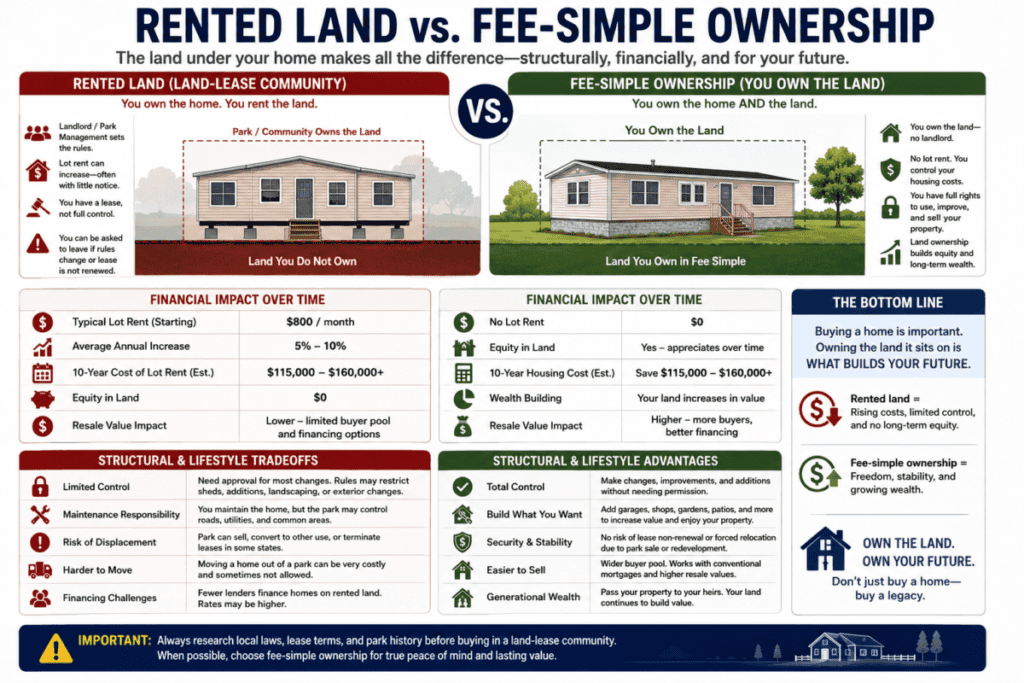
19. Lot Rent vs. Owning Your Own Land
Evaluating a manufactured home purchase requires comparing the land-lease model against fee-simple real estate ownership (purchasing the home attached to a private lot, or buying into a resident-owned subdivision).
| Feature / Attribute | Rented-Land Park Community | Resident-Owned Land / Private Lot |
|---|---|---|
| Initial Acquisition Cost | Low: You buy only the home structure. Entry costs are significantly lower. | High: You purchase the home and the real estate land parcel together. |
| Monthly Land Payments | Ongoing Lot Rent: Land rent payments continue indefinitely and escalate over time. | Zero Lot Rent: Standard land mortgage payments eventually extinguish, leaving only property taxes/HOA fees. |
| Land Control & Stability | Low: Subject to park rules, management decisions, and potential park sales. | High: You control the real estate within local municipal zoning codes. |
| Asset Appreciation Potential | Restricted: Home prices are tied to local lot rent levels and land lease terms. | High: Real estate land values appreciate over time, building equity. |
| Financing Options | Chattel / Personal Property Loans: Higher interest rates, shorter payback terms (15–23 years). | Conventional / FHA / VA Mortgages: Lower mortgage interest rates, 30-year terms available. |
| Maintenance Scope | Shared: Park handles common grounds, main roads, and primary utility mainlines. | Sole Responsibility: Homeowner manages all private utility connections, land care, and driveway repairs. |
If your primary goal is maximizing home equity growth and securing long-term housing cost stability, buying a manufactured home on fee-simple private land or within a Resident-Owned Community is superior to leasing park space. However, if minimizing initial acquisition costs and accessing shared community amenities are your primary drivers, a well-managed land-lease park can serve your immediate housing needs.
To analyze how land ownership directly alters home appreciation and loan options, read our detailed comparison on manufactured housing financing and land-title conversions.
20. Frequently Asked Questions
What is mobile home lot rent?
Mobile home lot rent is the monthly fee paid by a homeowner to a park operator for the right to occupy a specific land parcel within a manufactured housing community. It covers site occupancy and access to park infrastructure.
What does mobile home lot rent usually include?
Lot rent always covers access to your lot and internal park streets. Depending on the community, it may also include trash pick-up, sewer, water, common area landscaping, and facility access. Many parks bill utilities separately as submetered line items.
Are utilities included in mobile home lot rent?
Not always. While some parks include water, sewer, or trash in the base lot rent, most modern communities submeter utilities or require residents to set up direct utility accounts with local providers.
What is the average mobile home lot rent in the United States?
Baseline lot rents range from $250 – $400 / month in rural markets, $450 – $850 / month in suburban communities, and $1,100 – $2,500+ / month in high-cost metro and coastal areas.
Can a mobile home park raise lot rent every year?
Yes. In most states without active rent control, park owners can raise lot rent annually (or upon lease renewal) without statutory percentage limits, provided they comply with written notice laws.
Is there a limit on how much mobile home lot rent can increase?
Unless the park is located in a jurisdiction with active local rent stabilization ordinances, there are generally no statutory limits on lot rent increases. Your lease terms dictate escalation caps.
Why is mobile home lot rent getting so expensive?
Rising property taxes, increasing commercial insurance rates, municipal utility rate hikes, and corporate acquisitions by institutional investors drive increases. Extreme zoning restrictions also prevent new park supply, giving existing owners strong pricing power.
Can I move my mobile home if the lot rent gets too high?
While physically possible, relocating a manufactured home costs between $6,000 and $25,000+, requires transport permits, and faces home-age restrictions at receiving parks, making relocation economically impractical for most owners.
Does high lot rent lower mobile home equity?
Yes. Because buyers evaluate total monthly housing expenses, high site fees reduce how much buyers can afford to spend on the home structure itself, suppressing resale prices and equity.
Can a park charge fees in addition to base lot rent?
Yes. Park operators frequently bill line-item charges for pass-through real estate taxes, pet surcharges, additional vehicle parking, utility submeter administrative fees, and capital improvement assessments.
Do I still pay lot rent after my mobile home loan is paid off?
Yes. Paying off your home loan eliminates debt service on the structure, but your obligation to pay monthly lot rent to the landowner continues for as long as the home occupies the lot.
Is buying a mobile home in a park a bad investment?
It depends on your goals. A mobile home in a land-lease community should be evaluated as affordable shelter rather than an appreciating real estate investment. If managed carefully using low, predictable lot rent models, it provides cost-effective housing.
21. Final MHF Perspective: Buy the Home AND Investigate the Land
A manufactured home can be completely paid off, sitting under a clear title without a dime of mortgage debt, and yet remain at risk of housing instability if you ignore the land arrangement beneath it. Succumbing to the marketing appeal of a beautiful, low-cost home without auditing the park’s operational history, lease terms, and fee structures is a costly financial mistake.
Before making an offer or signing a lease, audit these three elements with equal rigor:
- The Physical Structure: Verify structural integrity, roof age, HVAC performance, subfloor soundness, and electrical safety.
- The Community Operator: Investigate ownership stability, management responsiveness, rule enforcement consistency, and resident satisfaction.
- The Land Obligation: Calculate true Effective Lot Rent, model 10-year escalation trajectories, verify utility submetering mechanics, and audit state landlord-tenant protections.
The purchase price of the home is fixed the day you sign the closing papers. The recurring cost of leasing the land beneath it is not. Treat the land lease with the scrutiny it deserves, and you will protect both your monthly budget and your long-term peace of mind.
About the Author: Charles O’Dell
Charles O’Dell is the founder and lead editor of MobileHomeFriend.com. With over 23 years of hands-on real estate investment experience, Charles has bought, renovated, flipped, and managed more than 100 mobile and manufactured homes across diverse markets. A dedicated first-principles thinker, he specializes in manufactured housing infrastructure diagnostics, park economics, chattel loan structuring, and mobile home valuation models.
Written by Charles O’Dell, a 23+ year real estate investor and mobile home specialist who has executed over 100 property flips and park audits.