
Table of Contents
Introduction
If you own a mobile or manufactured home and are thinking about selling it, one of the first questions you are likely to ask is:
How much is my mobile home actually worth?
Unfortunately, there isn’t a simple national price-per-square-foot formula that will give you a reliable answer.
I have bought, sold, renovated, rented, and helped clients buy manufactured homes for more than 20 years. I’ve worked with homes in mobile home parks where the homeowner rents the land, homes sitting on privately owned lots, fixer-uppers that were almost given away, and beautifully renovated manufactured homes that sold using conventional real-estate financing.
One thing I’ve learned is that two manufactured homes that look very similar can have dramatically different market values.
The home itself is only part of the equation.
Where it is located, whether the land is owned or rented, the amount of lot rent, its condition, age, financing availability, title and identification status, foundation, and—most importantly—what buyers are actually willing and able to pay all affect its value.
So instead of giving you a questionable online estimate, I’m going to show you how I would go about determining the realistic value of a manufactured home.
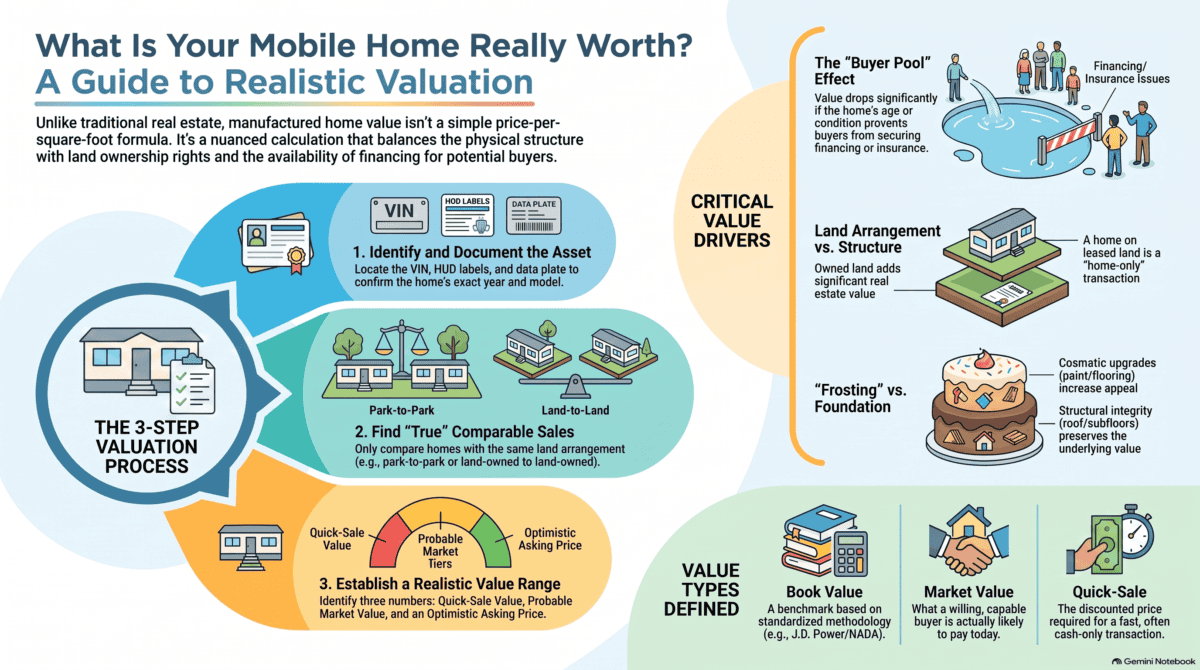
The Short Answer: How Do I Determine What My Mobile Home Is Worth?
To estimate the value of a mobile or manufactured home:
- Determine exactly what is being sold. Is it the home only on a rented lot, or does the sale include privately owned land?
- Identify the home correctly. Find the year, manufacturer, model, dimensions, square footage, serial/VIN information, HUD certification labels, and data plate.
- Find recent comparable sales. Look for homes with similar age, size, condition, location, land ownership, lot rent, and financing possibilities.
- Adjust for condition. Roof, HVAC, plumbing, electrical, subfloor damage, water intrusion, windows, foundation, kitchens, bathrooms, and deferred maintenance all matter.
- Consider how easy the home is to finance and insure. Anything that substantially reduces the number of qualified buyers can reduce market value.
- If the home is in a park, evaluate the park as carefully as the home. Lot rent, rent increases, rules, buyer approval, amenities, condition, and park desirability can materially affect what buyers will pay.
- If land is included, evaluate the land separately. A home-and-land sale is fundamentally different from a home-only sale.
- Use all of this information to establish a value range rather than pretending there is one exact number.
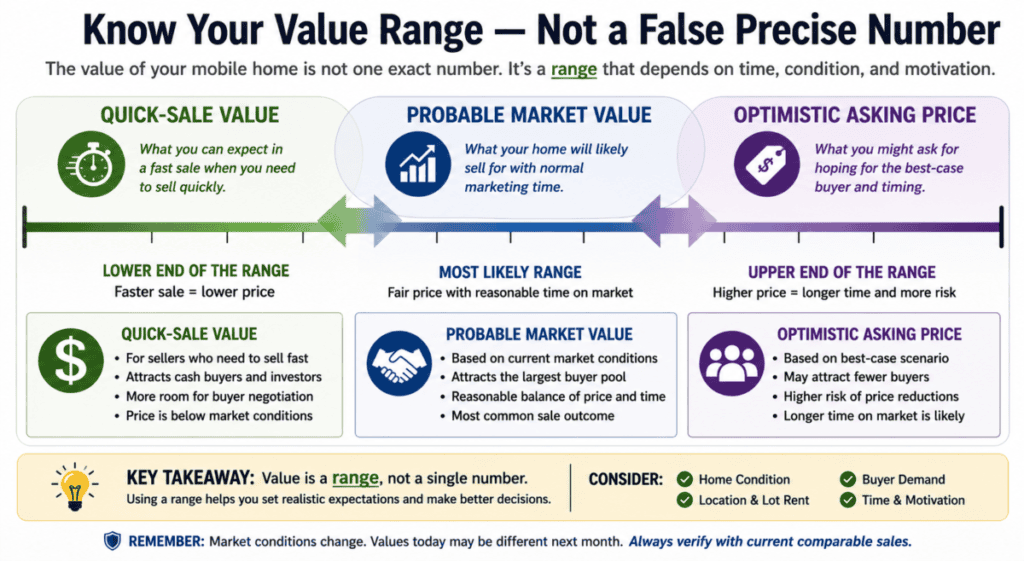
I like to think in terms of three numbers:
Quick-sale value — Probable market value — Optimistic asking price
We’ll get to those later.
But first, we have to determine what we’re actually valuing.
1. What Exactly Are You Valuing?
This is the first question I would ask anyone who says, “What is my mobile home worth?”
There are several very different possibilities.
Mobile Home in a Park on Leased Land
You own the home, but you do not own the land underneath it.
The buyer is purchasing the structure and generally taking over the right to occupy the space subject to the park’s approval, rules, lease terms, and lot rent.
This is primarily a home-only transaction.
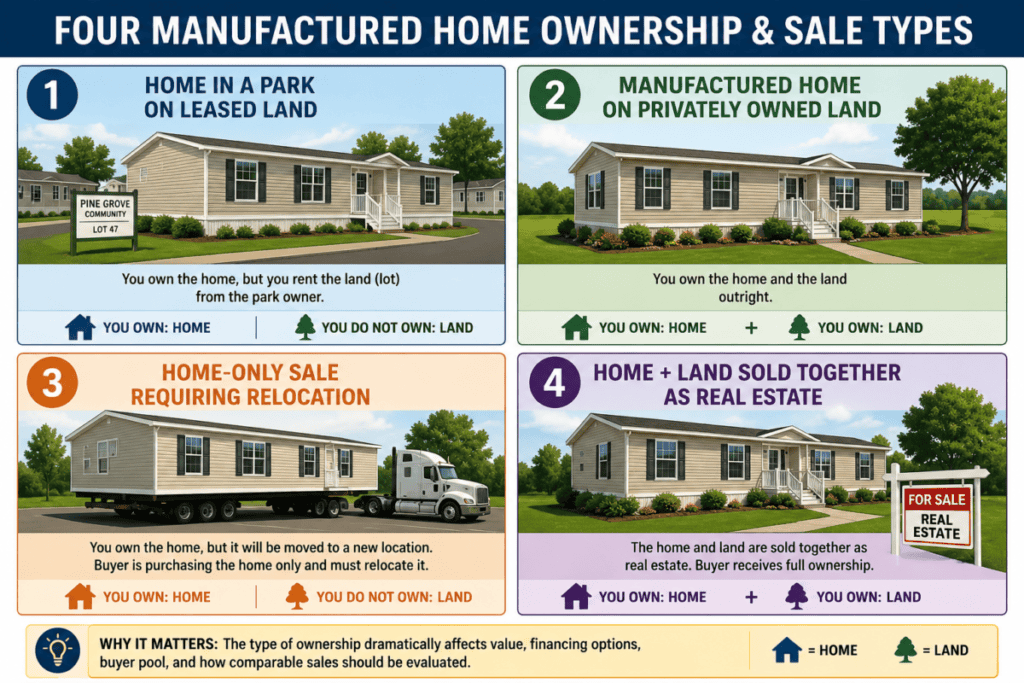
Manufactured Home on Privately Owned Land
Here, the owner controls both the home and the land.
Depending upon state law, title status, installation, and other requirements, the manufactured home may also be legally treated as real property.
The buyer may therefore be purchasing a complete piece of real estate rather than simply buying the manufactured home.
Home-Only Sale on Private Property
Occasionally a manufactured home is being sold with the expectation that the buyer will remove it from its current location.
That is another completely different valuation problem because the buyer must consider disconnection, transportation, permits, setup, a new site, utilities, and the risk involved in moving an existing home.
Manufactured Home and Land Sold Together as Real Estate
When the home and land are legally and financially combined as real property, the valuation can resemble the appraisal of other residential real estate much more closely.
This distinction is enormously important.
A 1998 double-wide in a mobile home park is not automatically comparable to an identical 1998 double-wide sitting on a privately owned residential lot.
The structures might be nearly identical.
The assets being purchased are not.
2. Identify the Home Before Trying to Value It
Before looking at comparable sales or ordering a value report, gather as much accurate information about the home as possible.
You want to know:
- Year manufactured
- Manufacturer
- Model or series
- Single-wide, double-wide, or multi-section
- Width and length
- Approximate square footage
- Number of bedrooms and bathrooms
- Serial or VIN number
- HUD certification label numbers
- Information from the home’s data plate
- Major factory options
- Additions and alterations
- Whether additions were permitted when permits were required
- Whether the home has previously been moved
For manufactured homes built to the federal HUD Code, the certification labels and data plate can provide important identifying information.
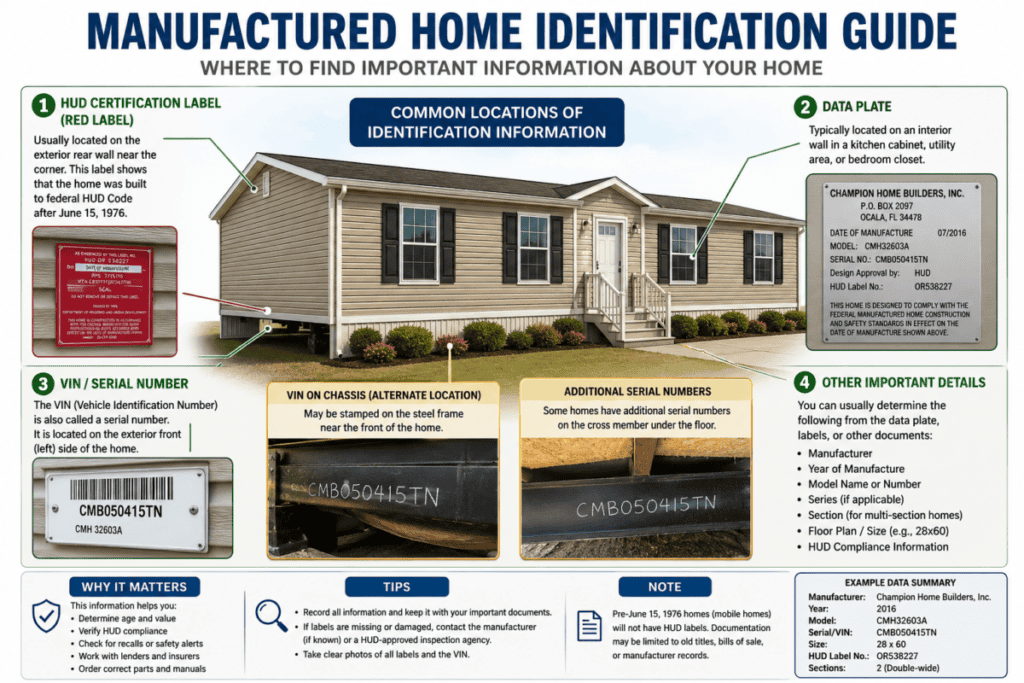
If you’re having trouble finding this information, see our guide to finding the VIN number on a mobile home.
Don’t skip this step.
You don’t want to spend hours comparing your home to 1,400-square-foot double-wides only to discover that your home is actually a 1,080-square-foot model from a different year.
3. Understand the Different Numbers People Call “Value”
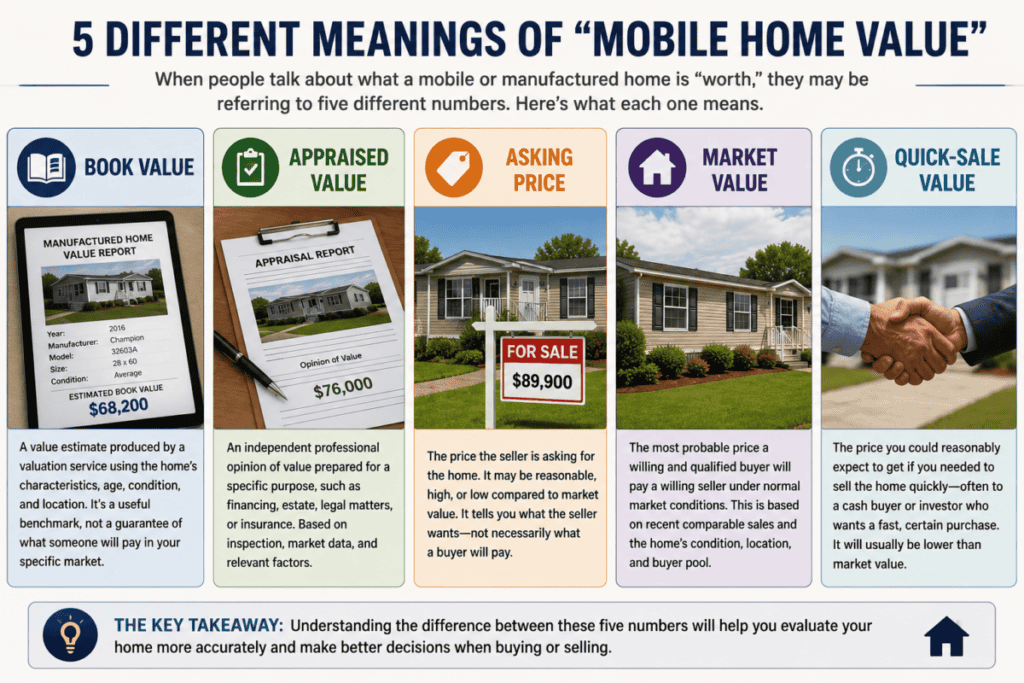
One reason mobile-home valuation becomes confusing is that several different numbers may all be described as the home’s “value.”
They don’t necessarily mean the same thing.
Book Value
A manufactured-home book value generally starts with the home’s characteristics—such as manufacturer, age, size, location, condition, and equipment—and applies a standardized valuation methodology.
This can be useful as a benchmark.
It is not necessarily what someone will actually pay for the home in your particular market.
Appraised Value
An appraisal is an independent opinion of value prepared for a particular purpose.
Depending on the property and type of appraisal, the appraiser may rely heavily on comparable sales, physical condition, community information, land value, and other market evidence.
Asking Price
This is simply what the seller is asking.
It may be reasonable.
It may also have very little connection to what buyers have actually been paying.
Market Value
For a seller, this is ultimately the number that matters most.
In practical terms, market value is what a willing and capable buyer is likely to pay under normal market conditions.
Quick-Sale or Cash Value
There is also a practical fifth number.
What could you sell the home for if you needed it sold quickly?
An investor paying cash and willing to close immediately will generally expect to pay less than an owner-occupant who loves the home and is willing to go through financing and a normal closing.
That doesn’t mean either price is “wrong.”
They represent different transactions.
4. The Main Ways Manufactured Homes Are Valued
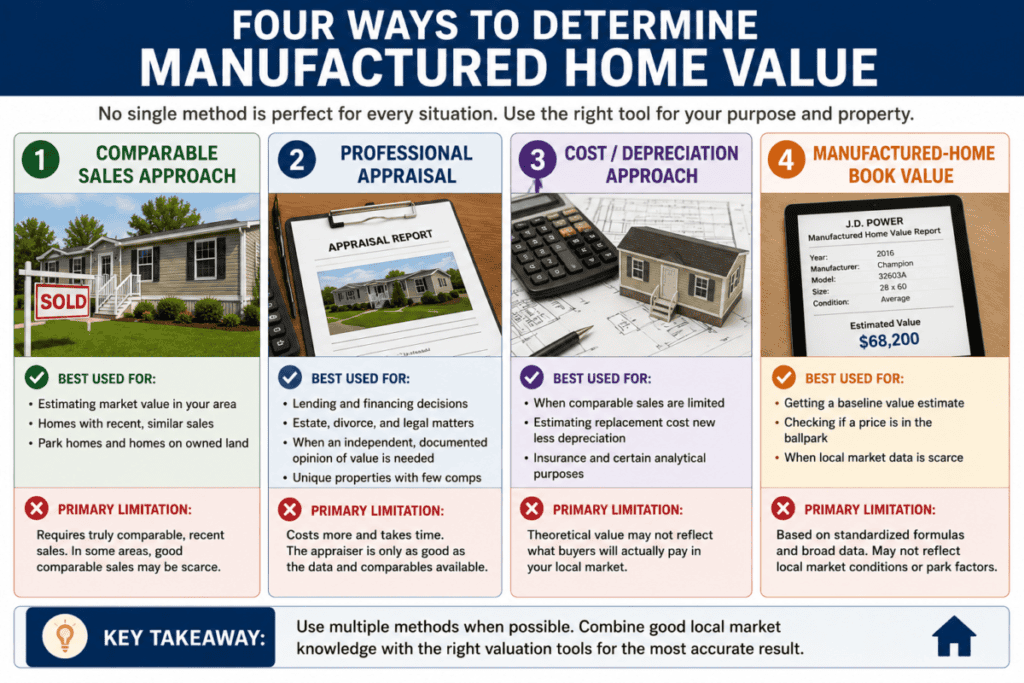
There isn’t one valuation method that works best in every situation.
Comparable Sales Approach
When good comparable sales are available, this is usually the evidence I want to see first.
What have buyers actually paid recently for similar homes?
The key word is similar.
If I’m evaluating a double-wide in a particular park, I first want to know what comparable double-wides have actually sold for in that park.
If I’m evaluating a manufactured home on its own land, I want recent sales of similar manufactured homes on owned land in the same competing market.
A good comparable sale can tell you far more than a nationwide average.
Professional Appraisal
Sometimes you need more than your own estimate.
A professional appraisal may make sense when:
- A lender requires it
- An estate needs a documented value
- The property is part of a divorce or legal matter
- There are few reliable comparable sales
- The property is unusual
- The home and land are being financed as real estate
- A buyer and seller strongly disagree about value
- A substantial amount of money is at stake
Manufactured-home appraisal specialists can also perform market-based appraisals of home-only manufactured housing using inspections and local comparable sales.
Cost or Depreciated-Cost Approach
Another method starts with what a similar home would cost and then accounts for age, condition, features, and depreciation.
This approach can be useful when good comparable sales are difficult to find and is also used in manufactured-home valuation systems.
Its weakness is obvious:
Theoretical value and local market value are not always the same thing.
A beautifully maintained home may calculate to one number while buyers in that particular park are simply unwilling to pay it.
Manufactured-Home Book Value
Many people still refer to manufactured-home book values as NADA values.
J.D. Power currently provides manufactured-home value reports based on information about the home, including its year, manufacturer, dimensions, location, condition, and features.
These reports can be useful as one piece of evidence, particularly when comparable-sales information is scarce.
I would not, however, use a book-value report by itself and declare:
“That’s what my home is worth.”
Even J.D. Power’s own materials caution that local market factors can significantly affect the value of a used manufactured home.
Use book value as a tool—not as a substitute for understanding your local market.
5. How to Find Truly Comparable Mobile Home Sales
This is where many do-it-yourself valuations go wrong.
People search online, find three mobile homes that look approximately like theirs, average the prices, and assume they’ve found the answer.
They haven’t.
First, remember:
An asking price is not a sale price.
A home listed for $120,000 tells you the seller wants $120,000.
It does not tell you that a buyer will pay $120,000.
Closed sales are much more useful.
When comparing manufactured homes, I would look at the following.
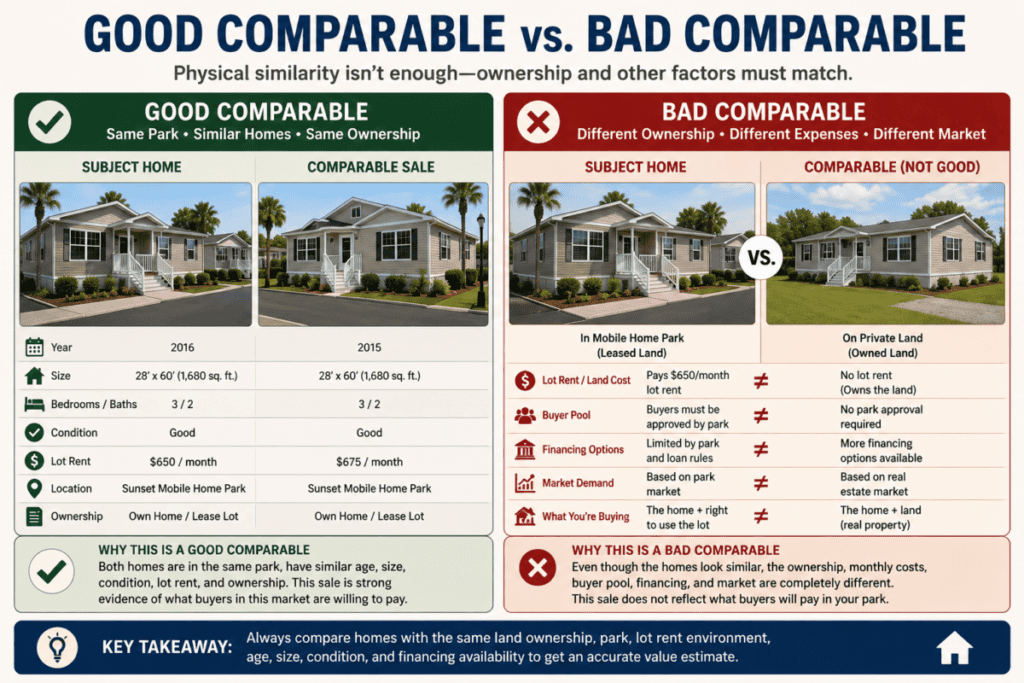
Same Land Situation
This comes first.
Compare:
- Park home to park home
- Owned-land home to owned-land home
- Real-property transaction to similar real-property transaction
Don’t casually mix these categories.
Same Park or Competing Location
For a park home, the best comparable may be another home in the same community.
Why?
Because the homes share:
- The same management
- Similar amenities
- Similar park appearance
- Similar location
- Similar rules
- Similar buyer-approval requirements
- Similar lot-rent environment
If there aren’t enough sales within the park, look for genuinely competing nearby communities.
Similar Age
A five-year-old manufactured home isn’t normally comparable to a 35-year-old home just because both have three bedrooms.
Age affects condition, construction, buyer perception, financing, insurance, and expected future repairs.
Similar Size and Configuration
Compare single-wides with similar single-wides and double-wides with similar double-wides whenever possible.
Square footage, bedrooms, bathrooms, layout, and overall utility matter.
Similar Condition
A completely renovated home and a home needing $30,000 of work aren’t equal just because they were manufactured in the same year.
We’ll discuss condition more in a moment.
Similar Lot Rent
For park homes, this is easily overlooked.
Imagine two similar homes in comparable parks.
If one requires $600 per month in space rent and the other requires $1,200, are buyers going to view the homes exactly the same way?
Probably not.
The buyer is evaluating the total housing expense, not merely the purchase price.
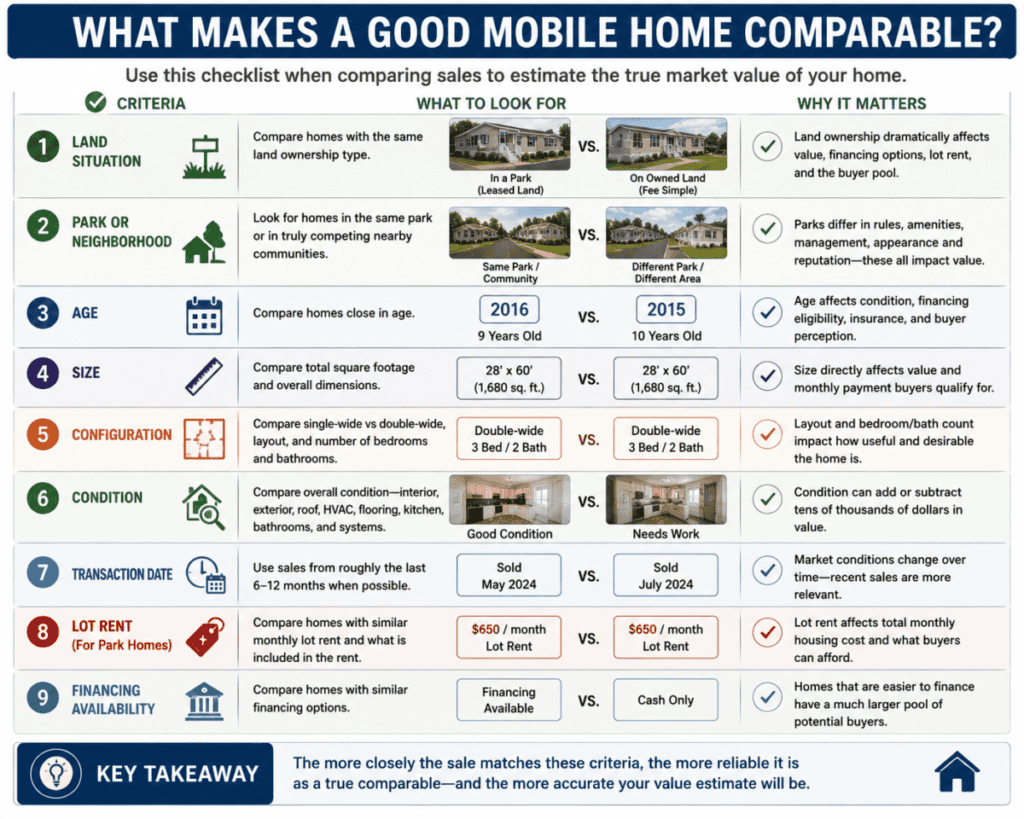
Similar Financing Availability
A home that can be purchased by a broad group of financed buyers may have a very different market from one that effectively requires cash.
This leads to one of the most important valuation concepts in this article.
6. Your Home’s Value Depends Partly on How Many People Can Buy It
When I evaluate a manufactured home, I don’t just look at the structure.
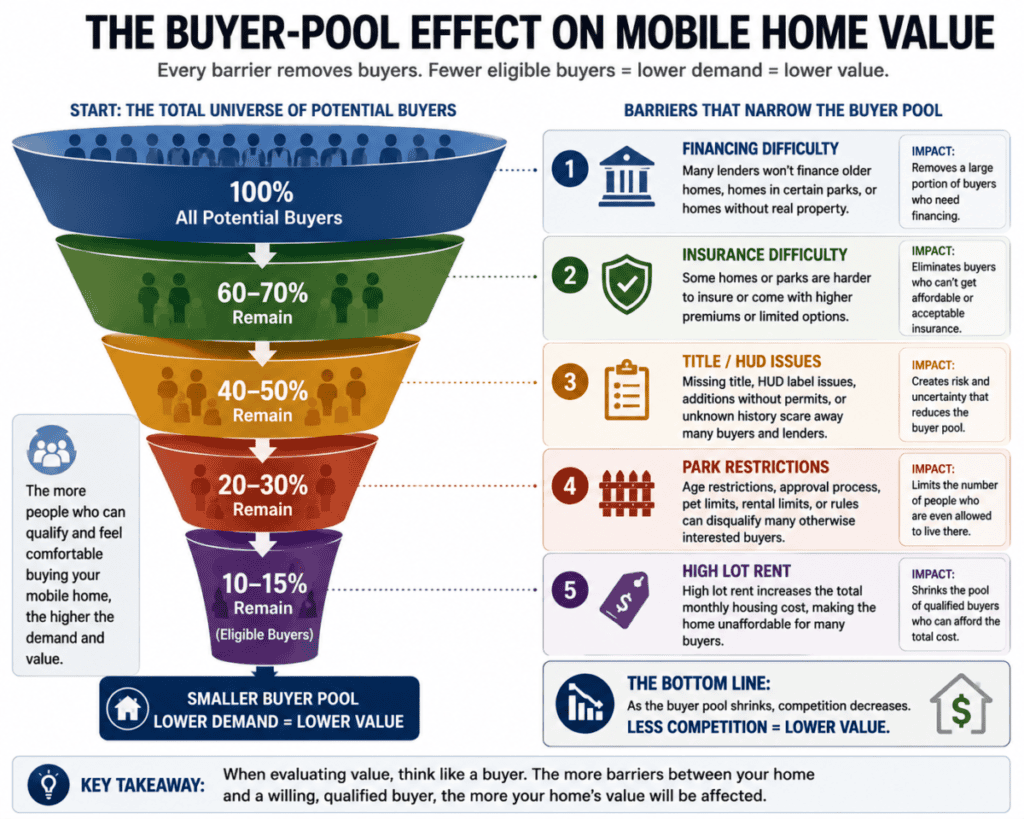
I think about the buyer pool.
Suppose Home A could realistically be purchased by 100 interested buyers.
Home B has problems that eliminate financing, creates insurance difficulties, or prevents many buyers from qualifying. Maybe only 15 of those same 100 buyers could realistically purchase it.
Everything else being equal, which home has the stronger market?
Usually Home A.
Factors that can shrink the buyer pool include:
- Pre-HUD construction
- Title problems
- Missing identification information
- Serious structural problems
- Poor condition
- Certain prior relocations
- Foundation or installation problems
- Insurance difficulties
- Lender requirements
- Park age restrictions
- Park financial qualifications
- Park buyer-approval requirements
- Very high lot rent
- Unpermitted additions
This is why financing availability can affect value even when you are selling to a cash buyer.
The cash buyer knows that someday they may need to resell the home.
7. How Much Does Condition Affect Mobile Home Value?
Condition can make an enormous difference, but not every repair or improvement has the same effect on value.
When evaluating a home, I would separate problems into three groups.
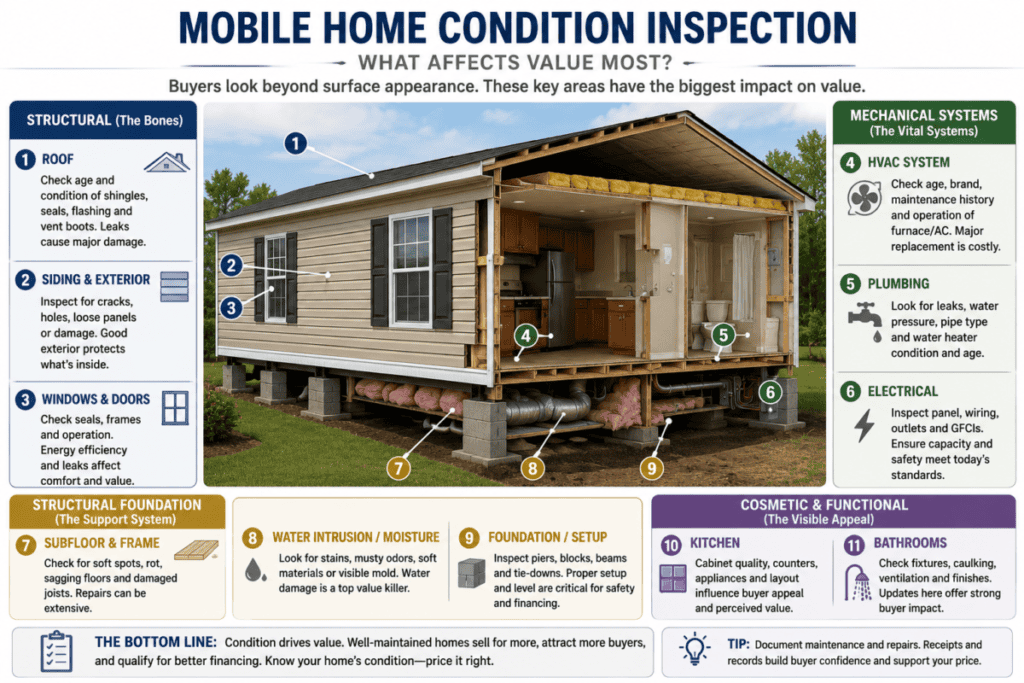
Structural and Water-Related Problems
These concern me the most.
Look carefully at:
- Active roof leaks
- Previous water intrusion
- Soft or damaged subfloors
- Rot
- Foundation or leveling problems
- Serious wall or ceiling damage
- Poorly constructed additions
- Moisture or mold problems
Water damage can spread far beyond the place where it first becomes visible.
Soft floors are especially common in older manufactured homes. If that’s an issue, our complete mobile-home subfloor repair guide explains what is usually involved.
Major Mechanical Systems
Consider the age and condition of:
- HVAC
- Electrical system
- Plumbing
- Water heater
- Roof
- Windows and exterior doors
An old HVAC system that still works isn’t necessarily a dollar-for-dollar deduction from value.
But if several major systems are simultaneously at the end of their useful lives, buyers will notice.
Cosmetic Condition
Then there is:
- Paint
- Flooring
- Cabinets
- Countertops
- Fixtures
- Trim
- Appliances
- Landscaping
Cosmetics absolutely affect buyer appeal.
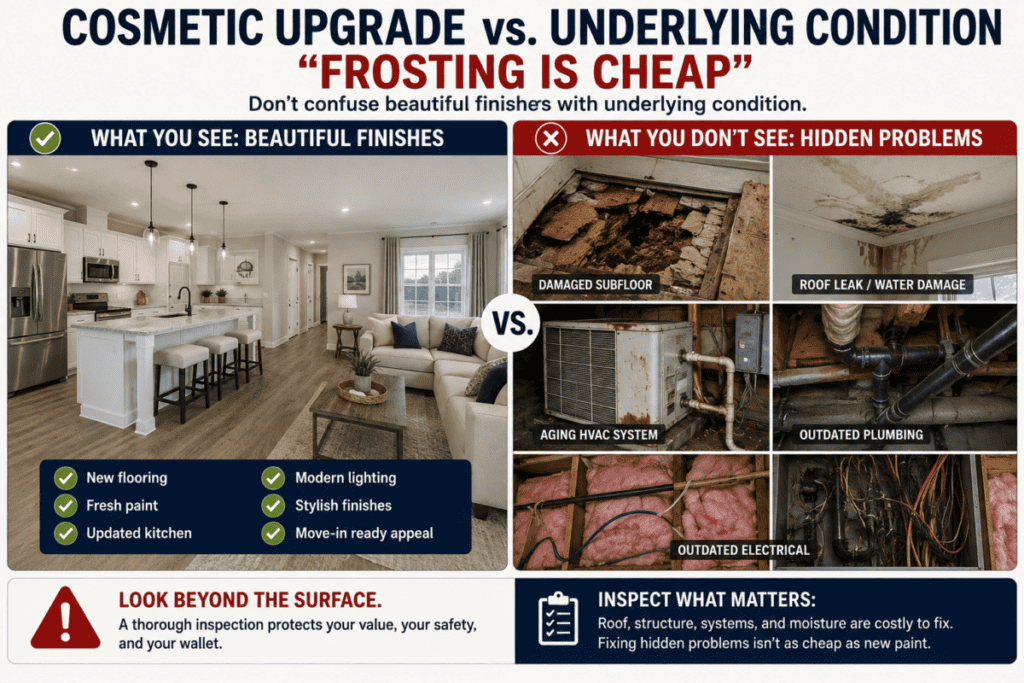
But don’t confuse appeal with underlying value.
I’ve shown many beautifully renovated manufactured homes to buyers over the years. Some looked like model homes. New flooring, fresh paint, attractive kitchens, staged furniture, landscaping—the whole package.
Buyers understandably fall in love with them.
But I have always cautioned my buyers:
Frosting is cheap.
Don’t let beautiful flooring and paint convince you to pay far beyond what comparable homes support.
A pretty house with an old roof, bad subfloor, questionable addition, or financing problem is still a house with those problems.
8. Does Remodeling Increase a Mobile Home’s Value?
Yes—but not necessarily by the amount you spend.
I’ve renovated a lot of manufactured homes, and this distinction is important.
Some improvements primarily restore lost value.
Repairing a leaking roof, replacing rotten subfloor, correcting plumbing leaks, and fixing serious electrical problems may not make the home dramatically more valuable than every other good home in the neighborhood.
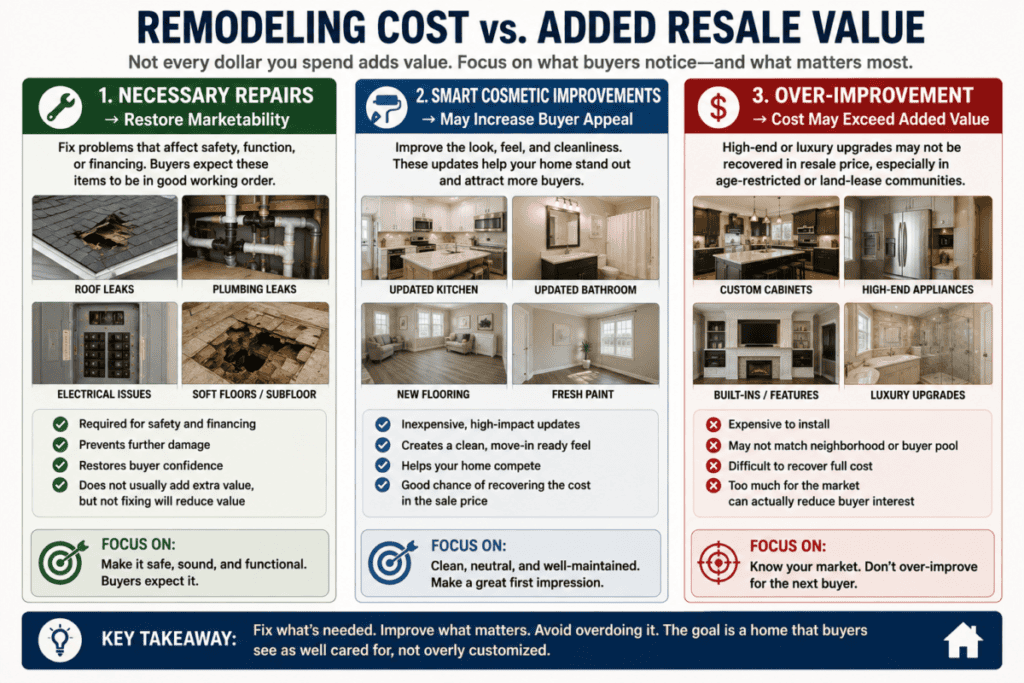
They may simply bring the property back to normal marketable condition.
Other improvements can improve buyer appeal:
- Fresh paint
- Attractive flooring
- Updated kitchen
- Updated bathrooms
- Better lighting
- Modern trim
- Improved exterior appearance
- Clean landscaping
These improvements may help the home sell faster and may justify a higher price—but don’t assume that spending $25,000 automatically adds $25,000 to market value.
The market determines the ceiling.
Before undertaking a major project specifically for resale, compare the likely after-repair value with the home’s present value and the true cost of the work.
For much more on that decision, see Should You Remodel an Older Mobile Home? and our older mobile-home remodeling guide.
9. A Real Example: Purchase Price Is Not the Same as Finished Value
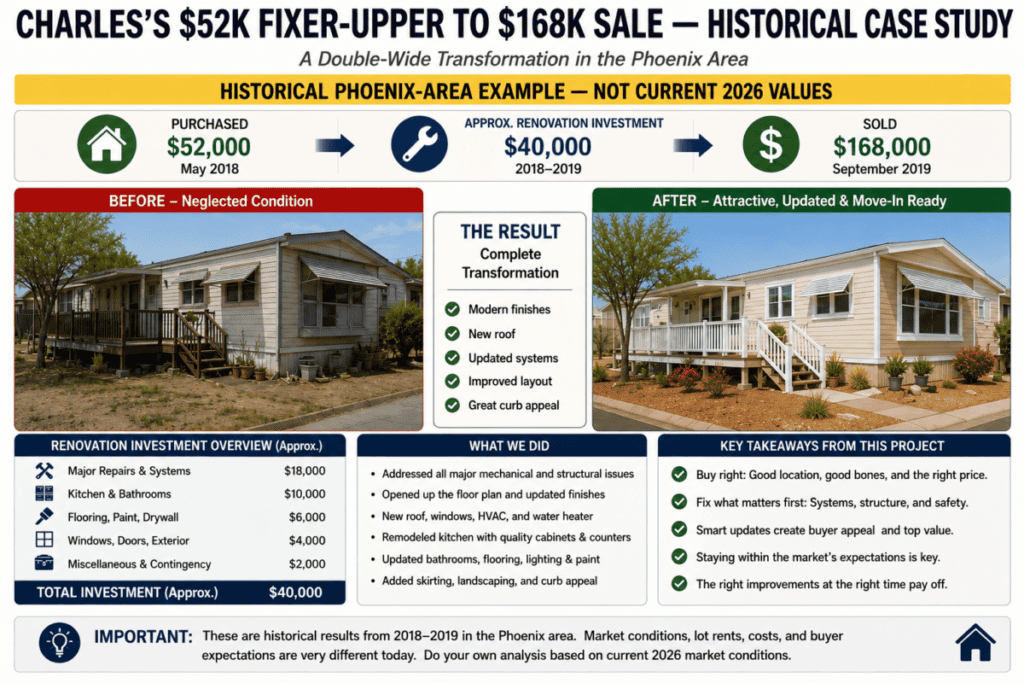
Years ago, we purchased a 1998 double-wide manufactured home on its own land.
It was approximately 2,200 square feet and had been vacant for around 10 years.
It looked terrible.
There were broken windows, holes in the floors, no HVAC system, and no water heater. Stray cats had been getting into the home.
We purchased the property for $52,000.
We then spent approximately $40,000 renovating it.
When we finished, the home looked phenomenal. We sold it within about a week for $168,000, and the buyer financed the purchase.
Those are historical numbers from one of our actual Phoenix-area projects, not estimates of what a similar property is worth today.
But the lesson is still extremely useful.
Was that manufactured home worth $52,000?
Yes—in the condition and circumstances in which we purchased it.
Was it later worth $168,000?
Yes—in its renovated condition and in the market in which we sold it.
The structure hadn’t magically become a different manufactured home.
Its condition, marketability, financing possibilities, and usefulness to the next buyer had changed.
That is why you have to value the home you actually have today—not the home it could become after spending a large amount of money.
10. For a Park Home, You Must Value the Park Too
This is one of the biggest mistakes I see people make.
If the manufactured home sits in a land-lease community, you are not really evaluating the home in isolation.
You need to evaluate the entire living arrangement.
We have bought and sold many homes in mobile-home parks. In our own investing, we eventually developed an informal grading system for parks because we learned that community quality strongly affected what we were willing to pay for a home.
The exact rents and prices we encountered years ago are no longer useful as current market figures.
The principle, however, hasn’t changed.
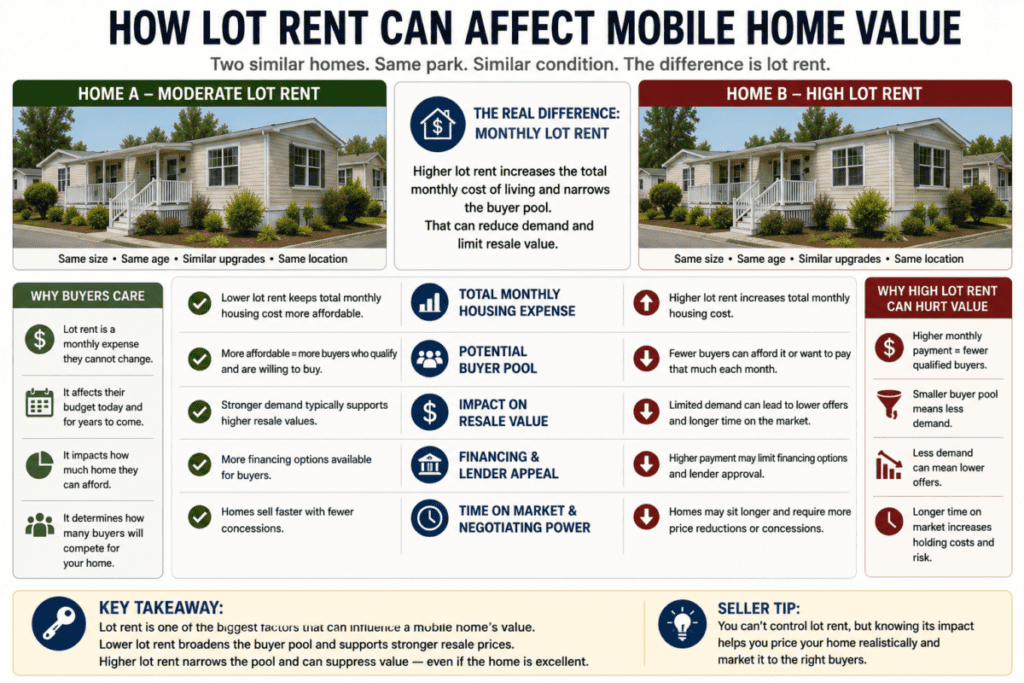
When valuing a home in a park, investigate:
- Current monthly lot rent
- What is included in the rent
- Utility charges
- Recent rent increases
- Park condition
- Landscaping and common areas
- Amenities
- Management quality
- Occupancy
- Age restrictions
- Pet restrictions
- Rules affecting the home
- Buyer approval requirements
- Income or credit requirements
- Lease terms
- Restrictions on renting the home
- Restrictions on remodeling or additions
- Community reputation
- Ownership and stability of the park
For a deeper examination of this issue, read our guide to mobile-home lot rent, increases, and the costs buyers often miss.
Can High Lot Rent Reduce a Mobile Home’s Value?
Absolutely.
Think like the buyer.
A buyer doesn’t simply ask:
“Can I afford the home?”
The buyer asks:
“What will it cost me every month to live here?”
That can include a loan payment on the home plus lot rent plus utilities and other community charges.
As lot rent increases, the amount some buyers can afford to spend on the home itself can decrease.
High lot rent can also make competing housing alternatives more attractive.
This is why comparing homes in two parks without considering their monthly space rents can produce a terrible valuation.
11. What If the Manufactured Home Comes With Land?
Now we’re dealing with something quite different.
When you own the land, part of the property’s value may have little to do with the manufactured structure itself.
Consider:
- Land value
- Location
- Parcel size
- Zoning
- Utility connections
- Septic or sewer
- Water source
- Access
- Garage
- Carport
- Fencing
- Landscaping
- Other improvements
- Neighborhood desirability
- Development potential
Land and structures do not necessarily appreciate or depreciate at the same rate.
This is one reason you should never take the selling price of a manufactured home on owned land and use it as a direct comparable for a similar home in a land-lease park.
Part of the price may be the dirt underneath it.
In some markets, a large part of the price may be the dirt underneath it.
12. Does a Permanent Foundation Increase a Manufactured Home’s Value?
It can, particularly when the foundation, title status, land ownership, and other property characteristics allow buyers to use financing programs that would otherwise be unavailable.
But this subject is often oversimplified online.
Putting a manufactured home on something described as a “permanent foundation” does not automatically guarantee that the property qualifies for every conventional, FHA, VA, or other mortgage program.
Different programs have specific requirements.
For example, HUD has separate FHA financing programs for manufactured housing. Its Title I program can cover a manufactured-home unit, a lot, or a home-and-lot combination, and a home under that program may in some circumstances be classified as personal property rather than real estate.
Other mortgage programs have different real-property and foundation requirements.
The valuation lesson is simpler:
A properly installed home with clean documentation and broader financing options generally has access to a larger buyer pool than an otherwise similar home with unresolved foundation, title, or installation problems.
And a larger buyer pool is usually good for value.
13. How Much Does the Age of a Mobile Home Affect Its Value?
Age matters, but it isn’t everything.
I’ve seen mobile homes from the 1960s that were beautifully maintained and much newer homes that needed major repairs.
A well-maintained older manufactured home can provide decades of additional service.
If you’d like a deeper discussion of physical longevity, see What Is the Life Expectancy of a Mobile Home?.
From a valuation standpoint, however, age affects more than physical condition.
It can affect:
- Financing
- Insurance
- Buyer perception
- Expected maintenance
- Availability of replacement components
- Park rules
- Marketability
And there is one particularly important date.
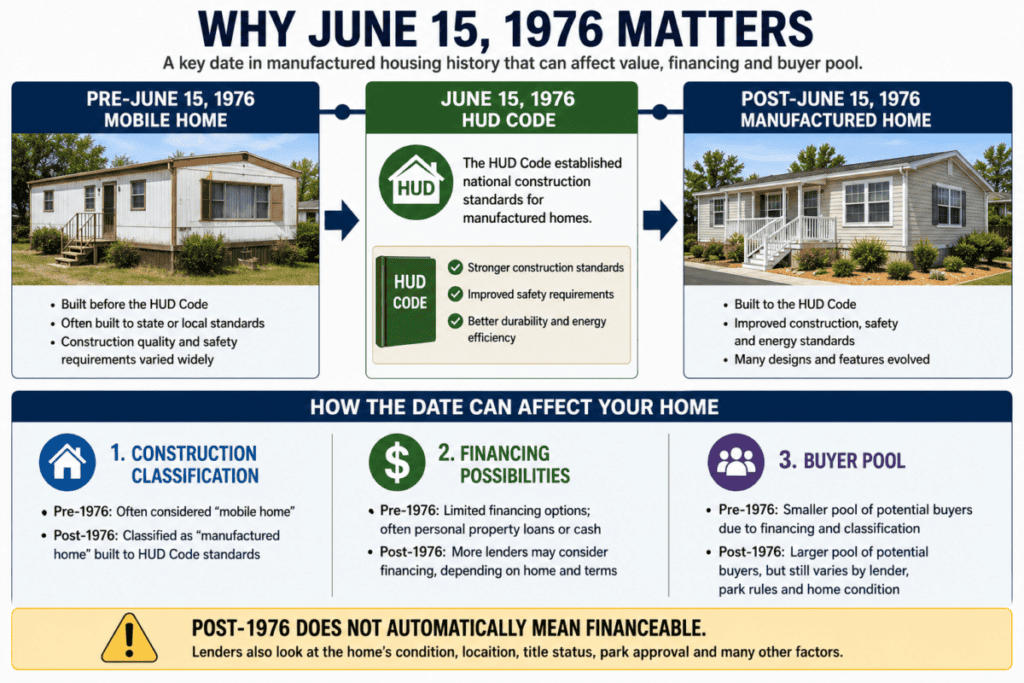
Why June 15, 1976 Matters
The federal Manufactured Home Construction and Safety Standards administered by HUD took effect on June 15, 1976.
Homes built to those federal standards are what federal terminology considers manufactured homes. Older factory-built homes are generally referred to as mobile homes.
You will often hear people say:
“Anything built after June 15, 1976 can be financed.”
That’s too simplistic.
Post-1976 HUD-Code construction opens financing possibilities that generally aren’t available to older pre-HUD mobile homes, but the construction date by itself does not guarantee that a particular buyer can obtain a particular loan.
The lender may also care about:
- Title status
- Foundation and installation
- Property classification
- Land ownership or lease
- Condition
- Identification documentation
- Prior relocation
- Loan program requirements
- Borrower qualification
So treat June 15, 1976 as an extremely important dividing line—not a guarantee of financing.
14. What Is a Pre-1976 Mobile Home Worth?
Pre-HUD mobile homes require special care when valuing them.
Historically, we encountered many of these homes in older Arizona parks.
Some were offered for almost nothing.
That doesn’t mean every pre-1976 home is worthless.
A beautifully maintained older mobile home in a desirable 55+ community, for example, may still have a real market because buyers want the location and affordable housing.
A pre-1976 home on valuable privately owned land may be another situation entirely.
But you need to understand the smaller potential buyer pool and financing limitations.
Don’t value the home merely by saying:
“It’s in great condition, so it should be worth almost as much as that 1985 home.”
The market may not see it that way.
For an older home, I would put even more weight on:
- Actual nearby cash sales
- Park desirability
- Lot rent
- Condition
- Land value, if applicable
- Insurance availability
- Local buyer demand
- Ability to legally remain in its present location
15. Do Additions Increase Mobile Home Value?
Sometimes.
They can also create problems.
Common manufactured-home additions include:
- Porches
- Decks
- Arizona rooms
- Screen rooms
- Carports
- Garages
- Storage rooms
- Extra bedrooms
- Expanded living areas
A well-designed, properly constructed and legally permitted improvement can make a property more useful and attractive.
But don’t automatically add the construction cost to the home’s value.
I become much more cautious when an addition:
- Was built without required permits
- Is poorly attached to the manufactured home
- Creates roof or drainage problems
- Places unintended structural loads on the home
- Has questionable electrical work
- Has questionable plumbing
- Shows signs of settling
- Cannot legally be counted as living area
- Creates a problem for financing or insurance
A 300-square-foot addition does not necessarily mean you can value the property exactly like a manufactured home that was originally built 300 square feet larger.
Investigate what was actually built.
16. Is Mobile Home Book Value Useful?
Yes—as long as you understand what it is.
J.D. Power currently offers manufactured-home value reports, and other manufactured-housing valuation services also offer cost-based or market-based reports.
A book-value report can be especially helpful when:
- You’re beginning your research
- There are few obvious comparable sales
- You want another independent reference point
- You’re buying or selling a home-only property
- You want to check whether an asking price appears wildly out of line
But I would never stop there.
A value report cannot completely replace knowledge of what is happening in the specific market surrounding the home.
Imagine two identical manufactured homes.
One is in a clean, desirable community with reasonable lot rent and strong demand.
The other is in a deteriorating park with high lot rent, poor management, and many vacancies.
Should they automatically have identical market values because the structures are identical?
Of course not.
Book value evaluates the home. Buyers evaluate the entire proposition.
17. Do Mobile Homes Depreciate or Appreciate?
You’ve probably heard that mobile homes always depreciate like automobiles.
You’ve probably also heard people claim manufactured homes appreciate just like site-built houses.
Neither statement is useful as a universal rule.
I’ve personally owned manufactured homes that increased substantially in value.
I’ve also seen homes become nearly worthless.
Why the difference?
Because manufactured housing exists under radically different circumstances.
A manufactured home sold together with desirable privately owned land is participating in a real-estate market that includes the value of that land.
A home-only property in a park is a different asset.
A deteriorating home in a park with rapidly increasing lot rent is different again.
Rather than asking:
“Do manufactured homes appreciate?”
I think the better question is:
“What forces are likely to increase or decrease the demand for this particular home?”
Look at:
- Local housing supply
- Land ownership
- Community desirability
- Lot rent
- Condition
- Financing
- Insurance
- Age
- Buyer demand
- Alternative housing costs
- Land values
- Maintenance
Those factors tell you much more than a blanket rule about appreciation or depreciation.
18. How to Calculate a Realistic Value Range
By now you should have several pieces of information:
- Accurate identification of the home
- Recent comparable sales
- Current competing listings
- Condition
- Repair needs
- Book value, if you chose to obtain one
- Land value, if applicable
- Lot-rent information, if applicable
- Financing limitations
- Park restrictions
- An understanding of the likely buyer pool
Now don’t ruin all that good research by pretending you can calculate the home’s value to the nearest dollar.
Real estate doesn’t work that way.
Manufactured housing certainly doesn’t.
Instead, establish a range.
1. Quick-Sale Value
Ask:
What price would likely produce a relatively fast sale to a qualified buyer or cash purchaser?
This will normally be toward the lower end of the supportable range.
An investor offer may be lower still because the investor needs room for repairs, holding costs, resale expenses, risk, and profit.
2. Probable Market Value
This is the number I care about most.
Based on actual comparable sales and the home’s advantages and disadvantages, what would a typical qualified buyer probably pay after reasonable market exposure?
This should be supported by evidence—not by what you hope the home is worth.
3. Optimistic Asking Price
There is nothing wrong with testing the upper end of a reasonable range if you have time.
But distinguish an optimistic asking price from market value.
If comparable homes are selling around $80,000, listing yours at $89,900 because it is particularly attractive may be reasonable.
Listing it at $139,900 because you spent $60,000 remodeling it does not force the market to reimburse you.
19. A Simple Mobile Home Valuation Worksheet
Use this as your final check.
| Question | What You Need to Determine |
|---|---|
| What am I selling? | Home only, home on leased land, or home plus owned land |
| What is the home? | Year, manufacturer, model, size, sections and square footage |
| Is the identity documented? | VIN/serial, HUD labels and data plate where applicable |
| What have similar homes sold for? | Recent closed comparable sales |
| Are the comps truly comparable? | Same land arrangement, location, age, size and condition |
| What condition is the home in? | Structural, mechanical and cosmetic |
| Are major repairs needed? | Roof, HVAC, plumbing, electrical, subfloor, water damage, foundation |
| Can typical buyers finance it? | Investigate realistic financing options |
| Can buyers insure it? | Check age and property-specific limitations |
| Is it in a park? | Evaluate lot rent, rules, management and buyer approval |
| Is land included? | Estimate the land and site-improvement contribution |
| Are there additions? | Determine quality, permits and effect on financing/insurance |
| What does book value indicate? | Use as supporting evidence, not the final answer |
| What is my quick-sale range? | Lower price for speed and certainty |
| What is probable market value? | Most likely normal-market selling range |
| What is a reasonable asking price? | Upper end that can still be defended by the market |
20. The Biggest Mistake: Starting With What You Have Invested
There is one final lesson from buying and selling manufactured homes that I think is worth emphasizing.
The market doesn’t care what you have invested.
You may have:
- Paid too much for the home
- Spent too much remodeling it
- Installed improvements buyers don’t value
- Paid expensive moving and setup costs
- Bought when prices were unusually high
- Financed at an unfavorable rate
None of those things require the next buyer to reimburse you.
The opposite can also happen.
You may have bought a neglected home at an exceptional price, made smart repairs, and now own something worth considerably more than you have invested.
We’ve done exactly that.
As I often say when buying fixer-uppers:
You make your money when you buy.
Knowing the home’s realistic after-repair value before spending the money is what makes the difference.
Summary: How to Determine Your Mobile Home’s Real Value
There is no single formula that can accurately tell you what every mobile or manufactured home is worth. The most reliable estimate comes from looking at the home the same way a knowledgeable buyer would.
Start by determining exactly what is being sold: a home on leased land, a manufactured home on privately owned land, or a home-and-land property being sold as real estate. Then identify the home accurately and look for recent sales that are truly comparable.
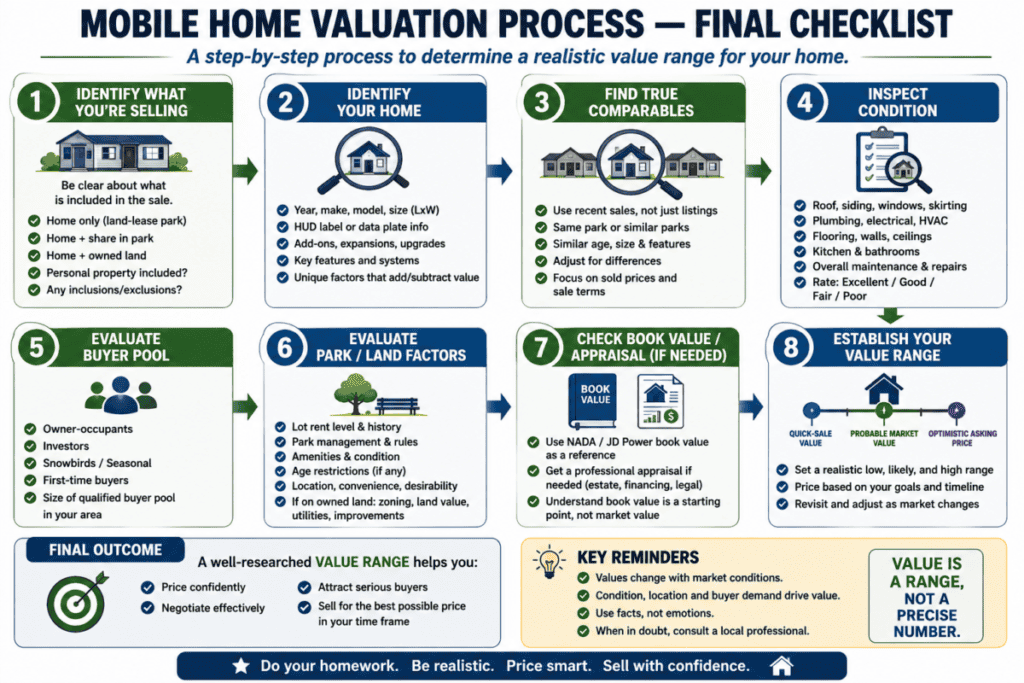
From there, consider the factors that can move the value up or down:
- Location and land ownership: A home in a land-lease park and an otherwise identical home on privately owned land are different assets.
- Comparable sales: Recent closed sales of genuinely similar properties are generally much more useful than asking prices.
- Condition: Roof, HVAC, plumbing, electrical, subfloor, water damage, foundation, exterior condition, kitchens, bathrooms, and deferred maintenance all matter.
- Age and HUD status: Age affects condition and buyer perception, while pre- and post-June 15, 1976 homes can face very different financing and marketability issues.
- Financing and insurance: Anything that reduces the number of people who can realistically buy the home can affect its market value.
- Lot rent and park quality: For a home on leased land, the buyer is evaluating the entire monthly housing expense and the community—not just the house.
- Land value: When privately owned land is included, part of the property’s value may come from the land and site improvements rather than the manufactured home.
- Remodeling and additions: Improvements can increase appeal and marketability, but the market does not necessarily return every dollar spent.
- Book values and appraisals: Both can be useful tools, but neither should automatically replace good local market evidence.
Finally, don’t try to force all of this into a supposedly exact number. Establish a reasonable range:
Quick-sale value — Probable market value — Optimistic asking price
If those three numbers are supported by good comparable sales and an honest assessment of the home’s strengths and weaknesses, you will have a much more realistic understanding of what your mobile home is actually worth.
About the Author
Charles O’Dell is the founder of MobileHomeFriend.com. His experience with manufactured housing spans more than two decades and includes buying, selling, owning, renovating, renting, and helping clients purchase manufactured homes.
Charles and his family have purchased and renovated manufactured homes ranging from inexpensive older park homes to large double-wides on privately owned land. That firsthand experience has included evaluating mobile-home parks, estimating renovation costs, dealing with damaged and neglected homes, determining realistic resale values, and seeing how financing, land ownership, lot rent, condition, and community quality affect what buyers are actually willing to pay.
MobileHomeFriend.com was created to share that practical experience with manufactured-home owners and buyers. The goal is not to promote manufactured housing as the right choice for everyone, but to help readers understand what they are buying, recognize potential problems, make better-informed decisions, and avoid expensive mistakes.
Written by a real estate professional and investor who specializes in the valuation and sale of manufactured homes on owned land.