
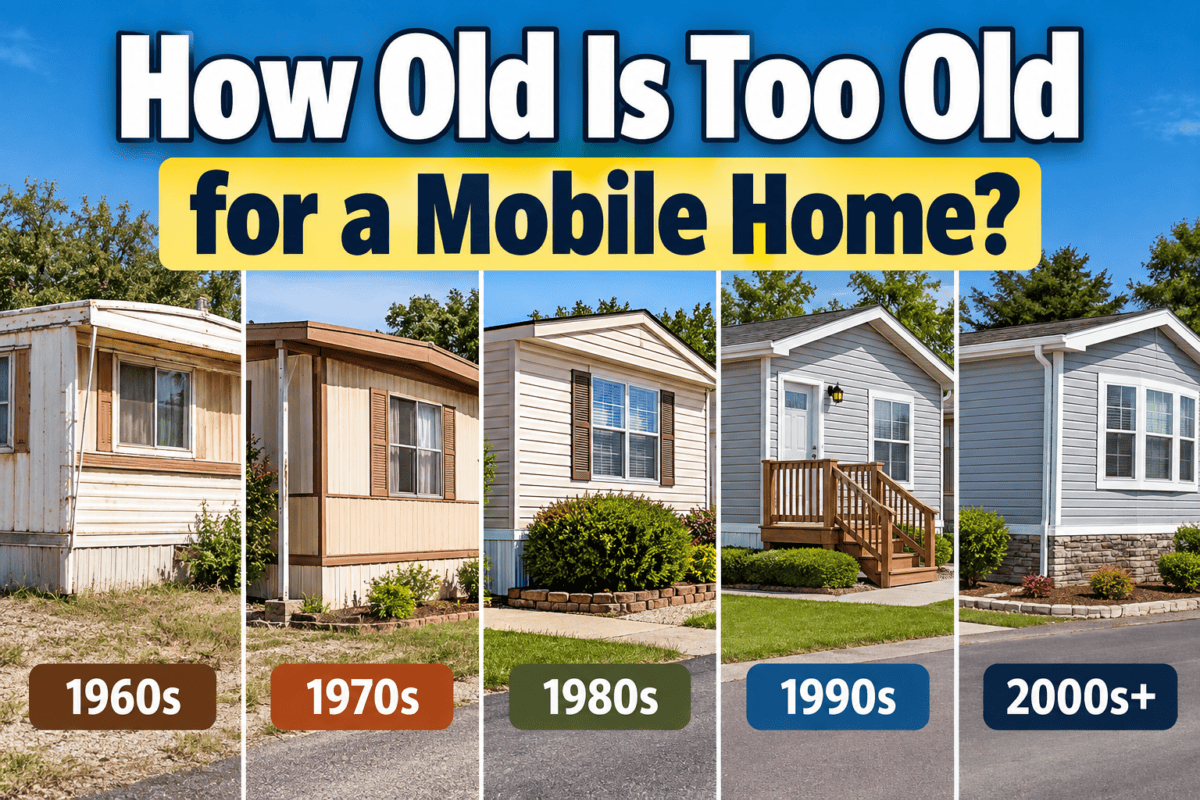
Table of Contents
Introduction
You find a mobile home for sale at what looks like a great price. The interior has been remodeled. The flooring looks new. The kitchen has fresh cabinets and countertops.
Then you discover the home was built in 1972.
Or 1984.
Or 1993.
Suddenly the question becomes:
How old is too old for a mobile home?
That is actually the wrong question—or at least an incomplete one.
After buying, repairing, remodeling, renting, and selling older mobile and manufactured homes for many years, I have learned that chronological age matters, but condition matters considerably more.
A well-maintained manufactured home from the 1980s can sometimes be a much better purchase than a badly neglected home built 20 years later.
But that does not mean age should be ignored.
The year a mobile home was built tells you what risks you should be looking for. A 1968 mobile home creates a very different set of questions than a 1988 manufactured home. A home built in 2005 creates another set of questions entirely.
This guide will walk through those differences decade by decade so you can decide whether the older mobile home you are considering deserves a closer look—or whether you should walk away.
Video Guide Overview
The Short Answer: When Is a Mobile Home Too Old?
There is no specific age at which a mobile home automatically becomes too old to buy.
A much better buying decision considers:
- Structural condition
- Evidence of water damage
- Roof condition and history
- Subfloor condition
- Electrical system
- Plumbing system
- Heating and cooling equipment
- Foundation, piers, and leveling
- Previous additions and modifications
- HUD identification and title documentation
- Financing availability
- Insurance availability
- Park restrictions, if located in a mobile home community
- Likely resale market
Age is therefore best thought of as a risk indicator rather than a pass/fail test.
The older the home becomes, the more important the investigation becomes.
If you are primarily interested in how long these homes can physically survive rather than whether you should buy a particular older home, see our detailed guide: How Long Do Mobile Homes Last?
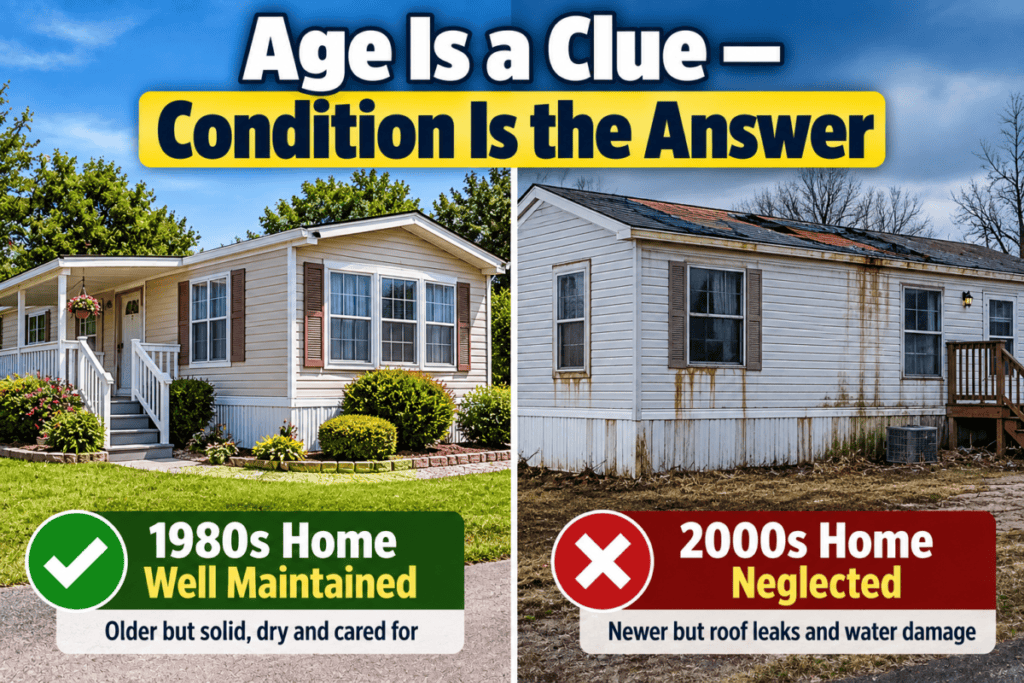
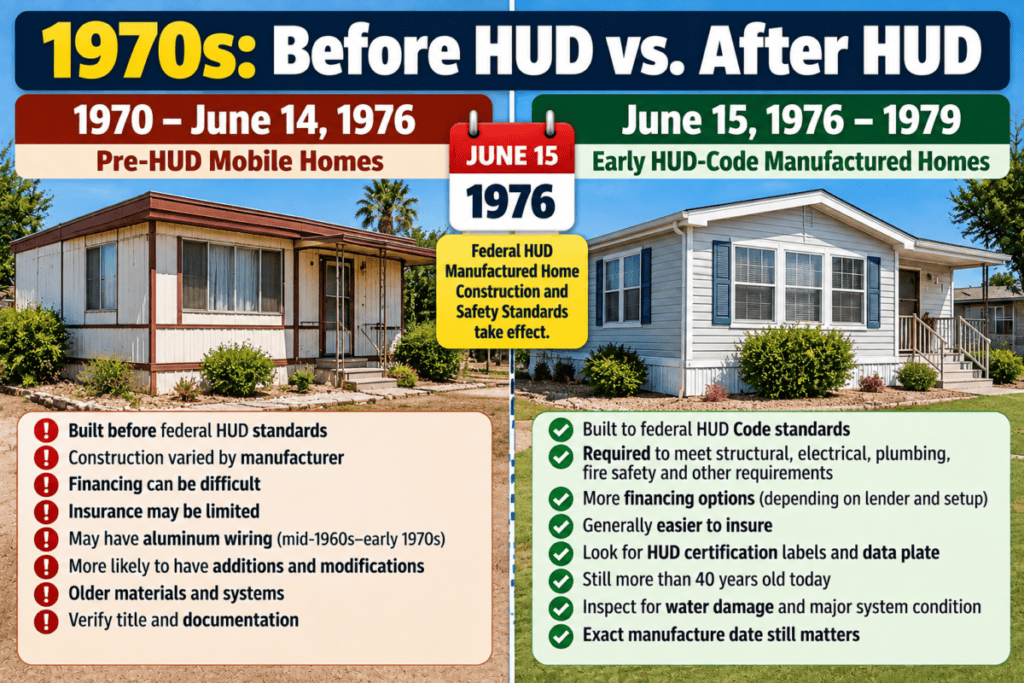
The Most Important Date in Mobile Home History: June 15, 1976
If you are shopping for an older mobile home, there is one date you should understand:
June 15, 1976.
That is when the federal Manufactured Home Construction and Safety Standards administered by the U.S. Department of Housing and Urban Development took effect.
Homes manufactured after that date are built under what is commonly called the HUD Code.
Technically, this is also where the terminology changes:
- Homes built before June 15, 1976 are properly called mobile homes.
- Homes built to the federal standards after that date are properly called manufactured homes.
People commonly use “mobile home” to describe both, and we do the same throughout MobileHomeFriend.com because that is the term most homeowners use. But when you are evaluating a purchase, the distinction matters.
HUD-Code manufactured homes are built under federal requirements covering areas such as structural design, fire safety, plumbing, electrical systems, and heating systems.
That does not mean every post-1976 manufactured home is a good home.
It does mean that a 1978 home and a 1974 home should not be evaluated as though they are simply two similarly old homes.
There can also be an important financing difference. Some major mortgage programs require the manufactured home to have been built in compliance with the federal standards established beginning June 15, 1976.
A pre-1976 home therefore deserves an additional investigation into financing, insurance, and resale before you become emotionally committed to buying it.
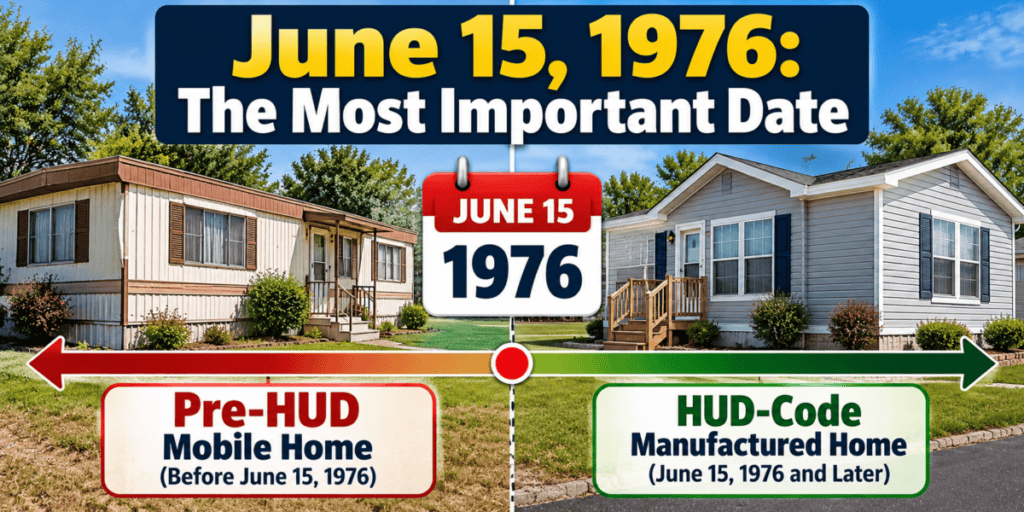
Should You Buy a Mobile Home From the 1960s?
A surviving 1960s mobile home is now more than half a century old.
That fact alone does not tell you whether it is structurally sound. Some older homes have lived remarkably sheltered lives and have been continually maintained and upgraded.
But when considering a 1960s home, I would approach the purchase very differently than I would a 2005 home.
Risk #1: It Predates the HUD Code
A 1960s mobile home was built before the federal manufactured-home standards that began in 1976.
Construction standards therefore depended on the manufacturer and whatever state or local requirements existed at the time.
This does not automatically make the home unsafe.
It means you cannot simply assume that it was originally constructed to the same nationally standardized requirements as a later manufactured home.
Risk #2: Financing May Be Much More Difficult
This may kill the deal before physical condition does.
If you need financing, talk to the lender before spending money on inspections, appraisals, or improvements.
Do not assume that because someone is willing to sell the home, someone else will be willing to finance it.
This matters again when you eventually sell.
You may be a cash buyer today, but your future buyer may not be.
Risk #3: Electrical Systems Deserve Special Attention
Residential aluminum branch-circuit wiring came into use during the mid-1960s and into the early 1970s.
That does not mean every 1960s mobile home has aluminum wiring.
It means a home from that period deserves professional electrical evaluation rather than assumptions based on what the outlets and breaker panel look like from the outside.
Old electrical systems may also have been modified repeatedly over the decades.
In my opinion, that history of modifications can be as important as the original construction.
Risk #4: Decades of Repairs May Be Hidden
A home that has existed for nearly 60 years has had a lot of opportunities for owners to make changes.
You may encounter:
- Added rooms
- Porches attached to the structure
- Roof-overs
- Replacement electrical panels
- Rewired circuits
- Replacement plumbing
- Modified walls
- Window replacements
- Altered heating systems
- Multiple generations of flooring
Some of these improvements may have been professionally completed.
Others may not have been.
The older the home, the less willing I am to assume that what I see today represents the way the factory built it.
Risk #5: The Economics Can Stop Making Sense
A repairable house is not necessarily an economically sensible house.
Suppose you purchase an old home cheaply but discover that it needs:
- Major electrical work
- Plumbing replacement
- A roof
- Subfloor repairs
- HVAC replacement
- Exterior repairs
- Foundation or leveling work
Individually, nearly all of those problems can be fixed.
The real question is:
Should you put that much money into this particular home?
Before buying a 1960s mobile home, establish the home’s realistic completed value and compare it with the total cost of purchasing and rehabilitating it.
My position: I would not automatically reject a 1960s mobile home, but I would consider it a specialized purchase requiring unusually careful due diligence.
Should You Buy a Mobile Home From the 1970s?
The 1970s are the most complicated decade because the decade straddles the beginning of the HUD Code.
A home manufactured in 1972 and one manufactured in 1978 may look superficially similar.
From a regulatory and financing standpoint, however, they can be very different properties.
1970 Through June 14, 1976
These are pre-HUD mobile homes.
The concerns discussed in the 1960s section continue to apply:
- Potential financing restrictions
- Potential insurance issues
- Older construction
- Electrical concerns
- Long histories of homeowner modifications
- Very old mechanical systems unless previously replaced
- Documentation problems
Homes from this era can also fall within the period associated with residential aluminum branch-circuit wiring.
Do not determine wiring type yourself by removing outlets or opening electrical equipment unless you are qualified to do so. Have an electrician investigate questionable older wiring.
June 15, 1976 Through 1979
These homes fall on the other side of the line.
They are early HUD-Code manufactured homes and should have been certified by their manufacturer as complying with the federal standards in effect when they were produced.
You should look for the home’s identifying information, including its HUD certification labels and data plate information where available.
For more on identifying these items, see What Is the HUD Tag and Where Do I Find It on a Mobile Home?
Lead Paint Is Another Pre-1978 Consideration
Most housing built before 1978 falls within federal lead-based-paint disclosure requirements, and manufactured/mobile homes are not automatically excluded.
This does not mean your 1970s mobile home necessarily contains lead paint.
It means you should not treat deteriorating old painted surfaces casually simply because the structure happens to be a mobile home.
What Would Make Me Comfortable With a 1970s Home?
I would want strong answers to questions such as:
- Has the electrical system been professionally evaluated or updated?
- Has the plumbing been replaced or substantially updated?
- Has the home suffered roof leakage?
- Is the subfloor solid around bathrooms, exterior doors, water heaters, and kitchen plumbing?
- Has the home been properly supported and kept level?
- Are additions self-supporting rather than improperly loading the original structure?
- Can the title, serial number, and HUD information, if applicable, be verified?
- Can I finance and insure it if necessary?
- Will the park accept the home and its future buyer?
With 1970s homes, the exact manufacture date matters—not merely the decade.
Should You Buy a Manufactured Home From the 1980s?
Now we enter an era where I become considerably less concerned about age by itself.
A manufactured home built in 1985 is obviously old today. But if it was installed correctly, protected from water, and properly maintained, its age alone would not prevent me from considering it.
At this age, I am primarily evaluating what 35 to 45 years of ownership have done to the home.
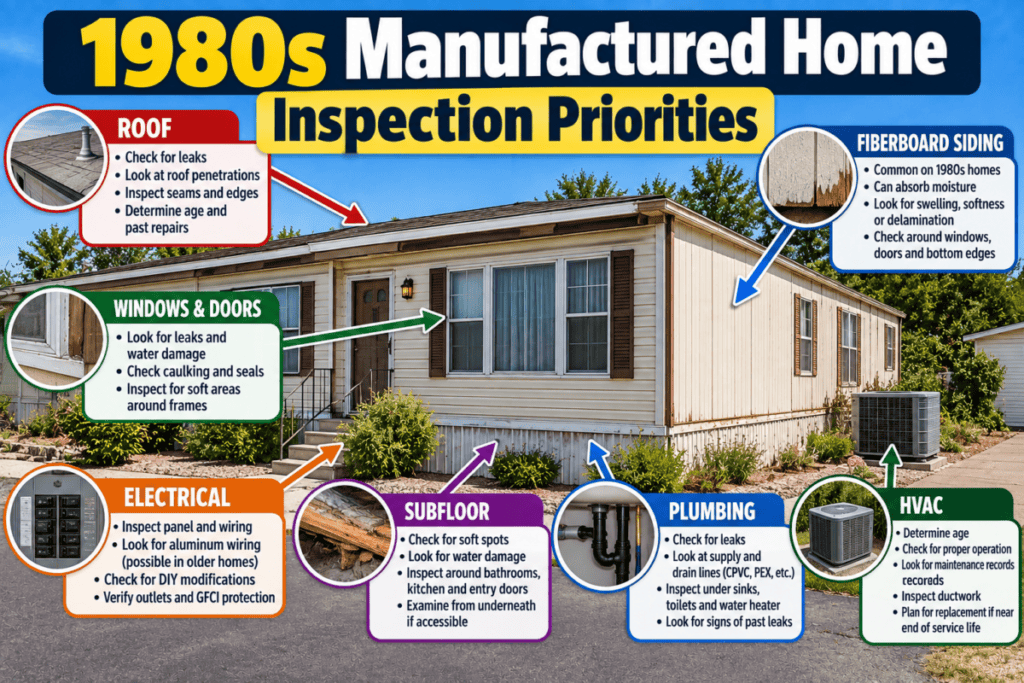
The Big 1980s Question: Where Has Water Been?
Water is one of the greatest enemies of manufactured housing.
Check carefully around:
- Exterior doors
- Windows
- Bathrooms
- Toilets
- Tubs and showers
- Water heaters
- Kitchen sinks
- Laundry connections
- Roof penetrations
- Roof edges
- Exterior wall penetrations
A freshly installed floor can hide an ugly history.
Do not confuse attractive vinyl plank flooring with a healthy subfloor underneath it.
Exterior Siding Can Tell a Story
Some manufactured homes from this era used siding products that do not tolerate long-term moisture exposure well.
Look closely at:
- Bottom edges of siding
- Areas near hose bibs
- Around windows and doors
- Behind decks and porches
- Roof-to-wall intersections
- Areas that have been repeatedly caulked or patched
Swelling, softness, delamination, or extensive patching deserve further investigation.
Assume Major Systems Have a History
Unless documentation proves otherwise, a 1980s manufactured home may have gone through multiple generations of:
- HVAC equipment
- Water heaters
- Roof repairs
- Floor coverings
- Plumbing repairs
- Appliances
You are therefore not simply buying a 1980s factory product.
You are buying the accumulated maintenance decisions of every owner since the home left the factory.
This is why maintenance records and a careful inspection become so valuable.
Should You Buy a Manufactured Home From the 1990s?
I would generally consider a well-maintained 1990s manufactured home without being overly concerned about the date on the title.
But remember what has happened to the calendar.
A manufactured home built in 1992 is now more than 30 years old.
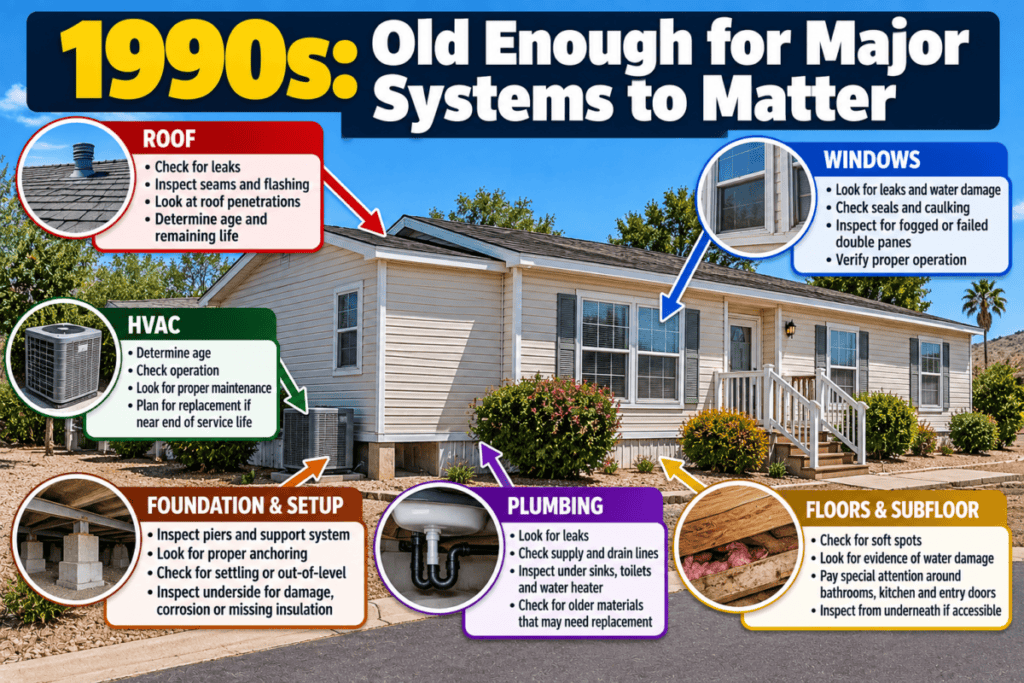
That means the original roof, HVAC equipment, water heater, and many other components may already have been replaced—or may be overdue for replacement.
Don’t Pay a Newer-Home Price for Old Mechanical Systems
This is where buyers sometimes get fooled by cosmetic remodeling.
The seller may have installed:
- New flooring
- White kitchen cabinets
- New countertops
- Fresh interior paint
- Modern light fixtures
Those improvements photograph beautifully.
But I would rather buy the home with an ugly kitchen and a solid subfloor, dry roof, properly functioning electrical system, and recently replaced HVAC than the reverse.
Cosmetics are usually the easy part.
Look Underneath the Home
The underside can tell you things the remodeled interior cannot.
An inspection should consider:
- Damaged or sagging belly material
- Evidence of plumbing leaks
- Wet or damaged insulation
- Rust or damage to structural components
- Pier condition
- Improvised supports
- Signs the home is out of level
- Drainage beneath the home
- Evidence of pests
If the seller will not allow reasonable inspection of accessible areas underneath the home, I would want to understand why before proceeding.
Should You Buy a Manufactured Home From the 2000s or Newer?
Once we reach homes built in the 2000s, age itself becomes less useful as a screening tool.
I would be much more interested in what happened to the home during those years.
A 2003 manufactured home that has remained dry, level, and well maintained can potentially have many useful years ahead.
A considerably newer home with chronic roof leakage and neglected plumbing problems can be far less attractive.
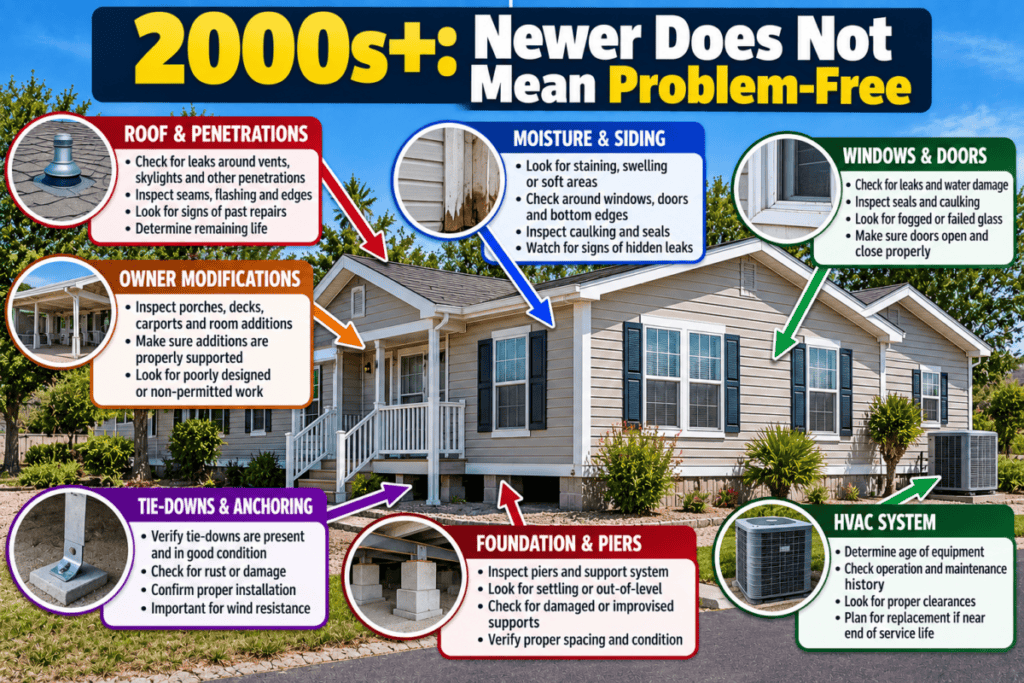
Installation Still Matters
A manufactured home is a factory-built structure, but a substantial part of its long-term performance depends on what happens after it arrives at the homesite.
HUD itself emphasizes the importance of proper site preparation, support, anchoring, and utility connections.
Check for signs such as:
- Doors that swing open or closed by themselves
- Doors that no longer latch correctly
- Cracks or separation around the marriage line of a multi-section home
- Uneven floors
- Cabinet doors noticeably out of alignment
- Unusual roofline movement
- Improvised support underneath
None of these proves the home has a serious structural problem.
They do tell you to investigate further.
Inspect Owner Modifications
Even a relatively modern manufactured home can be damaged by a poorly designed modification.
Pay attention to:
- Attached porches
- Decks
- Carports
- Patio covers
- Room additions
- Roof-overs
- Removed interior walls
- Modified windows or exterior doors
Newer does not mean untouched.
A Quick Era-by-Era Comparison
| Home Era | Age Concern | Primary Buyer Questions | Overall Approach |
|---|---|---|---|
| 1960s | Very high due-diligence requirement | Financing, insurance, electrical, modifications, structure, documentation, economics | Specialized purchase; investigate everything |
| 1970–June 14, 1976 | Very high due-diligence requirement | All pre-HUD issues plus exact manufacture date | Understand pre-HUD limitations before proceeding |
| June 15, 1976–1979 | High | HUD identification, maintenance history, water, electrical, plumbing, structure | Can be viable if condition and economics work |
| 1980s | Moderate to high | Water damage, siding, subfloor, roof, plumbing, HVAC, modifications | Condition increasingly matters more than age alone |
| 1990s | Moderate | Major-system replacement history, water, foundation/setup, owner modifications | Often reasonable candidates after thorough inspection |
| 2000s+ | Lower as an age issue | Installation, maintenance, water intrusion, major systems, modifications | Judge the individual home, not merely its year |
The Biggest Mistake: Buying the Remodel Instead of the Home
This deserves its own section.
One of the easiest ways to overpay for an older mobile home is to fall in love with a remodel.
New flooring is inexpensive compared with repairing major structural water damage.
Paint is inexpensive compared with rewiring a home.
Countertops are inexpensive compared with replacing a deteriorated roof, plumbing system, and HVAC system at the same time.
When I look at an older manufactured home, my mental order is roughly:
- Can I legally and economically own, finance, insure, and eventually sell it?
- Is the structure sound?
- Has it stayed dry?
- Is it properly supported?
- Are the electrical and plumbing systems acceptable?
- What major systems will need replacement?
- What will all necessary repairs cost?
- Only then do I care about cosmetics.
That order protects you from spending $50,000 because you were impressed by $5,000 worth of visible improvements.
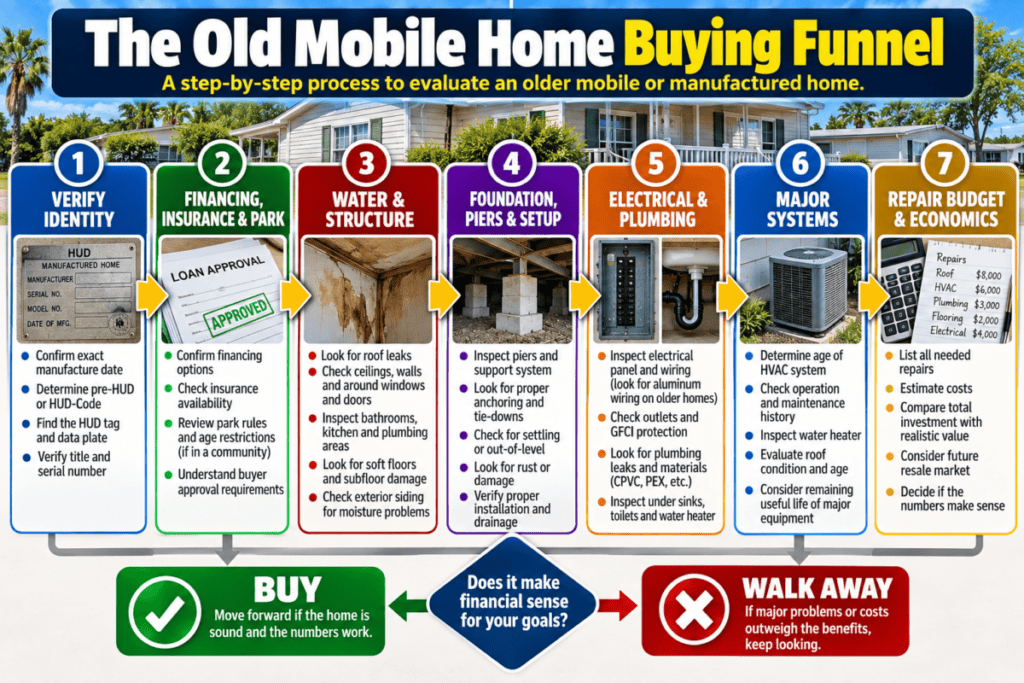
The Seven Questions I Would Answer Before Buying Any Older Mobile Home
1. Can I Finance It?
If financing is required, investigate it before making assumptions based on ordinary site-built-home mortgages.
Manufactured-home financing depends on numerous factors, including age, HUD status, whether the land is included, foundation requirements, title status, and lender rules.
2. Can I Insure It?
Ask the insurance question early as well.
Do not wait until days before closing to learn that your preferred insurer has restrictions on the home’s age, roof, wiring, or condition.
3. Will the Park Approve It and Me?
If the home sits in a land-lease community, you are evaluating two things simultaneously:
The home and the right to keep that home on somebody else’s land.
Understand park rules, buyer approval requirements, lot rent, and any age-related restrictions before closing.
4. Has Water Damaged the Structure?
If I could investigate only one category in an older manufactured home, water damage would be near the top of my list.
Walk slowly.
Feel for floor movement.
Look underneath sinks.
Check around toilets.
Look at ceilings.
Inspect around windows and exterior doors.
Look beneath the home where accessible.
A small visible stain may represent an old repaired leak—or the visible edge of a much larger hidden problem.
5. What Has Been Changed?
Ask the seller directly about:
- Additions
- Roof replacements
- Electrical work
- Plumbing replacement
- Window replacement
- HVAC replacement
- Floor repairs
- Leveling
- Foundation work
Then compare those answers with what you actually observe.
6. What Will Need Replacement During My Ownership?
Do not evaluate only what is broken today.
If the roof, HVAC system, and water heater are all near the ends of their useful service lives, your real purchase price is not simply what appears on the sales contract.
Expected near-term repairs are part of the economic cost of buying the home.
7. Who Will Buy It From Me?
This is especially important with very old homes.
You may be comfortable buying with cash.
But if future buyers cannot obtain financing, cannot insure the property, or cannot meet park requirements, your resale market could be narrower.
Always think about your exit before you enter.
Three Useful Tools When Looking at an Older Mobile Home
Affiliate Disclosure: Some product links on MobileHomeFriend.com may be affiliate links. If you purchase through one of these links, we may receive a small commission at no additional cost to you.
These tools do not replace a qualified professional inspection. They can simply help you notice areas that deserve additional investigation while initially evaluating a property.
| Tool | Why It Is Useful | Amazon Link |
|---|---|---|
| General Tools MMD4E Digital Moisture Meter | Useful for investigating suspicious areas around floors, walls, windows, and other locations where moisture may have been present. | Check Price on Amazon |
| Klein Tools GFCI Receptacle Tester | Can identify certain common receptacle wiring conditions. It is not a substitute for an electrician, especially in older homes. | Check Price on Amazon |
| Bright LED Work Light or Flashlight | Useful when looking into cabinets, utility areas, and accessible areas underneath a manufactured home. | Check Price on Amazon |
Red Flags That Matter More Than Age
I would become far more concerned about any of the following than I would about the manufacture date alone:
- Repeated or active roof leaks
- Soft floors in multiple areas
- Major structural deterioration
- Extensive corrosion underneath the home
- Poor drainage that keeps the crawlspace wet
- Improvised piers or supports
- Major out-of-level conditions
- Unsafe electrical modifications
- Chronic plumbing leaks
- Large additions improperly attached to the original home
- Missing or questionable ownership documentation
- Repair costs that exceed what the finished home can economically justify
For a much deeper discussion of physical problems commonly encountered as manufactured homes age, see Top 13 Issues Found in Aging Mobile Homes.
When Would I Walk Away From an Older Mobile Home?
There is no single problem that makes every deal impossible.
Price matters.
Location matters.
Your skill level matters.
Your intended use matters.
But I become cautious when several major problems stack on top of each other.
For example:
An older roof by itself?
Manageable.
An old HVAC system by itself?
Manageable.
A localized subfloor repair?
Manageable.
But combine a failing roof, widespread subfloor damage, questionable wiring, obsolete plumbing, major leveling problems, and an aging HVAC system in a home with limited resale potential?
Now the math can collapse.
That is where buyers need to stop asking:
“Can this be repaired?”
Nearly anything can be repaired with enough money.
The better question is:
“Does repairing this particular home make financial sense?”
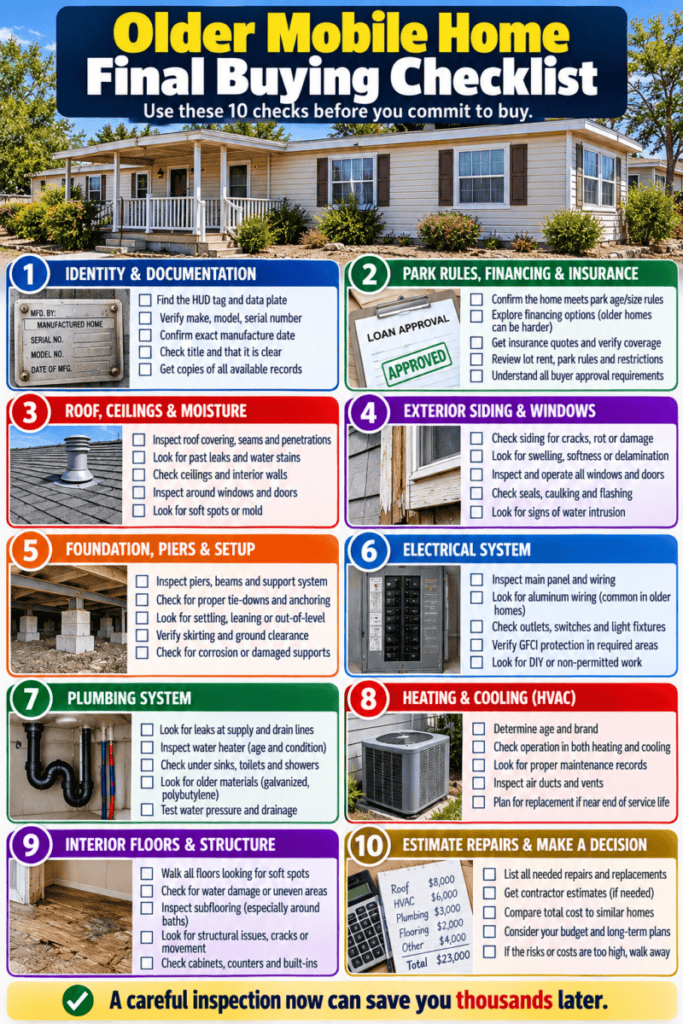
Older Mobile Home Buying Checklist
Before purchasing an older mobile or manufactured home, work through this list.
- Verify the exact manufacture date.
- Determine whether it is pre-HUD or HUD-Code.
- Verify title, serial number, and available HUD documentation.
- Confirm financing before assuming financing is available.
- Confirm insurance availability.
- Investigate park approval and restrictions if applicable.
- Inspect the roof and evidence of previous leakage.
- Inspect floors and subfloors for moisture damage.
- Evaluate the electrical system.
- Evaluate plumbing materials and condition.
- Determine the age of HVAC equipment and water heater.
- Inspect accessible areas underneath the home.
- Evaluate piers, support, anchoring, and level.
- Investigate additions and homeowner modifications.
- Estimate immediate repairs.
- Estimate likely repairs during your ownership.
- Compare total investment with the realistic finished value.
- Think about who will eventually buy the home from you.
So, How Old Is Too Old?
Here is the conclusion I would want you to remember:
A mobile home becomes “too old” when its physical condition, financial limitations, and required repairs no longer make sense for the price you are paying and the use you have planned for it.
That point is different for every home.
A well-kept 1984 manufactured home may still be a perfectly reasonable purchase.
A neglected 2004 manufactured home may not be.
A 1972 mobile home might be an inexpensive cash purchase that works perfectly for a particular buyer—or it might create financing, insurance, and resale problems that make another home the better choice.
Age tells you where to look.
Condition tells you what happened.
The numbers tell you whether you should buy.
That is ultimately the right way to judge an older mobile home.
Mobile Home Friend is based on real-world experience with mobile and manufactured homes, not simply information gathered from other websites. Over the years, I have personally bought, sold, owned, rented, managed, repaired, and remodeled mobile and manufactured homes. That experience has included evaluating older homes, uncovering water and subfloor damage, dealing with aging plumbing and electrical systems, replacing major components, and determining when an older home was worth repairing—and when the numbers simply did not make sense.
That hands-on experience is combined with research from authoritative sources such as the U.S. Department of Housing and Urban Development (HUD), federal agencies, manufacturers, and established industry resources when technical or regulatory information is involved.
The purpose of Mobile Home Friend is straightforward: to give homeowners and buyers practical, understandable information that helps them make better decisions. For an older mobile home, that means looking beyond its age and examining its construction era, condition, maintenance history, major systems, potential repair costs, and the economics of the purchase.