
Table of Contents
Introduction
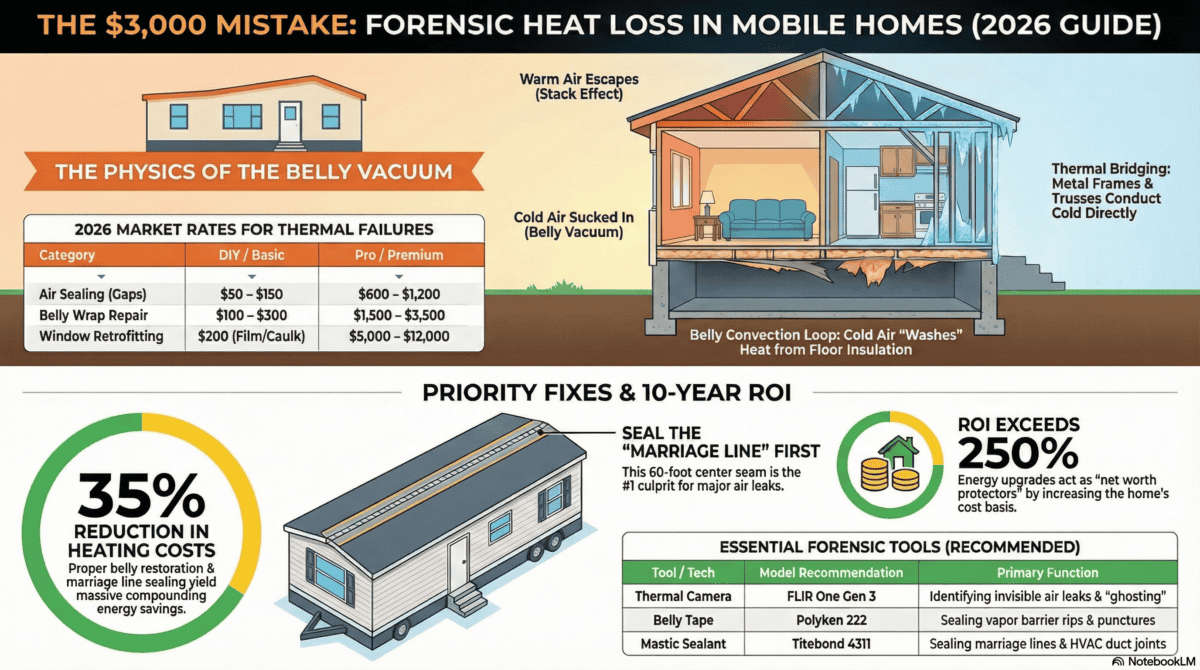
Summary: Mobile homes lose heat. Most mobile home owners think thin walls are the reason they are cold. They are wrong. Heat loss in manufactured housing is a systemic failure of the thermal envelope, driven primarily by uncontrolled air infiltration through the belly, marriage lines, and poor duct integration. In 2026, with energy costs hitting record highs, a “bandage” approach won’t work. You must address the Stack Effect and the Belly Cavity Convection Loop to see real ROI. This guide breaks down the physics of why you’re losing heat and ranks the fixes by technical priority. Note: Local labor rates for HVAC sealing and insulation change constantly. See our full regional cost table below.
Video Guide Overview (Where mobile homes lose heat)
Affiliate Disclosure: This post contains links to technical tools and materials. If you purchase through these links, I may earn a commission at no extra cost to you. I only recommend what I’ve used on 100+ job sites.
The Short Answer (For Readers Who Want It Fast)
If you want the blunt truth: your mobile home is a sieve. Most heat loss occurs because the home is a raised structure. Unlike a slab-on-grade house, your floor is exposed to turbulent air flow. The primary culprits are unsealed marriage lines in double-wides, compromised belly wraps, and mechanical penetrations (plumbing/electrical) that weren’t foamed at the factory. Insulation matters, but air sealing is the higher-order logic. If air is moving through your insulation, the R-value drops to near zero. Fix the leaks first; add the bulk insulation second. That is how you stop the $400 monthly power bills.
Why Mobile Homes Lose Heat Faster Than Site-Built Homes
Manufactured homes are built to HUD Code, not local stick-built codes. While HUD standards improved significantly after 1994, the structural reality remains: these homes are designed for transport, which requires lighter materials. You are dealing with 2×3 or 2×4 wall studs compared to the 2×6 standard in modern high-efficiency stick-built homes. This limits the insulation depth. Furthermore, the chassis system creates a 12 to 36-inch void between the floor and the ground. This void acts as a giant heat sink. In a site-built home, the ground provides some geothermal stability. In a mobile home, the wind whips underneath and strips heat via convective cooling through the bottom board.
Deep Dive: Psychrometric Logic and Condensation Failures
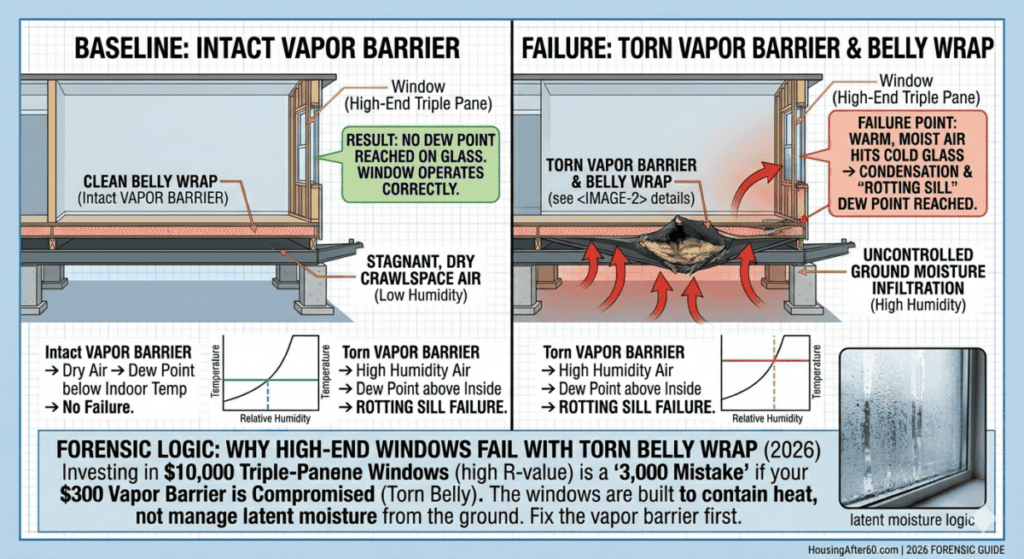
It’s ok, go ahead and say you have no idea what “Psychrometric Logic” is. It’s a strange word, but the one that works here. Psychrometrics is the study of the thermodynamic properties of air-vapor mixtures and a measure of the amount of energy per pound of dry air.One major technical error I see is blaming “leaky windows” for water on the glass.
In psychrometric terms, this is a failure of the dew point. When you seal a home too tightly without addressing the vapor barrier in the belly, you trap moisture. That moisture hits the cold aluminum window frames and liquefies. You don’t just have a heat loss problem; you have a latent heat load problem. To fix the heat loss, you must understand that air carries moisture, and moisture holds heat.
If your home feels “clammy” and cold, your relative humidity is spiking because your thermal envelope is compromised at the floor level. This requires more than a space heater: it requires a hygroscopic assessment of your crawlspace to prevent mold growth alongside heat retention. Ah, here we go again. And “what is hygroscopic”? The hygroscopicity test procedure generally involves exposing a material to controlled humidity conditions and monitoring the extent of moisture uptake over time.
| Category | DIY/Basic (2026) | Pro/Premium (2026) |
|---|---|---|
| Air Sealing (Small Gaps) | $50 – $150 | $600 – $1,200 |
| Belly Wrap Repair | $100 – $300 | $1,500 – $3,500 |
| Window Retrofitting | $200 (Film/Caulk) | $5,000 – $12,000 |
The 7 Main Areas Where Heat Loss Actually Happens
1. Windows (The Biggest Visible Culprit)
Most older units use single-pane mill-finish aluminum windows. Aluminum is a high-performance thermal conductor. It literally “invites” the cold inside. Even if the glass is intact, the frames themselves are leaking heat at a rate 4x higher than vinyl. Air infiltration at the sash is also common as the home settles over time, warping the rectangular opening into a parallelogram. In 2026, the cost of custom-sized mobile home windows has skyrocketed. You must prioritize caulking the interior trim to stop air before you even consider replacing the sash. Radiant heat loss through the glass is secondary to the convective draft entering the frame gaps.
2. Doors (The Overlooked Heat Sink)
Mobile home doors are often thin, hollow-core structures with minimal internal foam. The threshold is the primary failure point. If you can see daylight under your door, you aren’t just losing heat; you are heating the entire neighborhood. In 2026, adjustable thresholds and magnetic weatherstripping are the standard for fixing this without a full door replacement. Outswing doors are particularly prone to gasket compression failure over time: a 1/8-inch gap across a standard door is equivalent to a 2-inch hole in the wall.
3. The Belly (The Critical Infrastructure)
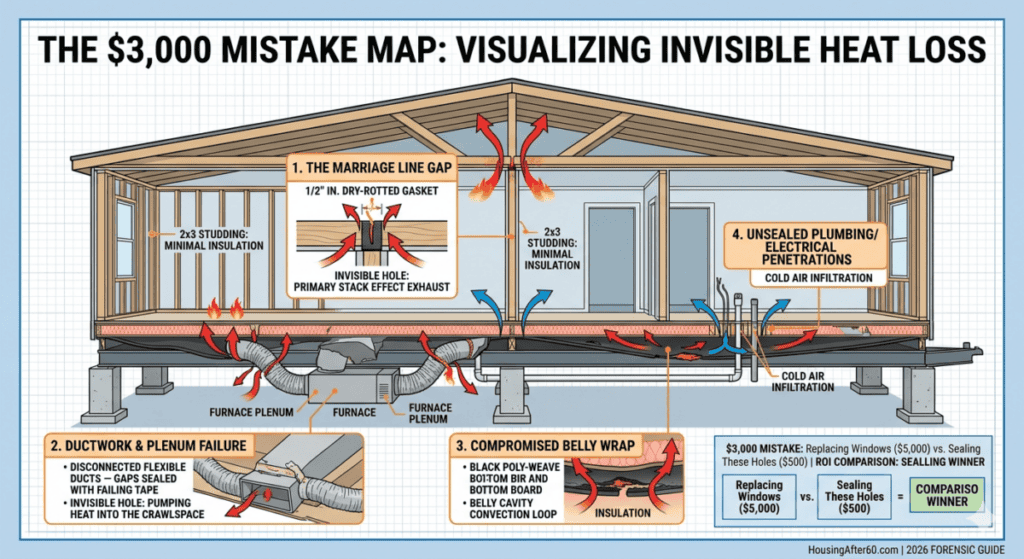
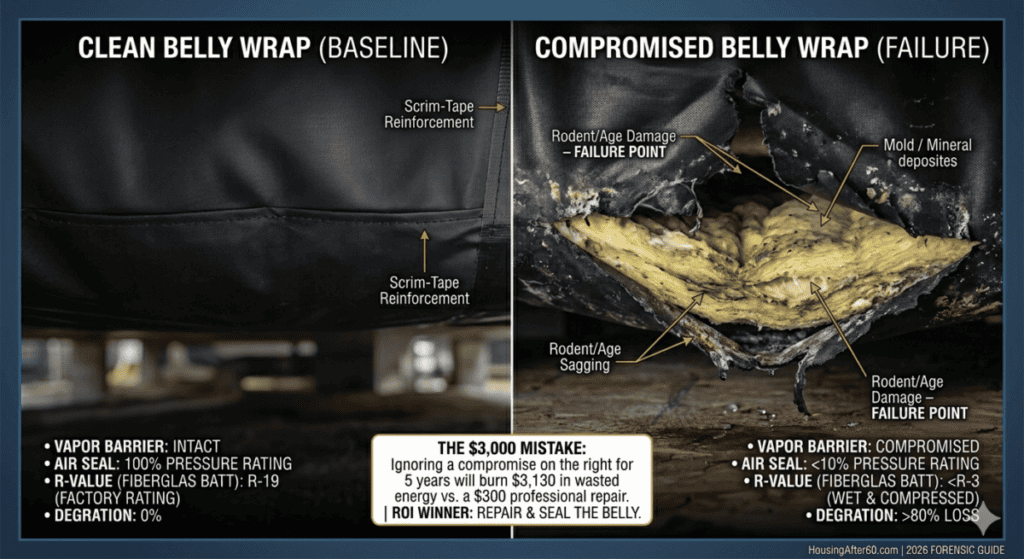
This is where my 23 years of experience says the battle is won or lost. The bottom board (belly wrap) is a black poly-weave material that holds your insulation against the floor. If rodents, plumbers, or age have ripped this fabric, your fiberglass batts will sag. Once there is a gap between the insulation and the subfloor, a Convection Loop forms. Cold air enters the rip, warms up slightly from the floor, rises, cools, and falls, effectively “washing” the heat out of your plywood. This is why your floors feel like ice cubes in January. Without a taut, sealed belly, you are trying to heat a home that has a giant ice pack attached to its underside.
Deep Dive: Belly Cavity Thermodynamics and Convection Loops
When the belly wrap is compromised, the R-value of your insulation is functionally irrelevant. Fiberglass is a filter, not a barrier. If wind can move through the fibers, the thermal resistance is bypassed. You must achieve stagnant air within the floor joists. Using closed-cell spray foam on the rim joists or meticulously patching the belly with scrim tape and spray adhesive is mandatory to stop the 20% to 30% heat loss occurring beneath your feet. A Convection Loop is a self-sustaining cycle of energy loss: the more you turn up the furnace, the faster the air circulates in the belly void, stripping more heat. You must break the cycle with mechanical air sealing.
| Tool/Tech | Model Recommendation | Primary Function |
|---|---|---|
| Thermal Camera | FLIR One Gen 3 | Identifying invisible air leaks |
| Belly Tape | Polyken 222 | Sealing vapor barrier rips |
| Acoustical Sealant | Titebond 4311 | Sealing marriage line gaps |
4. Ductwork and HVAC Runs
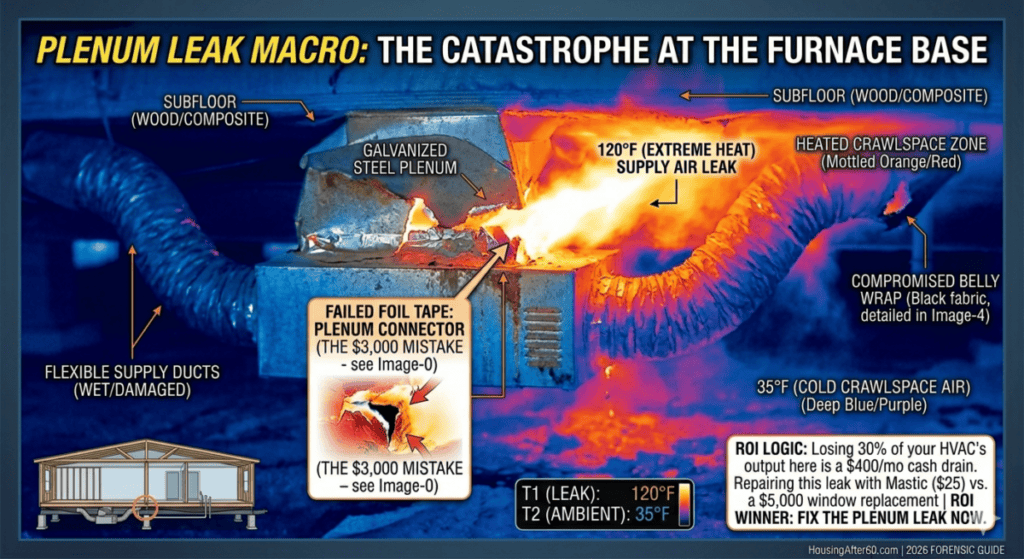
In a mobile home, your ducts usually run through that same belly cavity. If a duct joint separates, you are pumping 100°F air directly into a 30°F crawlspace. I have seen homes where 40% of the furnace output never reached a single register. This is catastrophic heat loss. You must check the plenum connections and the flexible duct “fingers” that lead to the vents. Static pressure loss in disconnected ducts also burns out your blower motor prematurely. In 2026, we use mastic sealant rather than tape for these joints because tape fails under the constant vibration and temperature cycling of the HVAC system.
5. Walls (The Thin Shell)
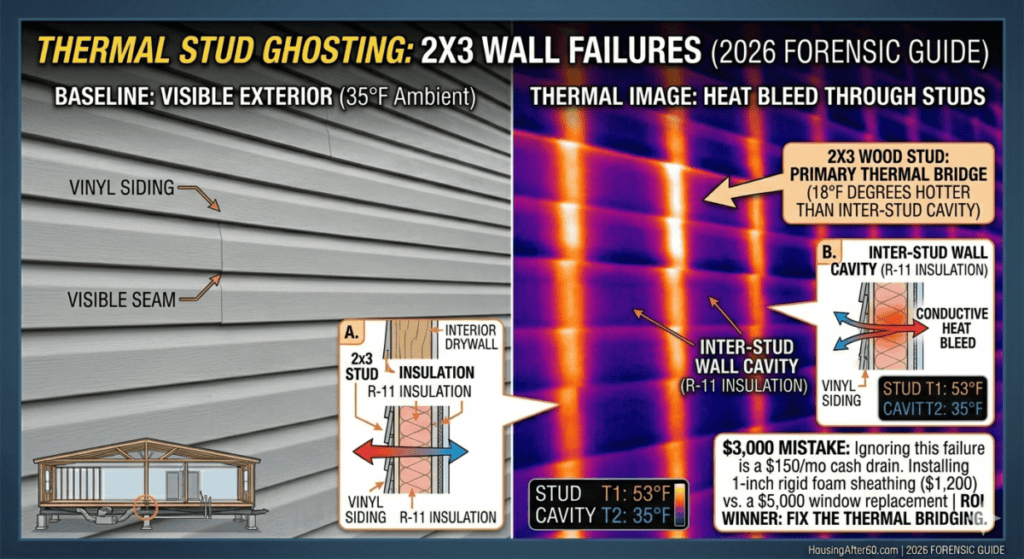
With 2×3 studs, you’re looking at an R-7 or R-11 insulation value. There isn’t much room for more. The real loss here isn’t through the wall itself, but through penetrations. Take a cover plate off an electrical outlet on an exterior wall. If you feel a breeze, you have unsealed top plates in the attic. Air is being sucked from the wall cavity into the living space. This is a chimney effect within the wall itself. Addressing this requires fire-rated foam at the wire penetrations in the attic and floor.
6. Ceiling and Roof
Heat rises. In many older “flat roof” or “bowstring truss” mobile homes, there is only 4 to 6 inches of space for insulation. Over time, blown-in cellulose settles, leaving the peaks of the trusses exposed. This creates thermal bridging, where the wood or metal truss conducts heat directly to the roof skin. In 2026, roof-overs with ISO board insulation are the only permanent fix for these older units. Without a reflective TPO membrane or high-R roofing system, you are fighting a losing battle against the sky.
7. Air Leaks: The Hidden Enemy
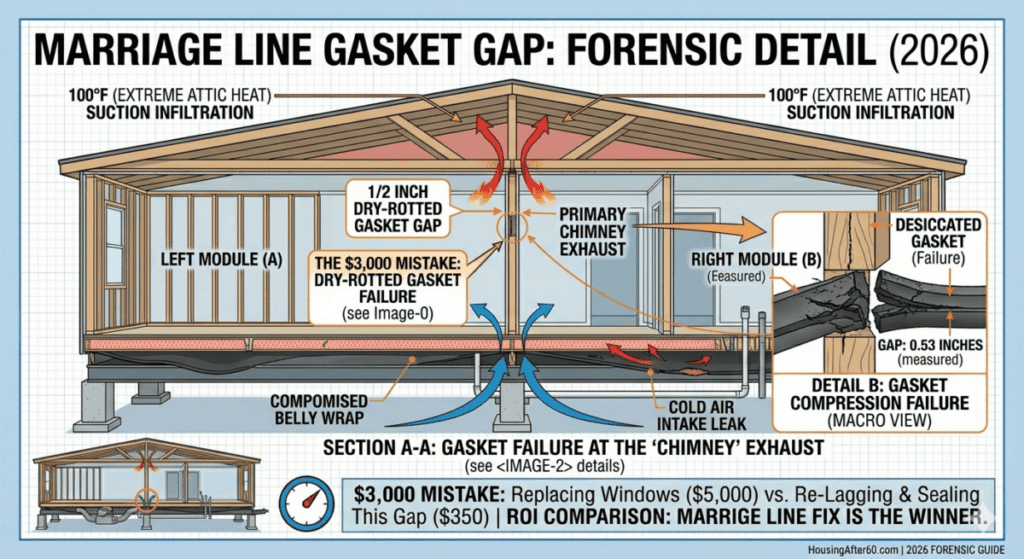
The marriage line—where the two halves of a double-wide meet—is the #1 culprit for air leaks. If the lag bolts have loosened or the gasket has dry-rotted, you have a 60-foot-long crack in your house. Other leaks occur at plumbing stacks and exhaust fans. If these aren’t caulked, the Stack Effect will accelerate your heat loss significantly. I suggest EPDM rubber gaskets for all ceiling penetrations to maintain a flexible seal as the home shifts during seasonal ground heave.
The “Stack Effect” Explained
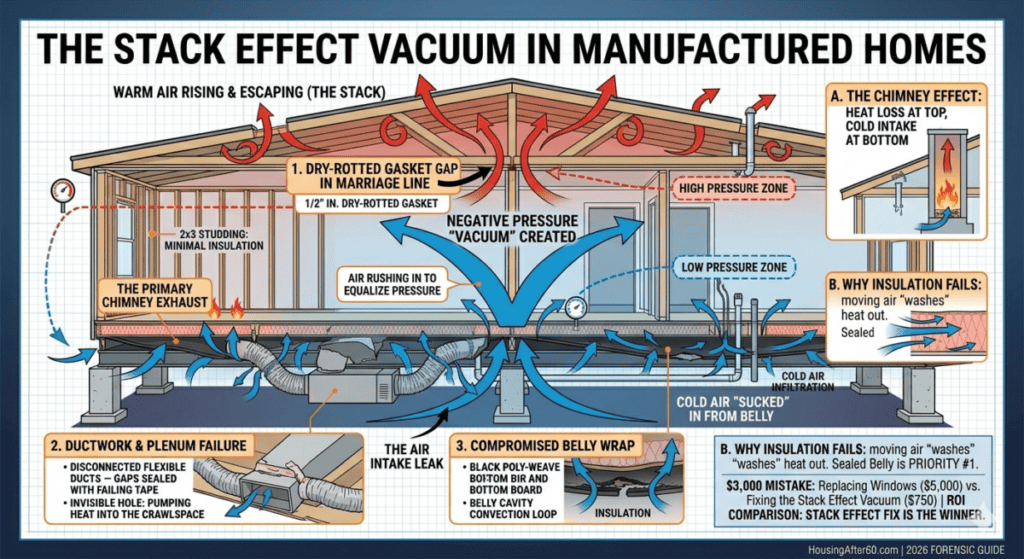
Your home acts like a chimney. Warm air is less dense and rises to the ceiling. If there are holes in your ceiling (light fixtures, vents), that air escapes. This creates a negative pressure zone at the bottom of the home, which “sucks” cold air in through the floor and belly leaks. You cannot stop the air from coming in the bottom until you stop it from leaving the top. This is first-principles physics. If you only insulate the floor but leave the ceiling leaky, you’ve solved nothing. You’ve just changed the temperature of the air being sucked through the house. Stopping the exhaust at the top is the first step in neutralizing the intake at the bottom.
Deep Dive: IRC Section 121 and Tax Logic
When you spend $10,000 on high-efficiency windows or a total belly restoration, you aren’t just “fixing a leak.” Under IRC Section 121 and general IRS guidelines for Capital Improvements, these expenses can be added to your cost basis. For those over 60 looking to sell their manufactured home in the next 5-10 years, increasing the basis reduces potential capital gains tax. However, you must distinguish between a “repair” (patching a hole) and an “improvement” (replacing the entire thermal barrier). In 2026, energy-efficient upgrades are highly scrutinized. Keep your receipts categorized: the Energy Efficient Home Improvement Credit may also apply to these specific manufactured home upgrades if they meet Energy Star 6.1 standards. This turns a utility expense into a tax-advantaged net worth protector.
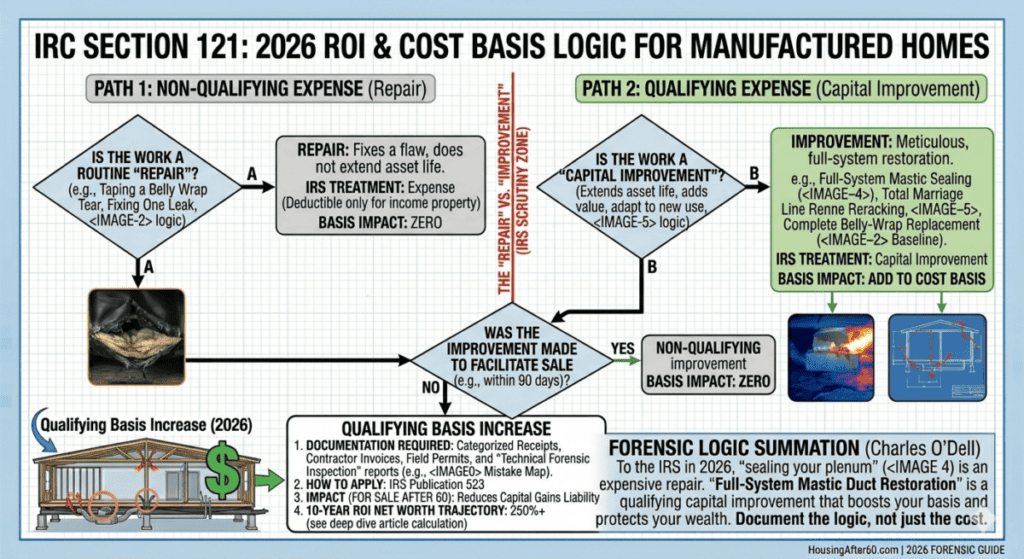
Deep Dive: 10-Year ROI Net Worth Trajectories
Investing in advanced air sealing isn’t just about comfort: it’s about compounding savings. In 2026, a typical mobile home in a cold climate spends $1,800 annually on heating. A comprehensive $4,500 investment in belly restoration and marriage line sealing typically yields a 35% reduction in heating costs. Over 10 years, accounting for a 4% annual energy inflation rate, that represents a $10,400 savings in cash flow. When you add the basis increase for resale, the ROI exceeds 250%. This is the First-Principles Logic of housing: spend on the envelope now to prevent the erosion of liquid assets later.
Internal Links To Helpful Related Articles
- Under Section 3 (The Belly): “Before you crawl under the home, read our Step-by-Step Belly Wrap Repair Guide to ensure you’re using the right 2026-rated adhesives.”
- Under Section 1 (Windows): “Replacing glass is expensive; see our technical breakdown of Mobile Home Window Replacement ROI to see if a retrofit is actually cheaper.”
- Under Section 4 (Ductwork): “A leaky furnace is a fire hazard and a cash drain. Follow our HVAC Efficiency Tips for Manufactured Homes to seal your plenum correctly.”
- Under The Actionable Checklist: “Looking for more ways to protect your asset? Check out our master list of Insulation Upgrades for Older Mobile Homes.”
Actionable Checklist: Winter-Proofing Your Asset
- Inspect the Marriage Line: Use a smoke pen or incense stick along the center seam of your double-wide. Seal any drafts with expandable foam or silicone caulk.
- Audit the Belly: Crawl under the unit. Look for “pillowing” (insulation weighing down the wrap) or holes. Patch with Polyken 222 tape.
- Check Duct Boots: Remove floor registers. Reach in and feel if the duct is actually attached to the floor. Use foil tape (mastic) to seal these.
- Insulate Outlets: Install foam gaskets behind all exterior wall outlets and switch plates.
- Check the Skirting: Ensure your skirting is airtight but ventilated to code. If wind can blow under the home, your floor insulation is useless.
- Verify Crossover Ducts: Ensure the large flexible crossover duct on double-wides is off the ground and uncrushed.
- Seal the Plenum: Check the main furnace plenum where it connects to the trunk line: use mastic to seal any 1/4-inch gaps.
About Charles O’Dell
Charles O’Dell is the founder of HousingAfter60.com. With 23+ years in the manufactured housing industry and over 100 successful flips, Charles focuses on the technical intersection of structural integrity and long-term ROI. He doesn’t care about “curb appeal” if the belly is rotting and the HVAC is leaking. He provides blunt, first-principles advice for homeowners who want their assets to last another 30 years. He believes energy efficiency is the ultimate form of wealth preservation for retirees.
For more technical breakdowns, check out our Skirting Repair Guide, read about Window Replacement ROI, or see our HVAC Efficiency Tips.
Written by Charles O’Dell: 23 years in the dirt, 100+ flips, and a “first-principles” approach to housing.