
Table of Contents
Introduction
A manufactured home can look incredibly inexpensive compared with an apartment or a traditional house. You might find a nice home advertised for $60,000, $80,000, or $100,000 and think, “I could live really cheaply there.”
Maybe you can. Mobile home park living can provide genuinely affordable housing. But there is one calculation you need to make before you know that.
The purchase price of the home is not your housing cost.
If the home sits inside a mobile home park, you may have a home payment, lot rent, utilities, insurance, property taxes, mandatory park fees, normal maintenance, and eventually some fairly expensive repairs. Even after the home is completely paid off, most of those expenses continue.
After more than 23 years working with mobile and manufactured homes, I have seen buyers focus intensely on getting a good price on the home while giving surprisingly little attention to what it will cost them every month to actually live there. That is backwards.
This article gives you a complete monthly-cost model you can use for any manufactured home you are considering. We will also compare that cost with renting an apartment and owning a manufactured home on your own land.
Video Guide Overview
The Short Answer
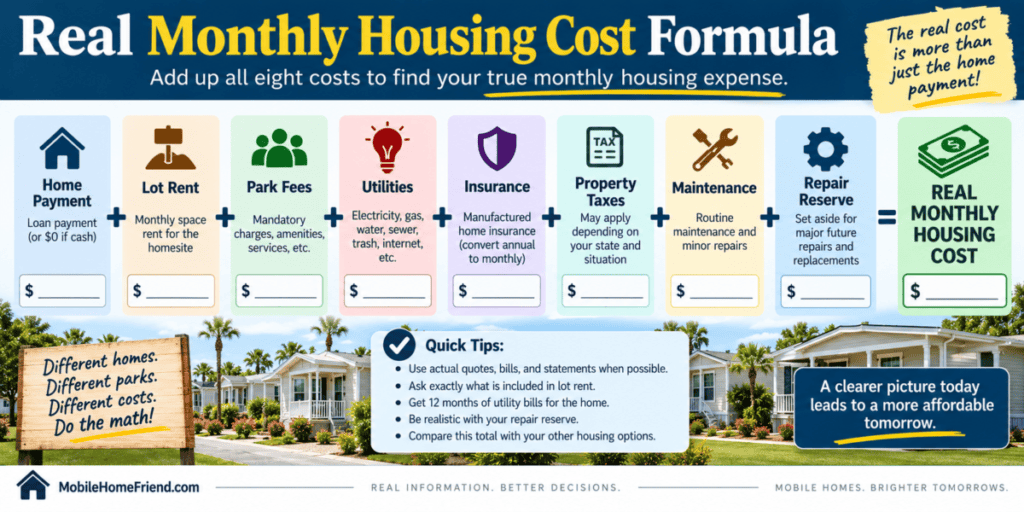
The real monthly cost of living in a mobile home park is:
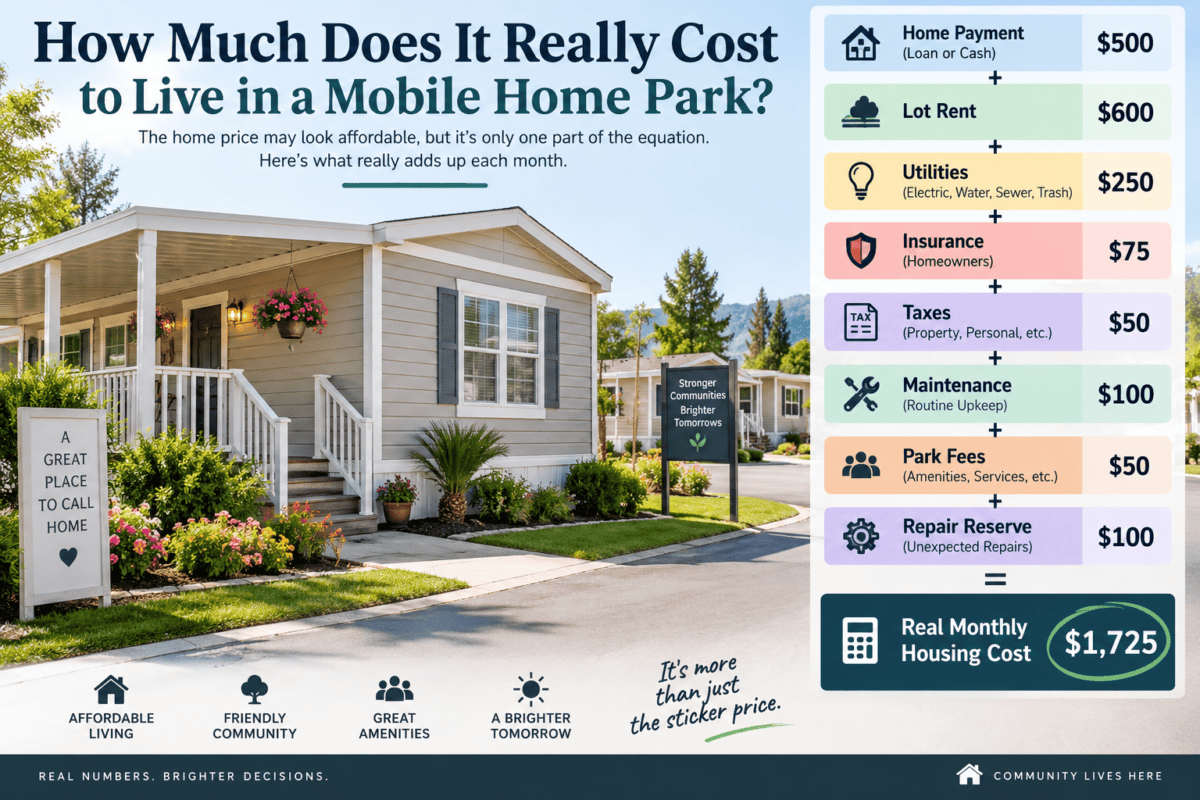
Home Payment + Lot Rent + Mandatory Park Fees + Utilities + Insurance + Property Taxes + Maintenance + Repair Reserve = Real Monthly Housing Cost
For example, a buyer might have a $500 home payment and $825 lot rent and initially think of the home as costing about $1,325 per month. Add $225 for utilities, $75 for insurance and taxes, $40 in park charges, $50 for routine maintenance, and $150 per month reserved for future repairs, and the actual economic cost becomes approximately $1,865 per month.
Your numbers could be dramatically lower or higher. That is exactly why national averages are less useful than calculating the expenses for the specific home and specific park you are considering.
Why Mobile Home Park Living Can Look Cheaper Than It Really Is
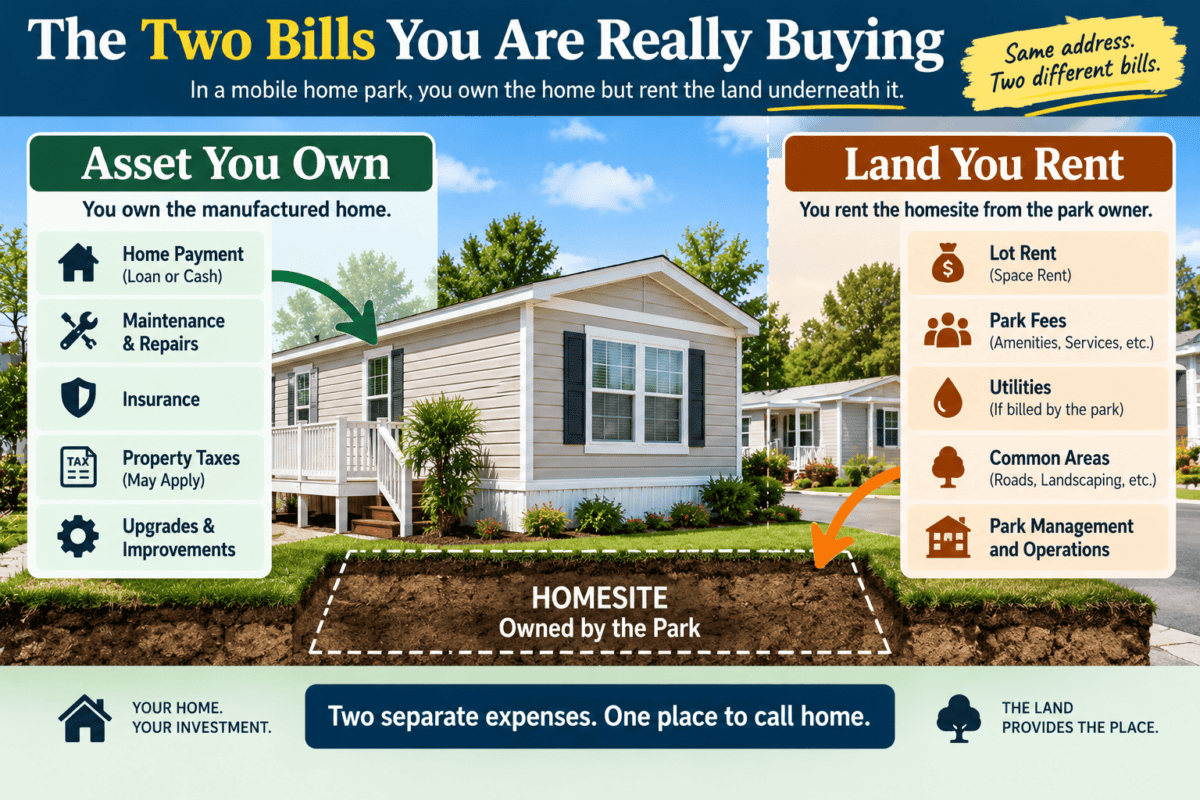
Manufactured housing inside a land-lease community has an unusual financial structure. You typically own the home but rent the land underneath it.
That makes you neither a conventional homeowner nor an apartment renter.
An apartment renter owns neither the building nor the land. In exchange, the landlord normally bears responsibility for major building repairs. If the air conditioner dies, the renter generally does not buy the replacement unit.
A traditional homeowner normally owns both the house and the land. There is no separate landlord charging monthly rent for the homesite.
In a mobile home park, you may get parts of both arrangements. You own the structure and therefore have many of the repair responsibilities of a homeowner, but you lease the homesite and therefore also have a recurring rent obligation.
That is why I like to look at park housing using this basic principle:
Home Cost + Land Cost + Operating Costs + Maintenance + Future Repairs = Real Housing Cost
Do not decide whether a mobile home is affordable by looking only at the price printed on the listing.
1. Start With the Cost of the Mobile Home
Your first expense is the home itself. How that expense appears in your monthly budget depends on how you buy it.
If You Finance the Home
Use the actual monthly loan payment, not an estimate based only on the asking price.
Manufactured homes in land-lease communities are frequently financed differently from homes sold together with real estate. Depending on the transaction and state, a home may be titled as personal property and financed with a personal-property loan, commonly called a chattel loan.
Those loans can differ substantially from conventional mortgages. The Consumer Financial Protection Bureau has found that manufactured-home borrowers using chattel financing have historically paid higher interest rates and had fewer refinancing opportunities than borrowers using manufactured-home mortgages.
That means two people purchasing identically priced homes could have very different monthly payments.
Never assume the financing cost until you have an actual loan quote.
If You Pay Cash
Cash buyers sometimes make the opposite mistake. They think:
“I paid cash, so I won’t have a housing payment.”
You will not have a loan payment. That is very different from having no housing cost.
You still have to account for the opportunity cost of tying up the cash, and more importantly for monthly budgeting, you still have lot rent, utilities, insurance, taxes where applicable, maintenance, fees, and repairs.
Separate Purchase Costs From Monthly Costs
There may also be acquisition expenses that do not show up as monthly bills:
- Inspection costs
- Loan or closing fees
- Taxes or transfer expenses where applicable
- Immediate repairs
- Moving expenses
- Furniture or appliances
- Park application or transfer fees where permitted
Keep these separate from your monthly calculation, but do not pretend they do not exist. We will bring them back when we calculate the five-year cost of living in the home.
2. Lot Rent: Usually the Biggest Expense After the Home
Lot rent, also called space rent, site rent, pad rent, or ground rent, is what you pay for the right to keep your home on land owned by somebody else.
This deserves special attention because lot rent continues even after your home loan is completely paid off.
What does the rent include? There is no universal answer.
Depending on the park, the base rent might include some combination of:
- The homesite itself
- Water
- Sewer
- Trash collection
- Common-area maintenance
- Road maintenance
- Clubhouse
- Pool
- Recreational facilities
- Community landscaping
- Gate or security services
Another park may charge separately for many of those items.
That is why comparing parks using only advertised lot rent can be misleading.
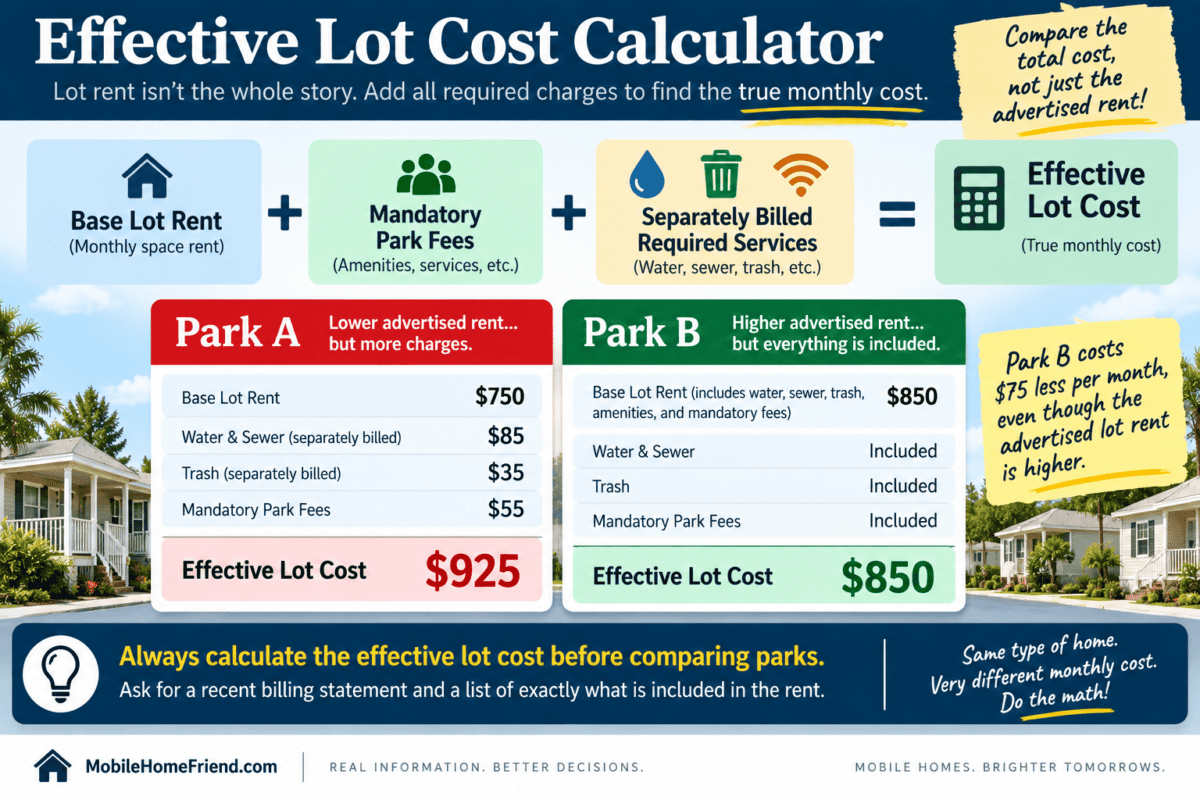
| Monthly Expense | Park A | Park B |
|---|---|---|
| Base Lot Rent | $750 | $850 |
| Water/Sewer | $85 | Included |
| Trash | $35 | Included |
| Mandatory Fees | $55 | Included |
| Effective Lot Cost | $925 | $850 |
The park advertising $750 rent is actually costing $75 more per month in this hypothetical example.
Use this calculation instead:
Base Lot Rent + Mandatory Park Charges + Required Separately Billed Services = Effective Lot Cost
For a much deeper explanation of this issue, read our Mobile Home Lot Rent Explained: What You Pay, Why It Goes Up, and the Costs Buyers Often Miss.
3. How Much Can Lot Rent Increase?
The current rent matters. The direction of the rent may matter even more if you plan to live in the home for ten or twenty years.
Rules governing rent increases vary by state and sometimes by local jurisdiction. Lease terms also matter. Do not assume a particular increase limit applies everywhere.
Instead, investigate the specific park.
One of the best questions you can ask is:
“What was the lot rent for this homesite five years ago?”
If management will provide a written rent history, even better. Sellers may also have old statements.
Consider an $800 monthly lot rent and assume, purely for illustration, that it increases by the same percentage every year:
| Annual Increase | Starting Rent | Approx. Year 5 Monthly Rent | Approx. Year 10 Monthly Rent |
|---|---|---|---|
| 3% | $800 | $900 | $1,075 |
| 5% | $800 | $972 | $1,241 |
| 7% | $800 | $1,049 | $1,574 |
| 10% | $800 | $1,171 | $2,075 |
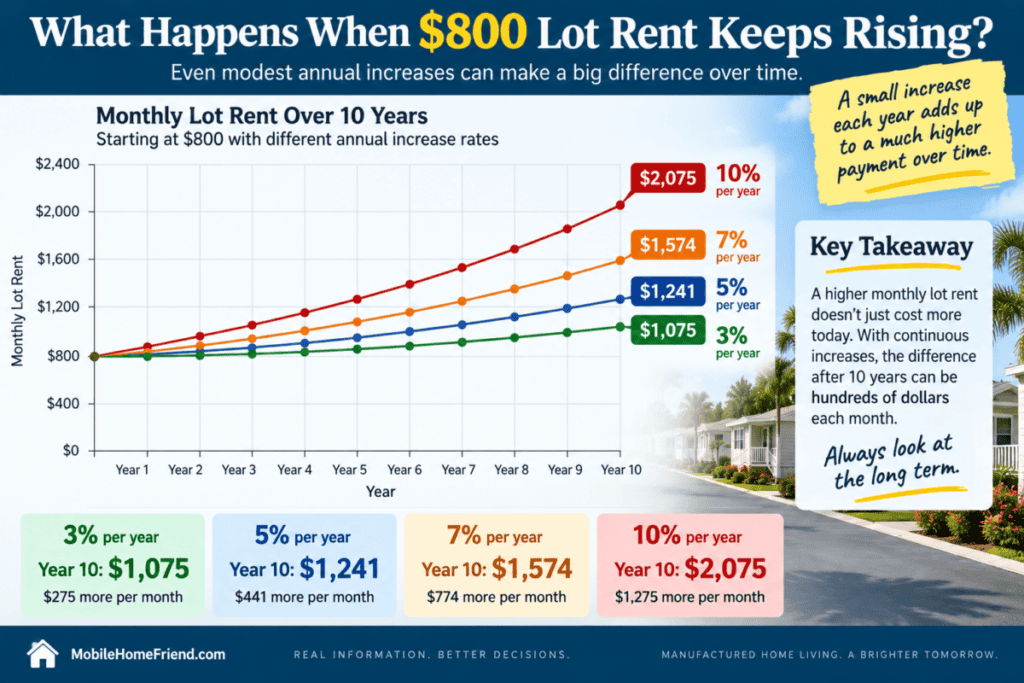
These are mathematical scenarios, not predictions of what your park will do. The point is to demonstrate why compounding matters.
An $800 rent that seems comfortable today can become a very different expense after repeated increases.
This matters especially for retirees or anyone living on income that may not increase at the same rate.
4. Utilities: What Is Included and What Is Not?
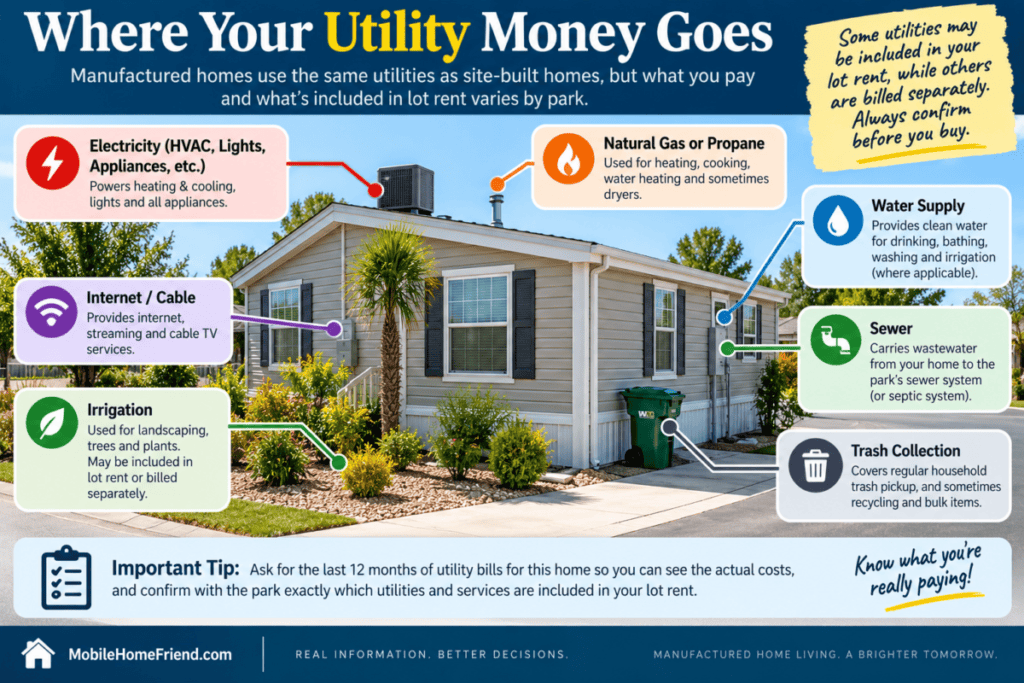
Next, determine exactly which utilities you will pay.
- Electricity
- Natural gas or propane
- Water
- Sewer
- Trash
- Internet
- Cable or required communications packages
- Irrigation where applicable
Do not estimate these from your current apartment or house if you can obtain actual information from the manufactured home.
Ask the seller for 12 months of utility bills when possible. A full year is far more useful than one mild-weather month.
Older Homes Can Change the Equation
An inexpensive older manufactured home may have:
- Older HVAC equipment
- Less insulation
- Leaky ductwork
- Older windows and doors
- Air leakage
- Underbelly damage
All of these can affect utility consumption.
A $10,000 cheaper home is not necessarily a bargain if it costs significantly more to heat and cool and immediately needs HVAC, insulation, or window work.
If energy efficiency is a concern, our guides to mobile home underbelly insulation and skirting and mobile home window and door replacement costs go much deeper into those systems.
5. Mobile Home Insurance
Manufactured-home insurance is another real monthly expense, even though the premium may be paid annually.
A policy may provide coverage for the dwelling, personal belongings, liability, additional structures, and loss of use, depending on the policy.
Your premium can be affected by:
- Location
- Age of the home
- Replacement value
- Condition
- Deductible
- Coverage limits
- Wind and storm exposure
- Wildfire exposure
- Claims history
- Other underwriting factors
Rather than relying on somebody else’s average premium, get an insurance quote for the exact home before buying it.
Then convert the annual premium into a monthly number.
If insurance costs $900 annually:
$900 ÷ 12 = $75 per month
That $75 belongs in your housing calculation whether you physically pay the insurer monthly or once per year.
6. Property Taxes: Yes, You May Still Have Them
One misconception I have heard repeatedly is that because somebody rents the land, they do not have property taxes.
Do not assume that.
Manufactured homes can be classified and taxed differently depending on the state, ownership arrangement, title status, and whether the home and land are owned together.
For example, Arizona treats manufactured homes as personal property unless the requirements for affixing the home to owner-held real estate are met. Other jurisdictions may use different systems.
The practical lesson is simple:
Ask what taxes were actually assessed against this particular home.
Get documentation if possible.
Then convert the annual amount into a monthly cost.
If annual taxes are $600:
$600 ÷ 12 = $50 per month.
7. Park Fees Beyond Lot Rent
Now look for everything that appears on the park bill besides base rent.
Depending on the community and what local law permits, charges might include:
- Water and sewer
- Trash
- Pet charges
- Storage
- Additional vehicle parking
- RV parking
- Amenity charges
- Landscaping services
- Cable or internet packages
- Administrative charges
- Other assessments or pass-through expenses
The important distinction is between optional and mandatory.
If you can decline a service, it is a lifestyle choice.
If you must pay it to live there, it is housing cost.
I would ask to see an actual recent billing statement for the homesite rather than relying only on a verbal description of the rent.
8. Maintenance: The Expense People Forget
This is where comparing a park home with an apartment gets interesting.
If you rent an apartment and the water heater fails, you generally call the landlord.
If you own the manufactured home, you are normally the one buying the water heater.
The same applies to many components of the home:
- HVAC system
- Roof
- Plumbing
- Electrical system
- Water heater
- Appliances
- Windows
- Doors
- Flooring and subfloor
- Siding
- Skirting
Some months you might spend almost nothing.
That does not mean the true maintenance cost for those months was zero.
Homes wear out gradually and send you the bill irregularly.
9. Create a Monthly Repair Reserve
I strongly recommend separating normal minor maintenance from a repair and replacement reserve.
Suppose your air conditioner is working perfectly today but is 15 years old. The fact that it did not break this month does not mean you should budget $0 toward its eventual replacement.
The same logic applies to the roof, water heater, appliances, plumbing, flooring, and other major components.
There is no universal monthly reserve appropriate for every manufactured home. A recently built home with newer systems should not be budgeted exactly like a 40-year-old home with an aging roof and HVAC system.
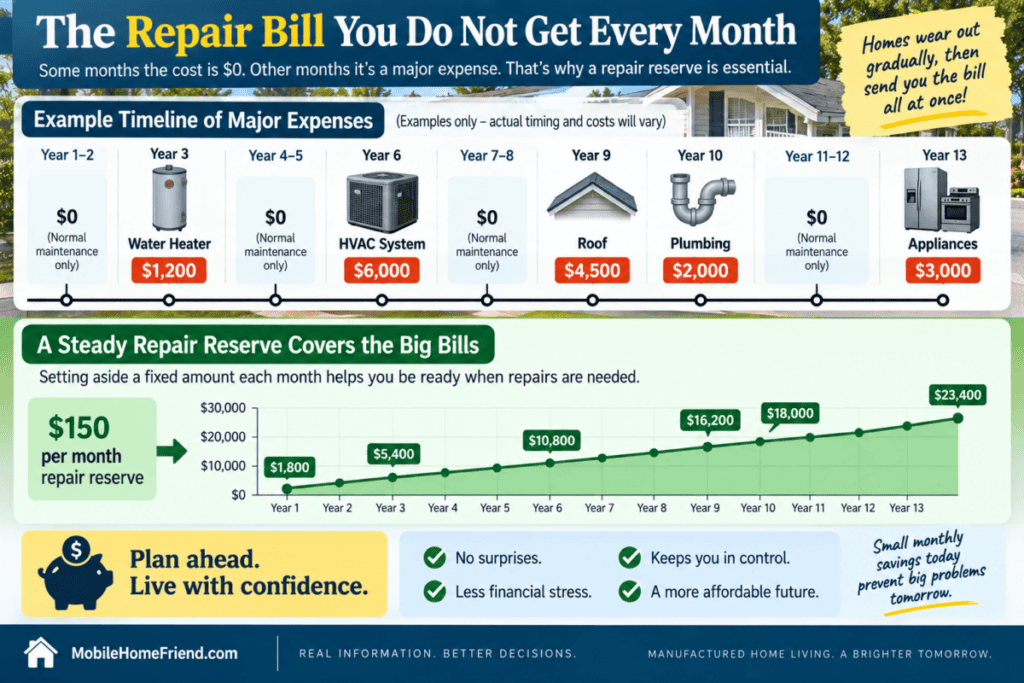
As a planning example, consider setting aside something like $100 to $250 per month for an older home, then adjust that number after inspecting the actual condition and age of its major components. This is a budgeting example, not a claim that every home will require that amount.
| Component | What to Check | Why It Matters |
|---|---|---|
| HVAC | Age, condition, service history | Major replacement expense |
| Roof | Age, leaks, coating, shingles | Water damage can multiply costs |
| Plumbing | Material, leaks, shutoffs | Hidden leaks can damage subfloor |
| Water Heater | Age, rust, leaks | Predictable eventual replacement |
| Subfloor | Soft spots, past water damage | Repairs can become extensive |
The repair reserve is not money you “lost” if nothing breaks. It is money accumulating for the day something does.
10. The MobileHomeFriend Real Monthly Cost Formula
Now we can put everything together.
| Expense | Your Monthly Cost |
|---|---|
| Home Payment | $________ |
| Lot Rent | $________ |
| Mandatory Park Fees | $________ |
| Electricity | $________ |
| Gas/Propane | $________ |
| Water/Sewer/Trash Not Included Above | $________ |
| Insurance | $________ |
| Property Taxes | $________ |
| Routine Maintenance | $________ |
| Repair/Replacement Reserve | $________ |
| REAL MONTHLY HOUSING COST | $________ |
This is the number I want you to compare with your other housing choices.
Do not compare apartment rent with mobile home lot rent.
Compare the apartment’s total monthly cost with the manufactured home’s total monthly cost.
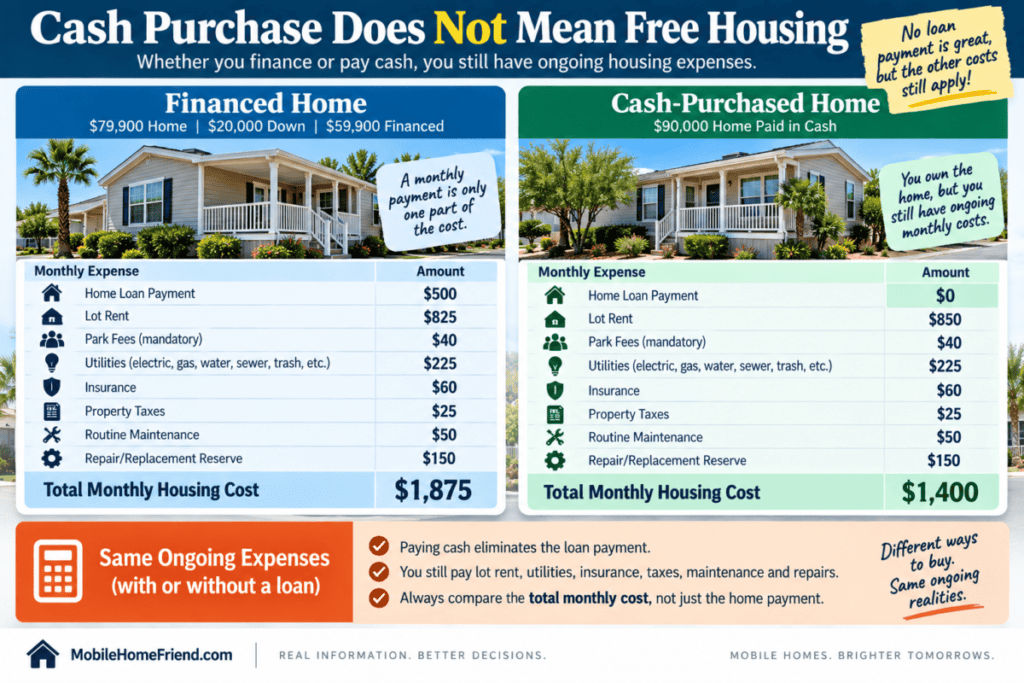
11. Example: The $79,900 Mobile Home
Let’s build a hypothetical example.
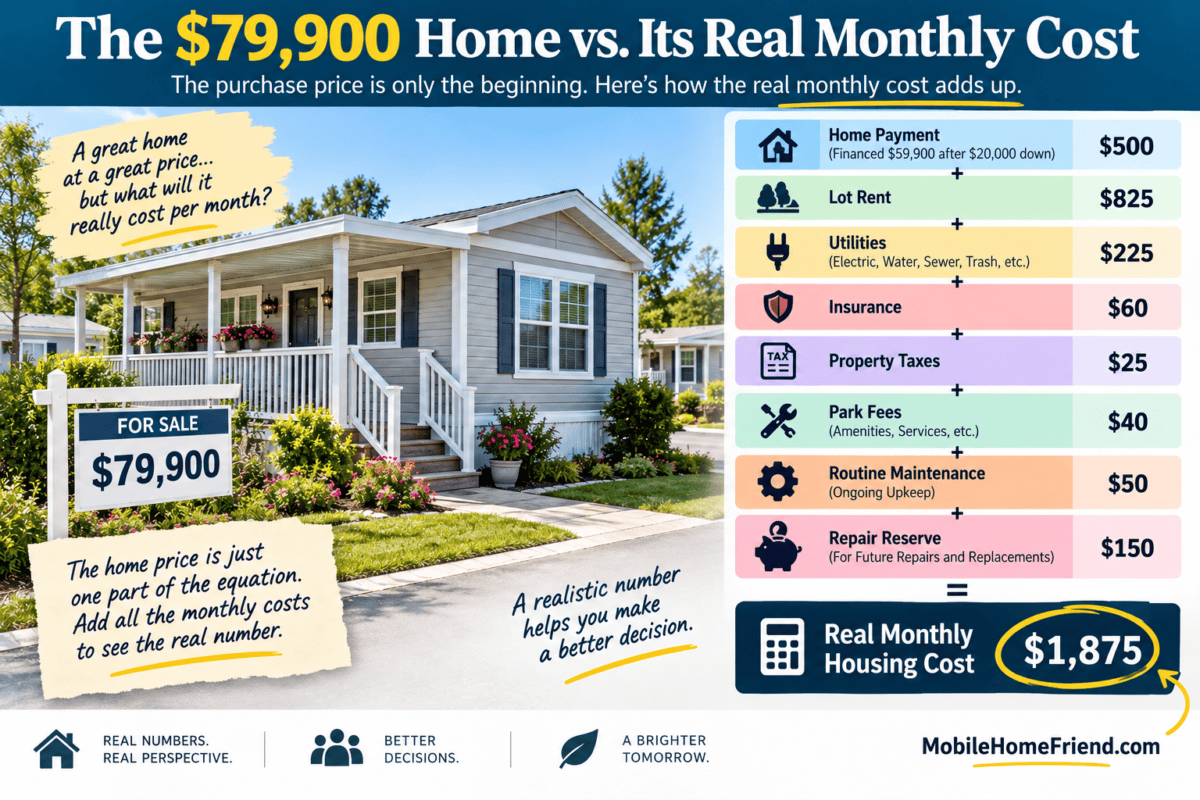
A buyer finds a nice manufactured home in a well-kept park for $79,900.
The buyer puts $20,000 down and finances $59,900. For illustration, assume the resulting loan payment is $500 per month. This is a hypothetical payment, not a current loan quote.
| Expense | Monthly Amount |
|---|---|
| Home Payment | $500 |
| Lot Rent | $825 |
| Park Fees | $40 |
| Utilities | $225 |
| Insurance | $60 |
| Taxes | $25 |
| Routine Maintenance | $50 |
| Repair Reserve | $150 |
| Real Monthly Cost | $1,875 |
Notice what happened.
The buyer can truthfully say, “My home payment is only $500.”
But that statement tells us almost nothing about whether the housing is inexpensive.
The more useful statement is:
“My estimated total housing cost is $1,875 per month.”
Now we have a number we can actually compare with alternatives.
12. What If You Pay Cash for the Home?
Suppose instead you purchase a $90,000 manufactured home with cash.
Your loan payment becomes:
$0.
Great. But suppose the remaining costs are:
- Lot rent: $850
- Utilities: $225
- Insurance: $60
- Taxes: $25
- Park fees: $40
- Maintenance: $50
- Repair reserve: $150
Your real monthly housing cost is still approximately $1,400, before considering what else the $90,000 cash might have earned if invested elsewhere.
This does not make the purchase bad. In many markets, $1,400 may be an excellent housing cost.
It simply means you should describe the economics correctly.
Paying cash eliminates the loan payment. It does not eliminate housing expenses.
13. Mobile Home Park vs. Apartment: Which Costs Less?
This comparison is where buyers often make a major mathematical mistake.
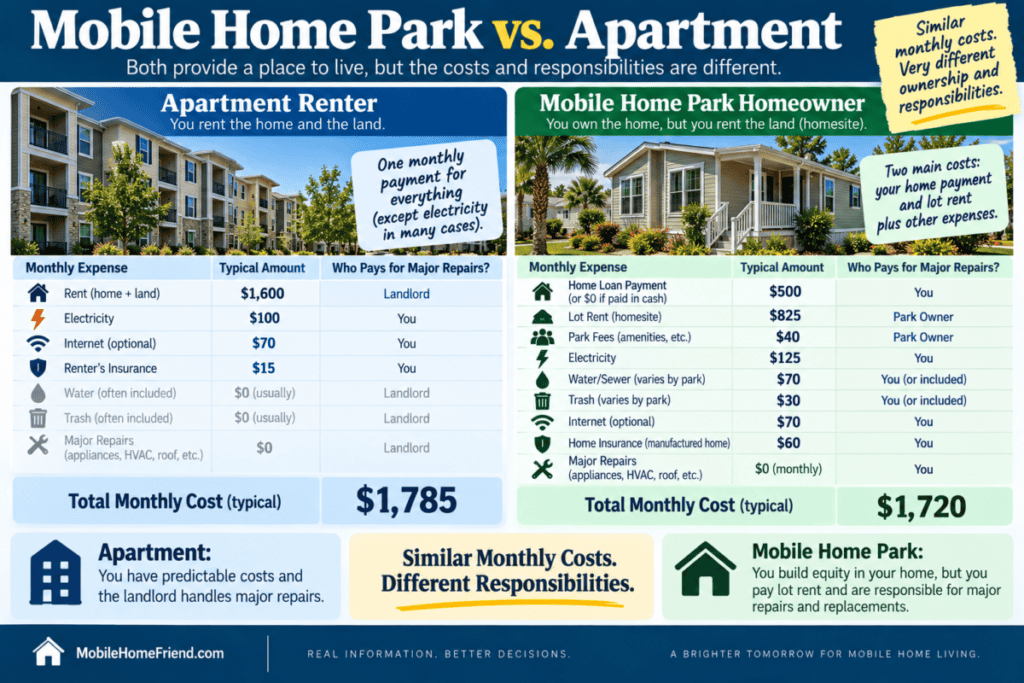
Imagine an apartment rents for $1,700 per month and a mobile home park charges $800 lot rent.
At first glance:
$800 park versus $1,700 apartment. Easy decision, right?
No. Those numbers are not measuring the same thing.
The $1,700 apartment rent pays for use of the dwelling and land. The $800 park rent generally pays primarily for the homesite and whatever park services are included. You still have to provide the home.
| Cost/Responsibility | Mobile Home in Park | Apartment |
|---|---|---|
| Home Payment | Possible | No |
| Rent | Lot Rent | Apartment Rent |
| Utilities | Usually Some/Most | Usually Some/Most |
| Insurance | Homeowner Policy | Renters Policy |
| Property Tax on Home | May Apply | Not Directly Paid by Renter |
| Major Home Repairs | Homeowner | Generally Landlord |
| Potential Resale Value | Yes | No |
Park ownership can offer things an apartment does not: more privacy, a yard, parking, more control over the interior, and an asset you may eventually sell.
Apartment renting offers something the park homeowner does not have: the landlord normally carries the risk of major building repairs.
Neither arrangement automatically wins.
The right calculation is:
Total Park Housing Cost vs. Total Apartment Housing Cost
If the mobile home totals $1,450 and a comparable apartment totals $1,850, the park home may provide meaningful monthly savings.
If the park home totals $1,850 and the comparable apartment totals $1,700, then the decision becomes more about lifestyle and ownership than immediate monthly savings.
14. Mobile Home Park vs. Manufactured Home on Your Own Land
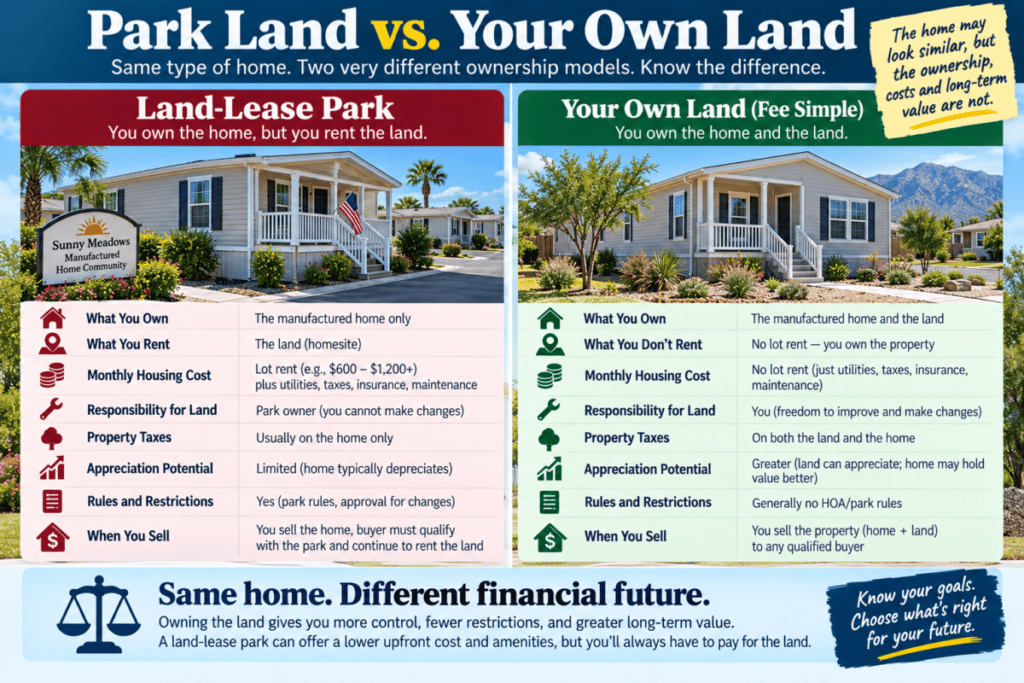
Now consider the third alternative: owning a manufactured home and the land underneath it.
This is financially very different from owning the same home in a park.
Manufactured Home in a Park
- Potentially lower initial acquisition cost
- Recurring lot rent
- Park rules
- Potential lot-rent increases
- Park controls the underlying real estate
- Some amenities and common-area services may be included
Manufactured Home on Private Land
- Potentially higher acquisition cost
- No separate lot rent once land debt is paid
- Property taxes on real estate
- Owner maintains the land
- Owner may be responsible for well, septic, driveway, fencing, and other site infrastructure
- Greater control over the property, subject to zoning, deed restrictions, HOA rules, and local law
- Ownership includes the underlying land
Private land is not “free land.” It has taxes, maintenance, and potentially substantial infrastructure costs.
But there is a fundamental economic distinction:
When you own the land, money spent acquiring the real estate buys an asset. Lot rent buys continued occupancy of somebody else’s land.
For more on the broader decision, read Should You Buy a Manufactured Home in a Park?.
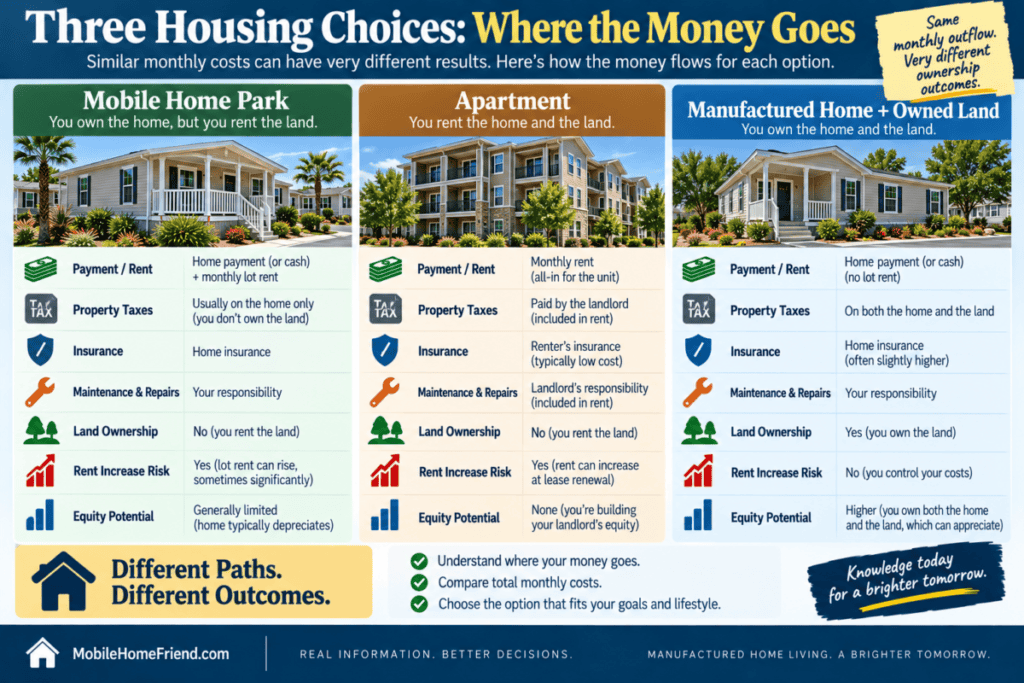
15. Three Housing Options Side by Side
| Factor | Mobile Home Park | Apartment | Manufactured Home + Land |
|---|---|---|---|
| Own Dwelling | Yes | No | Yes |
| Own Land | No | No | Yes |
| Recurring Rent | Lot Rent | Apartment Rent | None after land/home debt is paid |
| Major Home Repairs | Owner | Generally Landlord | Owner |
| Land Maintenance | Varies | Landlord | Owner |
| Rent Increase Risk | Yes | Yes | No Lot Rent |
| Potential Asset at Exit | Home | No | Home + Land |
The cheapest option depends on the local market, the home, the park, financing, your length of ownership, and the condition of the property.
There is no honest universal winner.
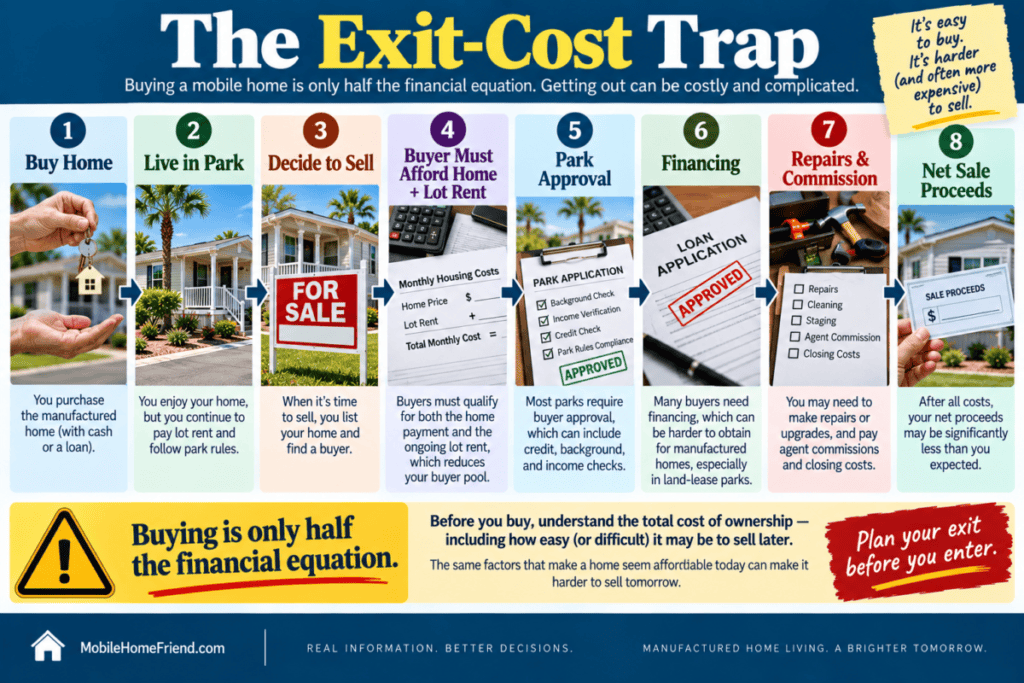
16. Do Not Forget the Cost of Getting Out
Most buyers calculate how to get into a home.
I also want to know how I am going to get out.
Eventually you may need or want to sell. Your exit could involve:
- Repairs before listing
- Sales commission or marketing expenses
- Park approval of the new resident
- Buyer financing limitations
- Transfer requirements
- A smaller buyer pool if lot rent has become expensive
- A discount if you need to sell quickly
Moving the home to escape high lot rent is theoretically possible in some situations, but relocation can be expensive, technically difficult, and sometimes impractical depending on the home’s age, condition, destination, permits, and availability of another site.
This is why lot rent and home value cannot be completely separated.
If the next owner must pay very high monthly lot rent, that can affect what buyers are willing or able to pay for your home.
Our detailed guide, How Much Is My Mobile Home Worth? How to Determine Its Real Value, explains how buyer pool, lot rent, condition, comparable sales, and land ownership affect valuation.
17. The Biggest Financial Risk: Owning the Home but Not the Land
I do not believe buying a home in a mobile home park is automatically a bad decision. I have bought, sold, renovated, and worked with many park homes.
But buyers need to understand the structural risk.
You own a valuable asset that sits on land controlled by somebody else.
The home is technically movable, but moving an established manufactured home is nothing like moving an RV out of a campground.
If lot rent rises substantially, you may face three effects at once:
- Your monthly housing expense rises.
- The next buyer also has to qualify for and afford that higher rent.
- The higher occupancy cost may put downward pressure on what buyers are willing to pay for the home.
That does not happen identically in every park or every market. But it is a risk you should evaluate before buying.
18. Questions to Ask Before Buying Into Any Mobile Home Park
Before I bought a park home, I would want answers to these questions:
- What is the current base lot rent?
- Exactly what is included in that rent?
- What mandatory charges are billed separately?
- Can I see an actual recent bill for this homesite?
- What was the rent one year ago?
- What was it five years ago?
- Are any increases already announced?
- How are water, sewer, trash, electricity, and other utilities billed?
- Are there pet charges?
- Are there extra vehicle or storage charges?
- What are the buyer approval requirements?
- Are there age or occupancy restrictions?
- What rules govern exterior improvements and maintenance?
- Are there restrictions affecting resale?
- Who owns the park?
- How long has the current owner owned it?
- Has management recently changed?
- Are major capital projects or assessments anticipated?
Then I would do something else that I consider extremely important:
Talk to several residents.
Not only the resident management recommends. Walk around, introduce yourself politely, and ask people who actually live there what their experience has been.
Ask about rent increases, management, utility billing, maintenance, rules, and unexpected charges.
You can learn an enormous amount in twenty minutes.
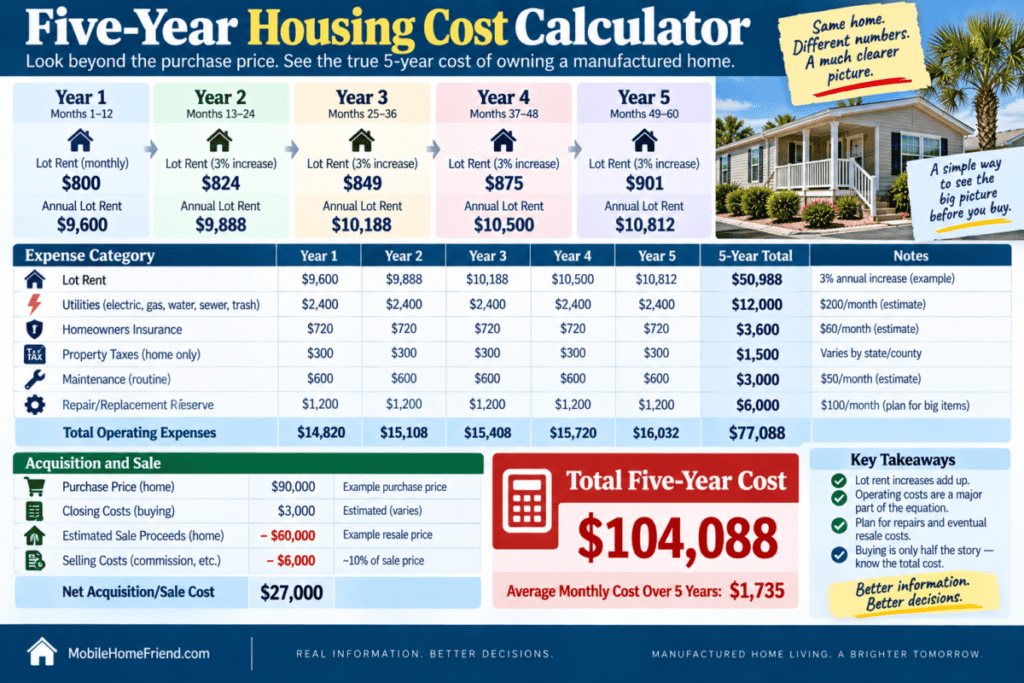
19. Calculate Your Five-Year Cost, Not Just Next Month
If you are seriously comparing housing choices, take the analysis one step further.
Calculate what each option could cost over five years.
A useful framework is:
Acquisition Costs + 60 Months of Housing Expenses + Major Repairs – Estimated Net Sale Proceeds = Approximate Five-Year Housing Cost
You cannot predict all of these numbers perfectly. That is not the goal.
The purpose is to expose financial differences that disappear when you look only at next month’s bill.
Suppose one park home is $20,000 cheaper to purchase but has $350 higher effective monthly lot costs than another alternative.
$350 × 60 months = $21,000.
Suddenly the $20,000 purchase-price advantage does not look nearly as impressive.
Now add different repair requirements and possible resale values, and the apparently “cheap” home could actually be the more expensive five-year housing choice.
This is exactly why I do not like making housing decisions from purchase price alone.
20. When Mobile Home Park Living Can Be a Great Financial Choice
After all these warnings, I want to make something clear. Mobile home park living can be an excellent housing choice.
The numbers can work especially well when:
- The home is purchased at a reasonable price.
- Lot rent is reasonable for the local market.
- Historical rent increases have been manageable.
- The park is well maintained.
- The home is in good physical condition.
- Mandatory additional fees are modest.
- The location would otherwise be expensive.
- The amenities are things you will actually use.
- You value the community and lifestyle.
- The total monthly cost compares favorably with realistic alternatives.
A well-run 55+ community, for example, may provide a lifestyle that a similarly priced apartment cannot duplicate. A resident may have a detached home, carport, patio, storage, community pool, clubhouse, activities, and neighbors with similar interests.
Those benefits have value.
The mistake is not choosing a park.
The mistake is choosing one without understanding the complete economics.
21. When the Numbers Should Make You Walk Away
Sometimes the calculation tells you something you do not want to hear.
I would become cautious when I saw combinations such as:
- Very high lot rent relative to local housing alternatives
- Rapid historical rent increases
- Numerous mandatory charges layered onto advertised rent
- An inexpensive home that needs substantial immediate repairs
- Difficulty obtaining reasonable financing
- A park with rules that significantly narrow the future buyer pool
- Poor resale activity
- Major uncertainty about future park ownership or operations
- A total monthly cost approaching or exceeding better housing alternatives
A $39,900 home can be expensive housing.
A $100,000 home can be inexpensive housing.
The purchase price alone does not answer the question.
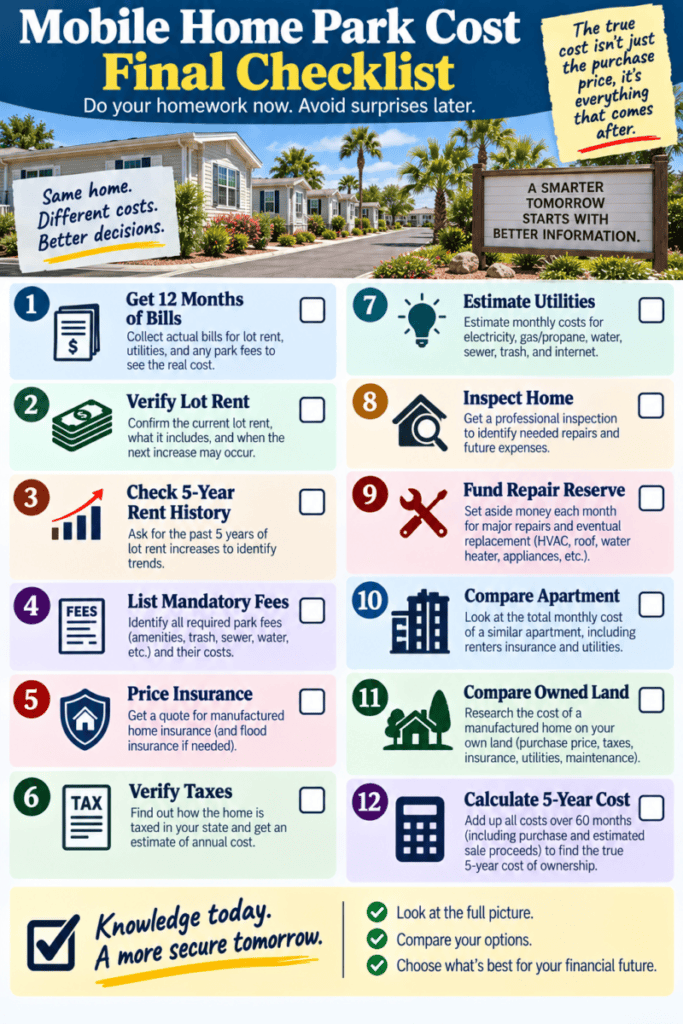
22. Your Mobile Home Park Cost Checklist
Before buying, complete this checklist using actual documents and quotes whenever possible:
- Get the exact home payment from an actual financing quote if financing.
- Verify current lot rent in writing.
- Get an itemized list of everything included in lot rent.
- Get an itemized list of mandatory charges not included in rent.
- Ask for the last 12 months of bills for the homesite when available.
- Ask for the park’s rent history, ideally going back five years.
- Get actual or historical utility costs.
- Obtain an insurance quote for the specific home.
- Verify the home’s actual property-tax treatment and recent tax amount.
- Inspect the HVAC system and determine its age.
- Inspect the roof and determine its remaining condition.
- Check plumbing, water heater, electrical system, subfloor, windows, doors, siding, and skirting.
- Establish a realistic monthly repair reserve.
- Calculate the real monthly housing cost.
- Compare that number with a realistic apartment alternative.
- Compare it with a manufactured home on owned land if that option exists in your market.
- Estimate the five-year cost, including likely rent increases and major repairs.
- Investigate how easily comparable homes in the park actually sell.
- Read the park rules before committing.
- Talk privately with current residents.
If you cannot get satisfactory answers to important financial questions, do not fill the blanks with optimistic assumptions.
23. Final Verdict: Is Living in a Mobile Home Park Actually Cheap?
It certainly can be.
Manufactured housing has provided affordable, attractive homes for millions of people, and a well-chosen home in a well-run park can offer a very good combination of cost, privacy, community, and lifestyle.
But the number on the home’s “For Sale” sign does not tell you whether it is affordable.
Neither does the lot rent by itself.
You need the entire equation:
Home Payment + Lot Rent + Mandatory Park Fees + Utilities + Insurance + Property Taxes + Maintenance + Repair Reserve = Real Monthly Housing Cost
Then compare that number with your actual alternatives.
And if you expect to stay for years, do not stop with Month 1. Look at Year 5 and, when appropriate, Year 10.
After working with mobile and manufactured homes for more than two decades, this is the principle I would most want a first-time park buyer to remember:
Do not buy the inexpensive home until you understand the cost of the land underneath it and the cost of keeping the home above it.
Frequently Asked Questions
How much does it cost per month to live in a mobile home park?
There is no useful single national number for every buyer. Your real monthly cost should include your home payment, lot rent, mandatory park fees, utilities, insurance, property taxes, routine maintenance, and a reserve for future repairs. Calculate these costs for the specific home and park rather than relying on a national average.
What does mobile home lot rent usually include?
It varies by park. Lot rent may include only the homesite or may also include services such as water, sewer, trash, common-area maintenance, roads, clubhouse, pool, or other amenities. Ask for an itemized list of exactly what is included.
Do you pay lot rent after you pay off your mobile home?
Yes, if the home remains on a rented homesite. Paying off the home loan does not eliminate the lease obligation for the land. Lot rent normally continues as long as the home occupies the rented space.
Do you pay property taxes on a mobile home in a park?
You may. Manufactured-home tax treatment varies by state and by whether the home is classified as personal or real property. Verify the classification and actual tax bill for the specific home with the appropriate local taxing authority.
Who pays utilities in a mobile home park?
It depends on the park. Some utilities may be included in rent, some may be billed by the park, and others may be billed directly by utility providers. Ask for the complete billing arrangement and, when possible, review 12 months of actual bills.
How much can a mobile home park raise lot rent?
That depends on state and local law, the lease, and other applicable rules. Do not assume a rent cap applies. Research the specific jurisdiction and ask for the park’s historical rent increases so you can evaluate what has actually happened there.
Is it cheaper to live in a mobile home park or an apartment?
Either can be cheaper. Do not compare apartment rent with lot rent alone. Compare the apartment’s complete monthly cost with the mobile home’s payment, lot rent, utilities, insurance, taxes, fees, maintenance, and repair reserve.
Is it cheaper to own a manufactured home on private land?
Not necessarily at the beginning. Buying land can require substantially more money. Over longer periods, however, private land eliminates the separate lot-rent obligation and gives the owner an interest in the underlying real estate. Property taxes, land maintenance, utilities, septic, wells, and other infrastructure still need to be included.
What hidden fees do mobile home parks charge?
Charges vary. Depending on the park and applicable law, residents may encounter separately billed water, sewer, trash, pet, storage, parking, utility, amenity, administrative, or other charges. Ask to see an actual itemized bill before purchasing.
Who pays for repairs to a mobile home in a park?
The homeowner is generally responsible for repairs to the home itself, subject to the lease, park responsibilities, warranties, and applicable law. This is an important difference from apartment renting, where the landlord generally handles major repairs to the dwelling.
Can high lot rent make a mobile home harder to sell?
It can. Buyers have to consider both the price of the home and the recurring cost of occupying the site. If total monthly housing cost becomes too high, the affordable buyer pool may shrink, potentially affecting marketability and value.
Is buying a mobile home in a park worth it?
It can be an excellent decision when the home price, lot rent, park stability, home condition, lifestyle, and long-term costs all make sense. The decision becomes much riskier when buyers focus on the inexpensive purchase price while ignoring lot-rent history, fees, repairs, and resale conditions.
About the Author
Charles O’Dell has more than 23 years of hands-on real estate experience and has bought, renovated, sold, managed, or otherwise worked with more than 100 mobile and manufactured homes. His experience includes homes in land-lease parks as well as manufactured homes on privately owned land. Through MobileHomeFriend.com, Charles focuses on helping mobile and manufactured home buyers, owners, and sellers understand the practical and financial realities of these homes so they can make better decisions and avoid expensive mistakes.
Charles O’Dell has more than 23 years of hands-on real estate experience and has bought, renovated, sold, managed, or otherwise worked with more than 100 mobile and manufactured homes.