
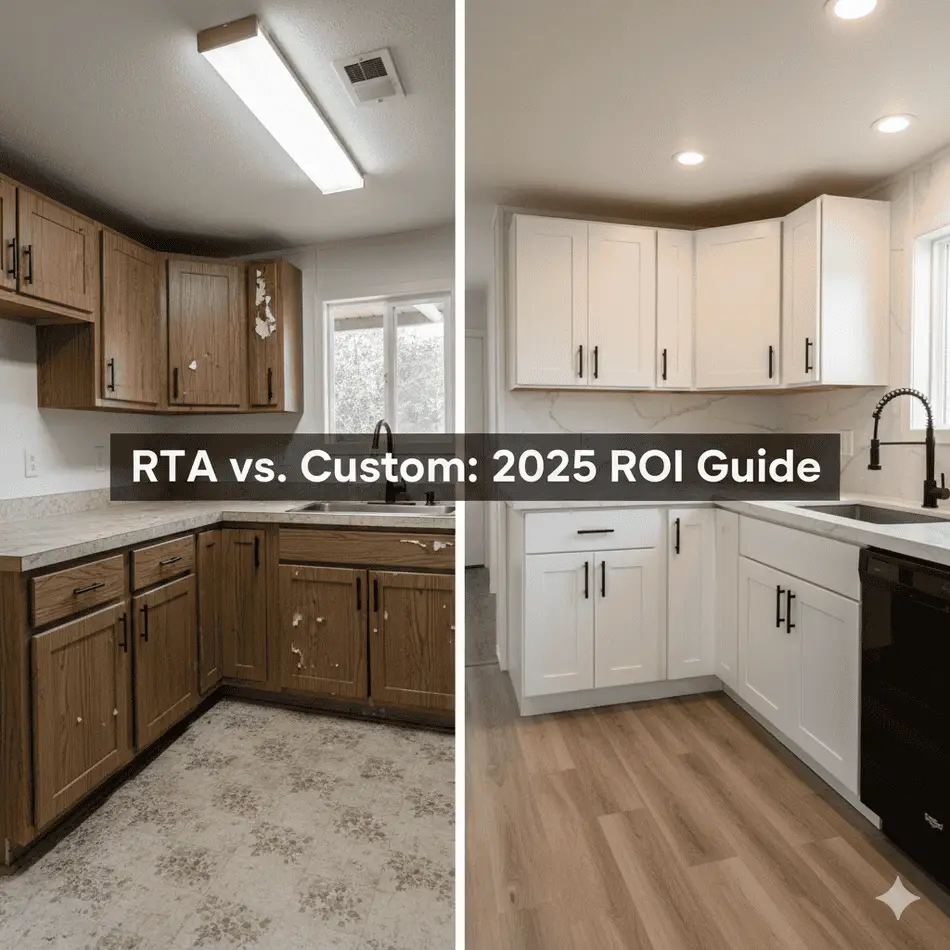
(Updated December 18, 2025) For a mobile home investor, the decision between Ready-To-Assemble (RTA) and custom cabinetry isn’t about personal taste—it is about the cold, hard logic of the “buy-to-exit” spread. If you over-improve with custom cabinets, you eat your profit. If you under-improve with cheap, original particle board repairs, the home sits on the market. In 2025, the sweet spot for a flip is modern RTA units that offer the look of high-end custom work at 40% of the price.
The average mobile home kitchen cabinet overhaul in 2025 ranges from $4,000 to $18,000. I break down why the “middle path” of RTA is almost always the correct move and when you are actually justified in hiring a custom shop. Crucially, any cabinet investment is a waste of money if you haven’t addressed the unique structural and plumbing liabilities of a manufactured home first.
Table of Contents
Video Guide Overview
Affiliate Disclosure: This article contains affiliate links. This means that if you choose to make a purchase through these links, I may earn a small commission at no additional cost to you. I only recommend high-ROI materials and tools that I stand behind for mobile home renovations based on years of investing experience. This support helps me continue providing free, logic-based content for investors and homeowners.
The Short Answer: Cabinetry Cost Tiers (2025 Estimates)
These tiers are based on a standard 10×12 mobile home kitchen. Our goal for a high-ROI flip is almost always Tier 2.
| Cabinet Tier | Average Total Cost | Investor ROI Focus |
|---|---|---|
| Tier 1: Stock RTA (Big Box/Online) | $3,500 – $6,500 | Best for rentals and entry-level flips. |
| Tier 2: Premium RTA (All Plywood) | $6,500 – $10,000 | Highest ROI for Flips (Our focus). |
| Tier 3: Full Custom (Local Shop) | $15,000 – $30,000+ | Only for high-end luxury park models. |
The ROI Sweet Spot: Aim for Premium RTA (Tier 2). These cabinets use a 3/4″ plywood box rather than particle board. To a buyer, they feel “solid,” and they withstand the vibration and “shifting” of a mobile home much better than cheaper alternatives.
Related Resource: Cabinets are just one part of the equation. To see how your cabinetry budget fits into the larger picture of counters, appliances, and layout changes, see my full report: Mobile Home Kitchen Remodel Cost: Maximizing ROI on Cabinets and Counters.
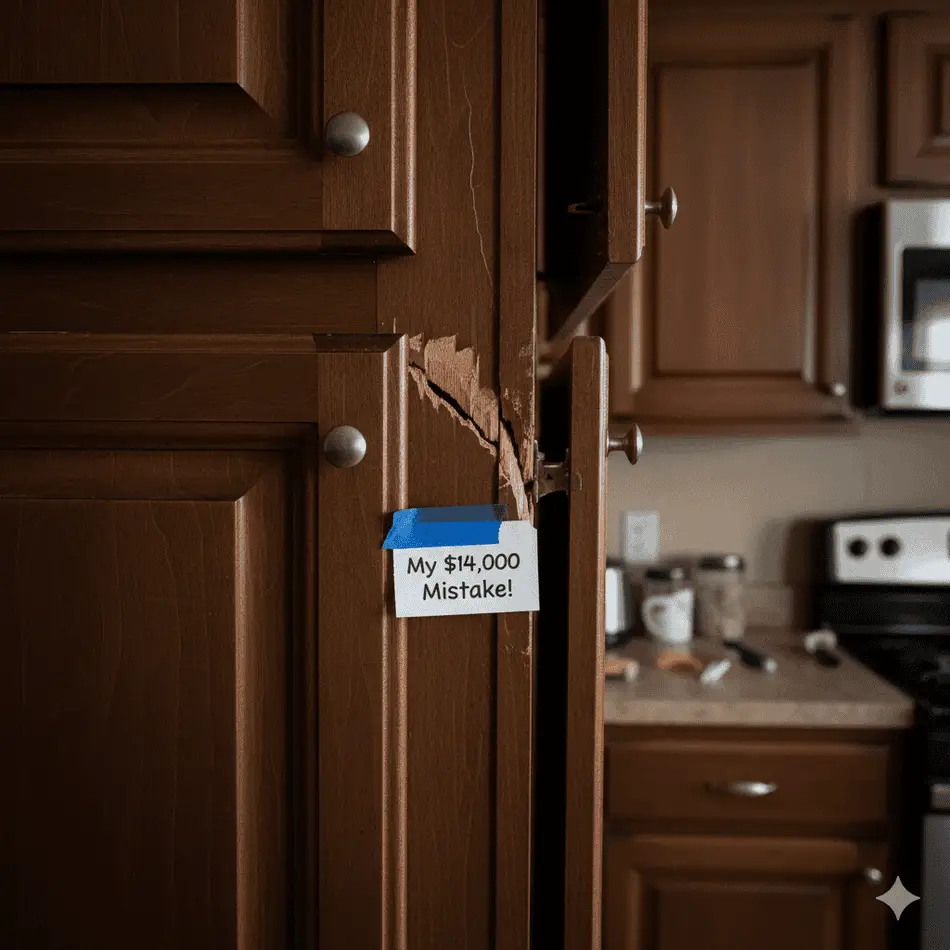
My $14,000 Custom Cabinet Mistake: Logic vs. Ego
I once took on a double-wide in a high-end retirement community. I convinced myself that because the lot rent was high, the buyers would demand “the best.” I bypassed my usual RTA supplier and higher end cabinets. I spent $14,000 on a semi-custom-built maple cabinets with intricate moldings.
The cabinets were beautiful. But here is the problem: the buyer liked them, but wasn’t going to pay extra for them over more standard new cabinets. They compared my house to another flip down the street that used $5,000 RTA Shaker cabinets from an online wholesaler. Because the other flipper used the $9,000 they saved on higher-end appliances and a quartz countertop, their kitchen actually looked “more” expensive than mine to the untrained eye. I spent more and got less “wow factor.” My ego cost me $9,000 in pure profit. In 2025, the gap in visual quality between “Premium RTA” and “Semi-Custom” is so small that a more expensive build is rarely a logical investment for a flip.
Cabinet Budget Breakdown: Where the Money Goes
When you buy RTA, you are trading your time for a lower purchase price. More expensive cabinets than these can sometimes be easier overall, but will generally net you less money.
| Cost Component | % of Budget | Investor Strategy |
|---|---|---|
| The Cabinet Boxes | 50% | SPEND HERE: Insist on plywood. Avoid MDF in mobile homes at all costs. |
| Hardware (Soft-Close) | 10% | SPEND HERE: Soft-close hinges are a “luxury” signal that costs very little. |
| Labor (Assembly/Install) | 30% | SAVE HERE: Assemble the RTA units yourself to keep $2k in your pocket. |
| Contingency (Subfloor) | 10% | MANDATORY: You *will* find rot under the sink. Budget for it. |
The Science of Durability: Why All-Plywood Trumps MDF in 2025
In a mobile home, your cabinets are not just furniture; they are structural components that must endure a unique set of stresses: vibration, chassis flex, and humidity spikes. To make the most logical investment, you must understand the material science behind the box.
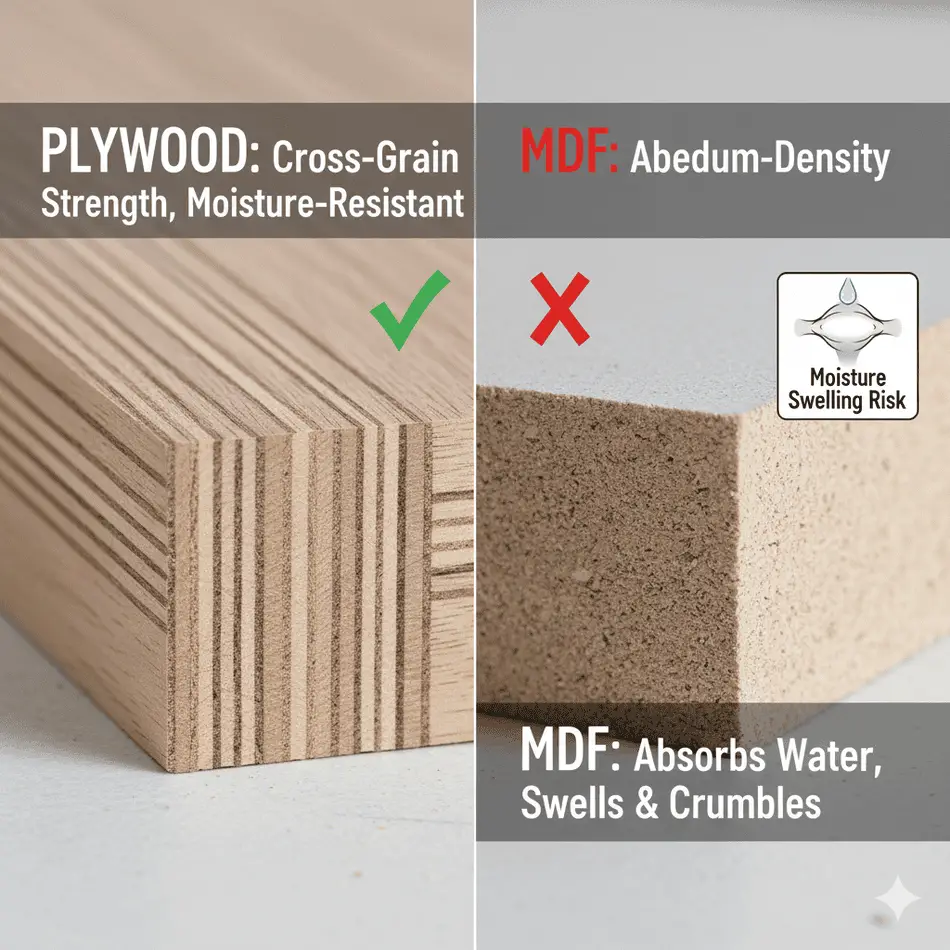
1. The Plywood Advantage (The Investor’s Choice)
High-quality RTA cabinets use 1/2-inch to 3/4-inch furniture-grade plywood. Plywood is made of thin layers of wood glued together in alternating grain directions (cross-lamination).
Logic: This cross-grain structure makes plywood incredibly resistant to “racking” (leaning to one side) when the home settles. It is also significantly lighter than engineered wood, reducing the permanent load on your mobile home’s outriggers.
2. The Failure of MDF and Particle Board
Medium-Density Fiberboard (MDF) is essentially sawdust held together by resin. While it provides a perfectly smooth surface for paint, it has zero structural “memory.”
The Trap: If a pipe leak occurs—common in older units—MDF acts as a sponge. It will swell and lose its screw-holding capacity within 24 hours. In 2025, if you are flipping a home, installing MDF cabinets is a liability that savvy inspectors will flag.
3. The 2025 “Off-Gassing” Reality
Modern buyers are increasingly concerned with Indoor Air Quality (IAQ). Cheaper particle board cabinets often use urea-formaldehyde glues that off-gas for years. Premium RTA lines are now moving toward CARB Phase 2 compliance, which is a major selling point in your listing description.
The Decision Point: RTA vs. Higher End Semi-Custom Cabinets
Option 1: Replacing with Premium RTA (Highly Recommended)
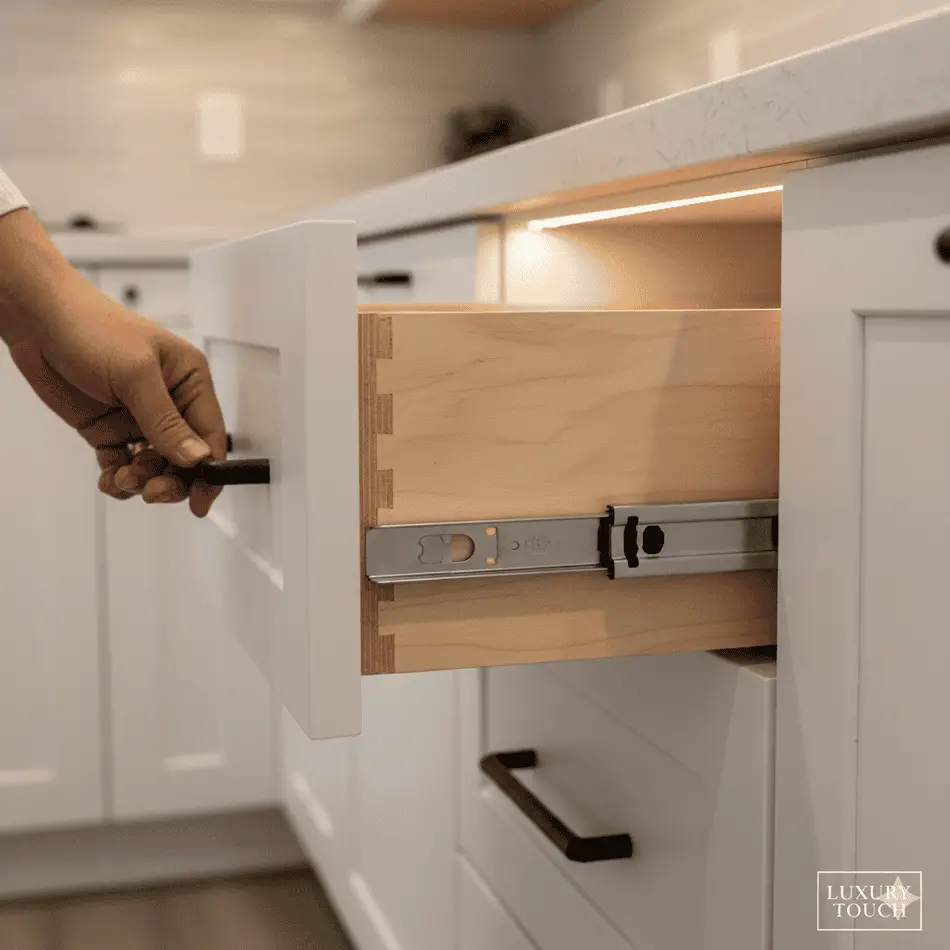
RTA cabinets arrive flat-packed. This is a massive advantage in mobile homes because you can carry the boxes through narrow 28-inch doors that fully assembled custom cabinets won’t fit through. In 2025, look for brands offering Dovetail Drawer Boxes and 6-way adjustable hinges. These features allow you to “square up” the kitchen even if the mobile home chassis is slightly out of level.
Option 2: Local Cabinet Shop (Use with Caution)
Custom is only logical if you have a “Dead Zone”—a space in your kitchen layout that is less than 9 inches wide where a standard RTA cabinet won’t fit. Even then, it is often cheaper to build a custom wine rack or spice pull-out in that gap than to order an entire custom kitchen. Semi-Custom cabinets can be heavy; ensure your outriggers and floor joists are not sagging before adding 800+ lbs of custom hardwood to one side of the home.
Pre-Remodel Mandatory Checks: Don’t Build on Sand
A $10,000 kitchen over a $10 pipe is a recipe for bankruptcy. Before the new cabinets arrive, you must perform these audits:
- The “Squish” Test: Walk the perimeter of the kitchen. If you feel even a slight dip near the sink or fridge, pull the old flooring. You are likely dealing with 5/8″ particle board rot. Replace it with 5/8″ CDX plywood or Advantech before the cabinets go down.
- The Poly B Check: If you see grey plastic pipes, stop. You must repipe the kitchen to PEX. A single pinhole leak in Polybutylene will swell your new plywood cabinet bottoms, ruining the investment in 24 hours.
- Electrical Load: 2025 appliances (induction ranges, high-speed microwaves) pull more amps. Ensure your kitchen is on a dedicated 20-amp circuit.
Investor Logic: Don’t risk a $10,000 kitchen on a $10 pipe. If your home still has the original grey plastic plumbing, it is a ticking time bomb. Check out my 2025 cost breakdown for modernizing your water lines in Mobile Home Whole-House Repiping Cost: The Investment in PEX Plumbing.
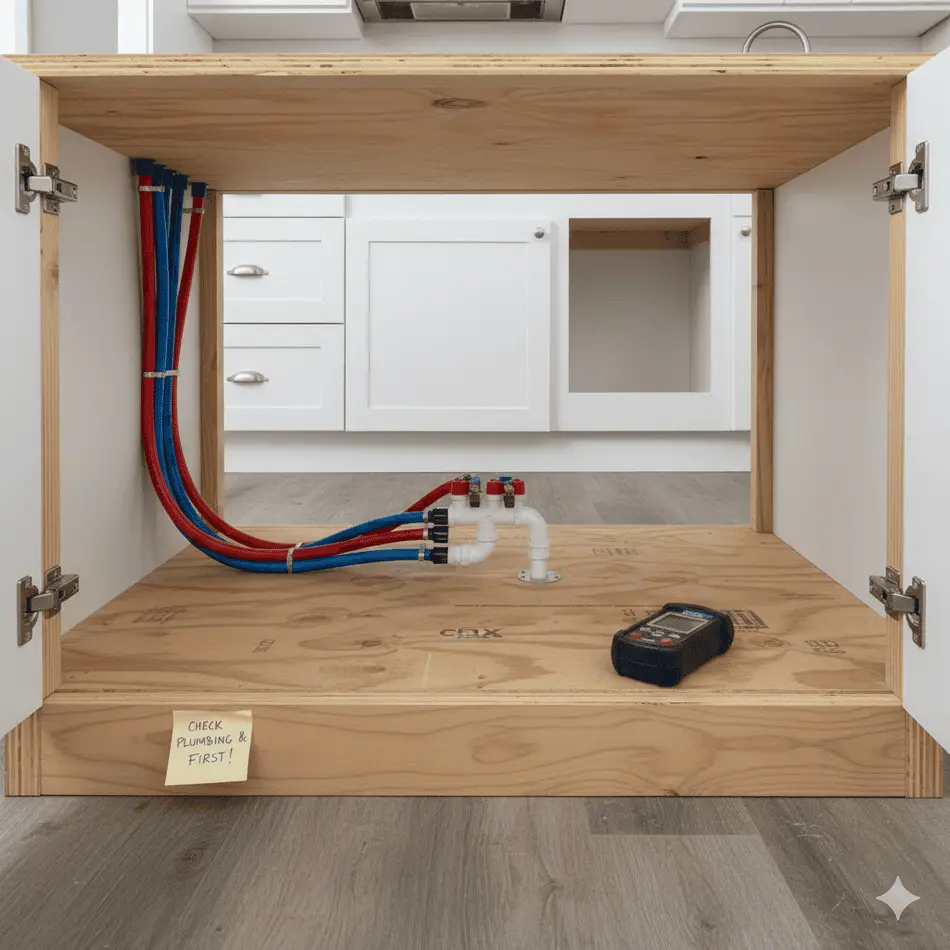
Investor Directive: If the subfloor is original particle board, do not install the cabinets directly on it. Install your LVP (Luxury Vinyl Plank) first, or use a plywood underlayment to distribute the cabinet weight. Mobile home floors flex; you need that extra layer of stability.
Must-Read Guide: Installing heavy new cabinetry over a compromised floor is a recipe for disaster. If you find soft spots or water damage during your audit, follow my step-by-step instructions in The Complete Guide to Mobile Home Subfloor Repair to ensure your foundation is rock solid before the cabinets go down.
The “Luxury Signal”: Why Hardware is Your Highest ROI Move
In real estate logic, “touchpoints” are the surfaces a buyer interacts with physically. In a kitchen, these are the cabinet handles and the drawer slides.
1. The Psychology of Soft-Close
In 2025, buyers equate “Soft-Close” hardware with high-end luxury. Installing RTA cabinets with integrated soft-close hinges costs an investor roughly $150–$300 more for the entire kitchen, but it removes the “clatter” associated with cheap mobile home construction. It is a silent signal to the buyer that the home has been renovated with care, not just a “quick coat of paint”.
2. Drawer Slide Physics: Undermount vs. Side-Mount
- Side-Mount Slides: These are visible when the drawer is open. They are the “budget” standard.
- Undermount Slides: These are hidden beneath the drawer box. They allow for a wider drawer and a much cleaner look.
Investor Directive: If the spread on your flip allows, go for undermount slides. They allow you to market the kitchen as “Full-Access Custom Style,” which can justify a $2,000–$5,000 increase in your asking price.
?️ Key Product Recommendations for Cabinet ROI
These selections focus on the “Standard Modern” look that buyers in 2025 associate with a high-value home.
✅ Option 1: White Shaker RTA Cabinets (Plywood Box)
White Shaker remains the #1 style for resale. It makes small mobile home kitchens feel twice as large. Ensure you select the “All Plywood” upgrade. Particle board (MDF) cabinets in a mobile home will fail at the hinge points within 3-5 years due to the home’s natural movement. This Plywood RTA Shaker Set is the investor standard.
✅ Option 2: Brushed Gold or Matte Black Hardware
Do not use the cheap chrome pulls that come in the “contractor pack.” Spending an extra $150 on modern, oversized matte black handles makes $5,000 RTA cabinets look like $15,000 custom units. This is the highest-leverage “finish” move you can make.
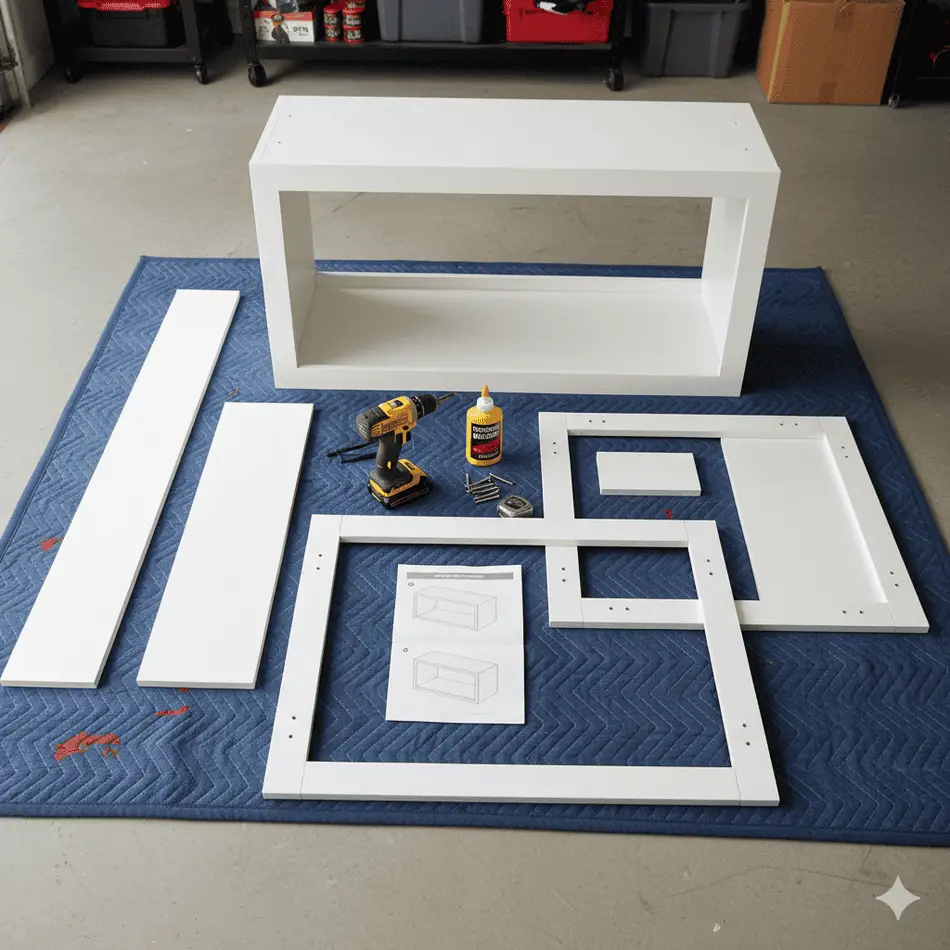
Step-by-Step RTA Assembly: The Investor’s Workflow
Assembling RTA cabinets is not just a DIY task; it is a manufacturing process that you must optimize to save time and money. Follow this logical sequence to avoid common errors that lead to crooked doors and sticking drawers—issues that are amplified by the natural movement of a mobile home.
1. The Prep Station (0–30 Minutes)
- Organize by Box: Do not open all boxes at once. Open one cabinet box at a time to prevent mixing hardware and losing small components in the subfloor gaps.
- Protect the Finish: Lay down a moving blanket or the flattened cardboard from the box itself. This prevents you from scratching the factory finish on the rough particle board or plywood subfloor.
- Gather the Essentials: You will need a cordless drill with a magnetic bit holder, a rubber mallet for tight joints, and a bottle of high-quality wood glue.
2. The “Dry Fit” and Glue Phase
- Apply Glue Strategically: Apply a small bead of wood glue into each dowel hole and groove. This creates a permanent structural bond that prevents the cabinet from “racking” or shifting over time as the home settles.
- The Box Assembly: Attach the side panels to the bottom board using the pre-drilled holes and dowels. Use your rubber mallet to gently tap the pieces into a snug fit without damaging the face frame.
- Back Panel Stability: Slide the back panel into the pre-cut 1/4-inch grooves on the sides. Attach the support rails across the top and back to square the rectangular shape of the box immediately.
3. The Finish Work (Doors and Drawers)
- Drawer Construction: Attach the brackets to the drawer back and front using the provided screws. Slide the sides onto the brackets and fit the bottom into the side grooves.
- Hinge Installation: Press the hinges into the pre-drilled holes on the doors and secure the covers. Attach the hinge plates to the pre-drilled holes on the cabinet frame.
- Leveling Check: Once assembled, place a spirit level across the face of the cabinet. If it is not perfectly square, adjust the hinge plates immediately before the glue sets to ensure the doors hang perfectly straight.
Pro Tip: Most investors prefer to run their flooring under the cabinets for a cleaner look and easier installation. If you are deciding which material to use, read my analysis on why waterproof vinyl is the only logical choice in Mobile Home Flooring Replacement Cost: Maximizing ROI with the Right Materials.
Maintenance Logic: Protecting Your Cabinet Investment
In a mobile home, cabinets face threats that site-built kitchens don’t: chassis settling and localized humidity spikes. To ensure your RTA or custom units last 20+ years, you must move beyond basic cleaning and focus on structural maintenance.
1. The 3-Year Releveling Rule
The most common cause of “sticky” cabinet doors in manufactured homes isn’t the hinge—it’s the home’s level. As soil settles or moisture shifts the piers, the frame twists. This puts “racking” stress on your cabinet boxes, causing joints to pull apart.
Investor Directive: Logically, you should check your home’s level every 3 to 5 years. If you notice cabinet doors that used to be square are now rubbing, do not adjust the hinges immediately—check the home’s level first.
2. Managing “The Sponge Effect” (Moisture Control)
Even with plywood boxes, high humidity is the enemy of cabinetry finish and structural integrity.
- Ventilation: Always use a range hood that vents to the exterior. Cooking without proper ventilation can raise localized humidity to 80%, causing wood expansion that cracks the paint at the joints.
- The Sink Audit: Check the “P-trap” and supply lines every 6 months. In a mobile home, small vibrations can loosen plastic plumbing nuts. A minor “drip” that goes unnoticed for a month will swell even the best plywood cabinet base.
3. Cleaning for Finish Longevity (2025 Best Practices)
Never use vinegar or ammonia-based cleaners on your cabinets. The acidity will eventually “eat” the topcoat, leading to a dull, sticky finish that attracts grease.
The Strategy: Use a pH-neutral cleaner (mild dish soap and warm water) and a microfiber cloth. For Shaker-style doors, pay special attention to the “recessed” ledge where dust and grease collect. Buffing these areas dry is the secret to preventing the “yellowing” common in white kitchen flips.
?️ 2025 Product Recommendations for Kitchen ROI
✅ The “Gold Standard” RTA Shaker Cabinet
Shaker cabinets remain the safest investment for resale appeal in 2025. I recommend using all-plywood RTA units because they are lighter and more moisture-resistant than particle board alternatives found in big-box stores.
? Shop All-Plywood Shaker RTA Cabinets here
✅ Pro-Grade Cabinet Installation Tools
Precision is everything when installing cabinets on uneven mobile home walls. A 4-foot level and a high-quality electronic stud finder are non-negotiable for ensuring your cabinets stay attached to the 2×3 or 2×4 studs.
? Get the Professional Cabinet Install Tool Kit here
✅ High-Impact Modern Hardware
Brushed gold or matte black handles can make a $5,000 RTA kitchen look like a $15,000 custom project. Choose oversized pulls to give the kitchen a “custom” signature that draws the buyer’s eye. I recommend the Ravinte Matte Black or Brushed Brass series for the best balance of cost and luxury feel.
? Upgrade your Kitchen Hardware here
Summary
The logic is simple: Buy Premium RTA cabinets, assemble them yourself, and spend the savings on the subfloor and plumbing. In a mobile home, the “hidden” infrastructure is what keeps the kitchen level and functional for the next twenty years. Custom cabinets are a luxury that rarely returns their cost in a manufactured home environment. Stick to the RTA Shaker-style path to maximize your 2025 ROI.
Related Questions
Can I use “Stock” cabinets from a big-box store?
Yes, but check the material. Many “off-the-shelf” cabinets are furniture-board (compressed paper). They are too heavy and too fragile for mobile homes. Spend the extra 15% to order the RTA plywood version online.
What if my mobile home ceiling is only 7 feet?
Standard wall cabinets are 30 inches tall. If your ceiling is low, you may need to use 12-inch or 15-inch “over-the-fridge” cabinets for your entire upper run to maintain a modern look without hitting the ceiling.
Written by a real estate investor with over 20 years of experience and 100+ successful renovations. This guide is based on first-hand data from mobile home flips in the Arizona market, focusing on 2025 material costs and structural requirements specific to manufactured housing. We prioritize logic and financial return over cosmetic trends to ensure your renovation is a permanent asset, not a liability.