
Summary: Removing walls in a mobile home in 2026 requires identifying the marriage line and truss orientation. While most interior walls are non-load-bearing, structural failures can cost over $15,000 to remediate if handled incorrectly. This guide covers engineering, legalities, and 2026 labor rates.
Note: Local labor rates for Mobile Home Wall Removal changed in 2026. See our full regional cost table below.
Table of Contents
Introduction
I have seen it a hundred times. A homeowner watches a 20-minute reality TV show and decides they want an “open concept” living room in their 1998 Fleetwood. They grab a sledgehammer, start swinging, and suddenly the ceiling starts to sag like an old mattress. I am Chuck O’Dell, and I am here to tell you that mobile homes are not built like stick-built houses. If you treat them the same, you are asking for a structural disaster that will tank your resale value.
In 2026, the cost of materials has stabilized, but the complexity of HUD-code compliance has not. Every wall you see serves a purpose: either it is holding up the roof, hiding a mess of 1970s aluminum wiring, or acting as a shear wall to keep the home from racking during a windstorm. Before you move a single stud, you need to understand the structural logic of your home’s chassis and roof system.
This article is the definitive guide to understanding if you can—and should—remove a wall. We are going to look at the physics of floor deflection, the IRS tax implications of structural improvements, and the exact dollar-for-dollar costs you will face this year. Strap in: we are doing this the right way, or we aren’t doing it at all.
Video Guide Overview
Affiliate Disclosure
I believe in transparency. Some of the links in this article are affiliate links. This means if you click them and buy a tool I recommend, I might get a small commission at no extra cost to you. I only recommend gear I’ve used on the job site to tear down or build up 100+ properties.
The Short Answer
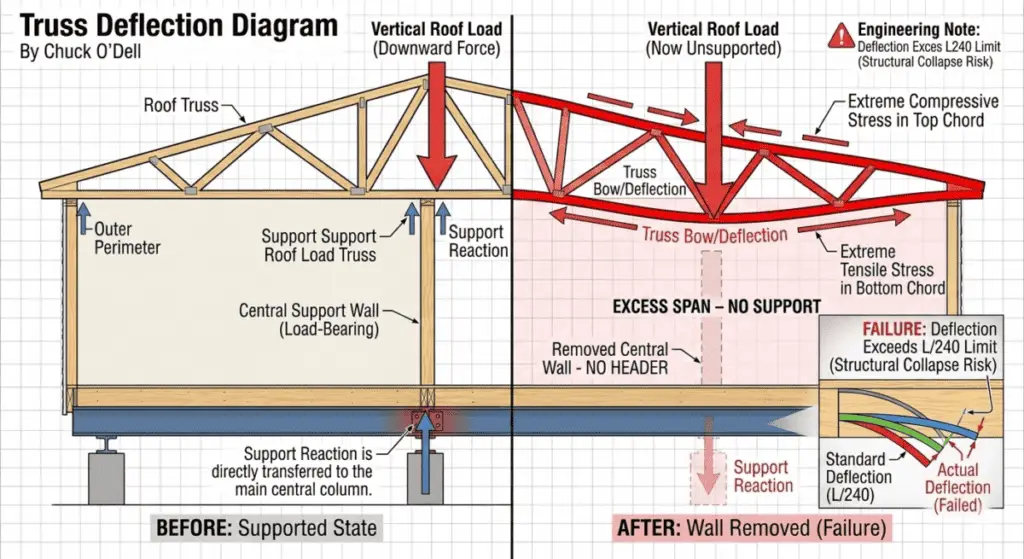
Yes, you can remove most interior walls in a mobile home because the perimeter walls and the marriage line usually carry the load. However, you must verify truss spans and shear strength before proceeding. If the wall runs parallel to the floor joists and lacks a heavy header, it is likely partition-only; if it supports a roof seam, touching it without a beam is a critical risk.
The Root Causes: Why Walls Fail or Need Removal
Most people want to remove walls because of bad 1980s floor plans. But often, we are forced to open walls due to underlying damage. The most common culprit is moisture intrusion from a failed vapor barrier or a slow plumbing leak that has rotted the bottom plate of the wall. In 2026, we are seeing more “hidden” structural rot than ever before because many homes built in the 1990s are hitting their 30-year fatigue point.
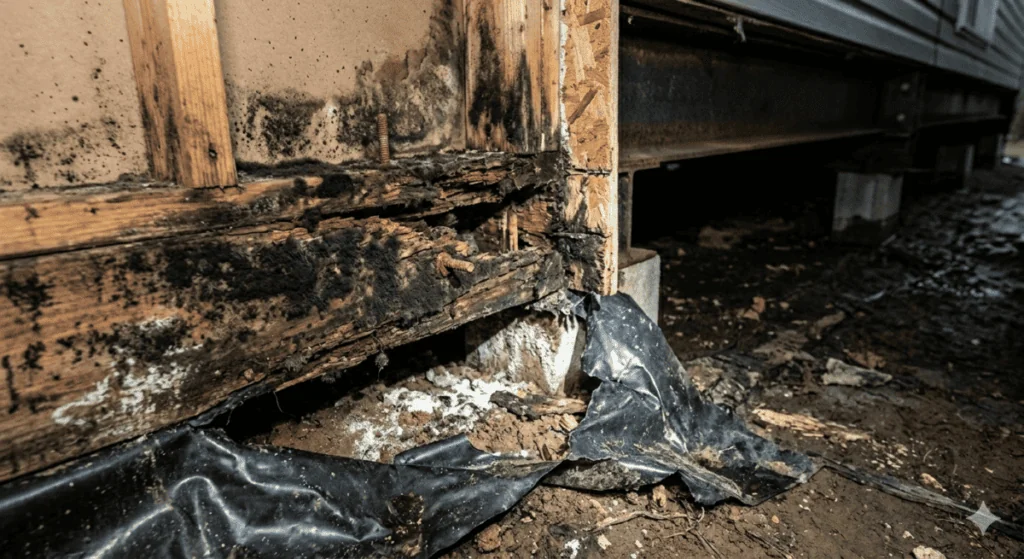
Plumbing leaks are particularly nasty in manufactured homes. Since many use particle board subflooring, a small leak at a sink base can travel under the wall, causing the 2×3 or 2×4 studs to wick up water. Once that wood loses its integrity, the wall is no longer doing its job. You aren’t just “opening up the room” at that point; you are performing a structural rescue mission.
Lastly, roof leaks at the marriage line of a double-wide often lead to wall removal. When the gasket fails, water runs down the center columns. If you see “V-shaped” cracking in your drywall above a doorway, that isn’t just settling. That is structural deflection, and it means the ground or the foundation has shifted, putting pressure on walls that weren’t meant to be load-bearing.
Engineering Deep Dive: The Physics of Floor Deflection and Materials Science
Let’s talk about Modulus of Elasticity (MOE). In a standard home, you might have 2×10 floor joists. In a mobile home, you likely have 2×6 or 2×8 joists sitting on a steel I-beam frame. The spacing matters immensely. If your joists are 16 inches On-Center (OC), you have a stiff floor. If they are 24 inches OC, you have a “bouncy” floor that is prone to deflection.
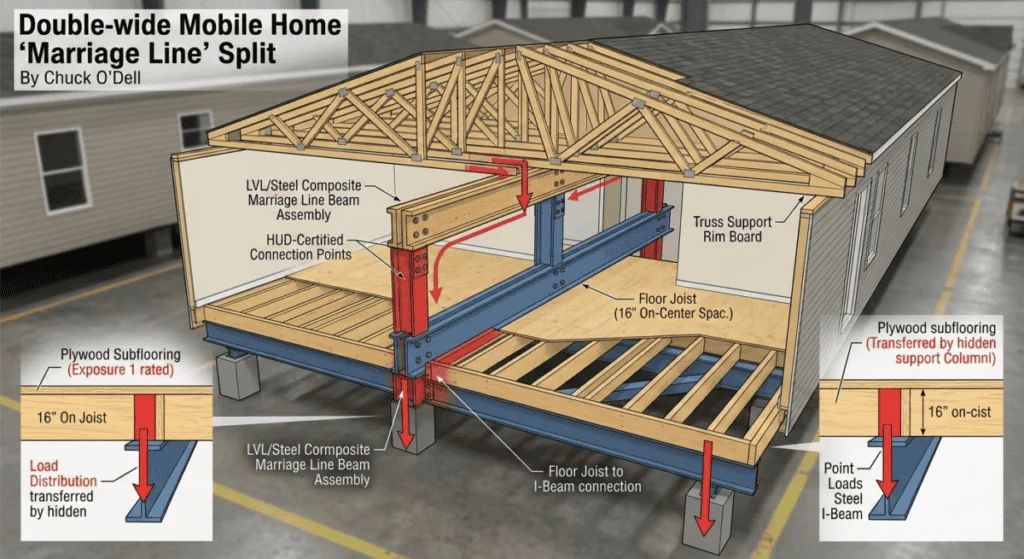
When you remove an interior wall, you are changing how weight is distributed across those joists. Even if a wall isn’t “load-bearing” in the sense of holding up the roof, it often acts as a stiffener for the floor. Removing a 12-foot longitudinal wall can increase the deflection of the subfloor, leading to cracked floor tiles or squeaky laminate. We use Plywood (rated Exposure 1) for repairs because it has a higher MOE than Oriented Strand Board (OSB) or the dreaded particle board. Plywood handles the tensile stress of a shifting mobile home frame much better.
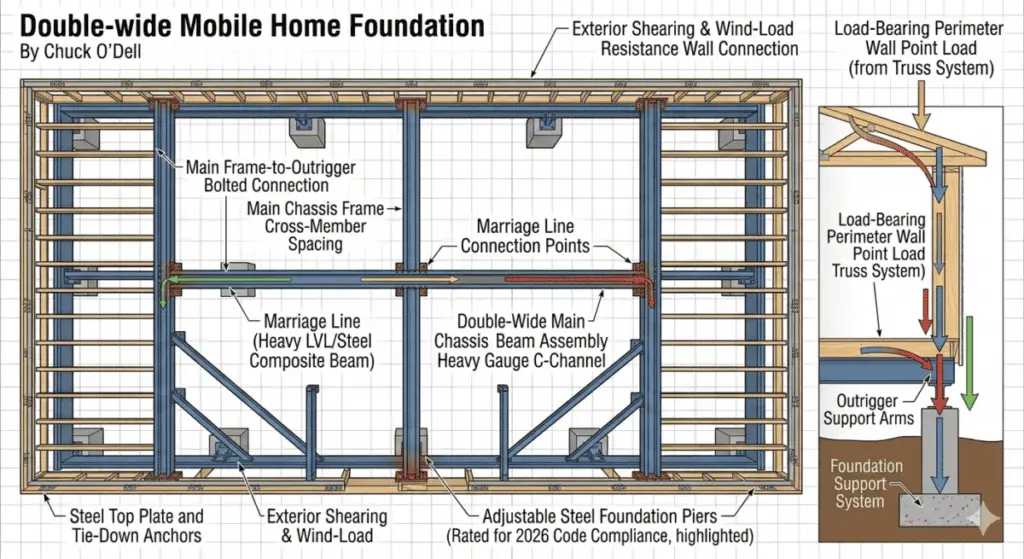
In a double-wide, the “Marriage Line” is where the two steel frames are bolted together. This is the strongest point of the house. Most interior walls run perpendicular to the marriage line. If you find a wall that has double studs or a built-up post, that is a “point load.” Removing that without calculating the PSI (pounds per square inch) transferred to the I-beam is a recipe for a collapsed roof. In 2026, we use Engineered LVL beams to bridge these gaps, ensuring the structural logic of the home remains intact even with an open floor plan.
| 2026 Wall Removal Cost Transparency Table | ||
|---|---|---|
| Task Component | Labor Cost (Professional) | Material Cost (DIY) |
| Non-Load Bearing Demo | $450 – $800 | $75 (Dump Fees) |
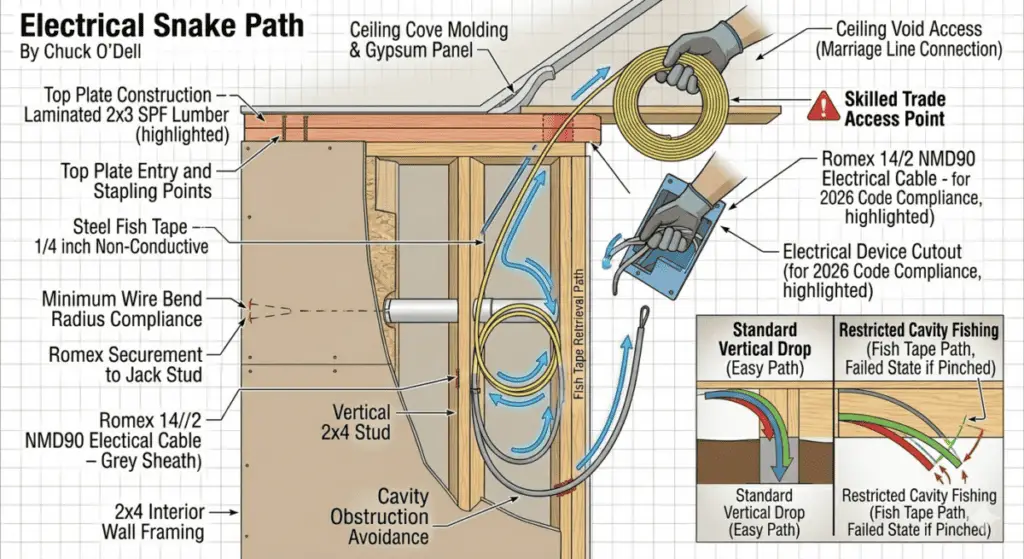
| Electrical Re-routing | $300 – $600 | $120 (Romex/Boxes) |
| Structural Header (10ft) | $1,200 – $2,500 | $350 (LVL/Hardware) |
| Drywall/Texturing Finish | $600 – $1,100 | $200 (Mud/Tape) |
| Recommended Structural Tools (2026) | ||
|---|---|---|
| Product | Why I Use It | Estimated Price |
| DeWalt 20V Reciprocating Saw | Essential for clean stud cuts and nail shearing. | $159.00 |
| Zircon m40 Wall Scanner | Finds metal/wood studs and live AC wiring before demo. | $55.00 |
Step-By-Step Repair Logic: Removing the Wall
If you have confirmed the wall is not holding up the sky, follow these steps. Do not skip the “exploration” phase. I have found dead squirrels, 1970s newspapers, and active 240V lines behind these walls. Be careful.
- Step 1: Shut off the Power. Locate your breaker panel and kill the circuits to the wall. Use a non-contact voltage tester to verify no juice is flowing through any outlets or switches.
- Step 2: Remove Trim and Molding. Use a flat bar to gently pry away the ceiling cove molding and floor baseboards. If they are real wood, save them. If they are wrapped MDF, throw them away; they break if you look at them funny.
- Step 3: The “Peep Hole” Investigation. Cut a small 6-inch square in the wallboard. Use a flashlight to check for plumbing vents or electrical wires. In mobile homes, plumbing vents often go through interior walls to reach the roof.
- Step 4: Skin the Wall. Remove the wall panels (VOG or Drywall) one side at a time. This allows you to see the framing logic. In most manufactured homes, the studs are stapled, not screwed.
- Step 5: Cut the Studs. Use your reciprocating saw to cut the studs at the midpoint. This creates “leverage” to pull them out of the top and bottom plates without damaging the ceiling.
- Step 6: Remove the Plates. The top plate is likely stapled to the roof trusses. Be gentle here. If you rip it out too fast, you will tear the ceiling gypsum, which is a nightmare to repair.
- Step 7: Address the Floor Gap. There will be a gap in the subfloor or carpet. Use **3/4 inch Plywood** to patch any subfloor holes, ensuring the patch sits on a joist.
Tax/Legal Deep Dive: IRS Compliance and 2026 Disclosure Law
Listen, the IRS cares about your wall. Under the IRS Tangible Property Regulations, removing a wall can be classified as either a “Repair” (fully deductible in year one) or an “Improvement” (capitalized over 27.5 years). If you are removing a wall because of rot, it’s a Restoration. If you are doing it to “open up” the space, it’s a Betterment.
In 2026, many states have updated Mobile Home Disclosure Laws. If you remove a load-bearing wall without a HUD-certified engineer’s stamp, you are legally required to disclose this “unpermitted structural modification” when you sell the home. If the buyer’s inspector sees a sagging roofline and you didn’t disclose the wall removal, you are looking at a lawsuit for triple damages in some jurisdictions. Always keep your receipts and, if in doubt, spend the $500 for a local engineer to sign off on your header design.
Furthermore, in 2026, Title 24 and similar energy codes in states like California and Florida require that any wall removal that affects the thermal envelope (like moving an exterior-facing wall) must be accompanied by an insulation audit. Don’t let a $500 DIY job turn into a $5,000 legal headache because you ignored the Disclosure Law.
| 2026 Regional Labor Rate Variations | ||
|---|---|---|
| Region | Hourly Rate (Specialist) | Permit Fees (Avg) |
| Southeast (FL/GA/SC) | $65 – $95 | $150 |
| West Coast (CA/OR/WA) | $110 – $165 | $450 |
| Midwest (OH/IN/MI) | $55 – $85 | $100 |
| Fastener Comparison for Structural Headers | ||
|---|---|---|
| Item | Best For | Strength Rating |
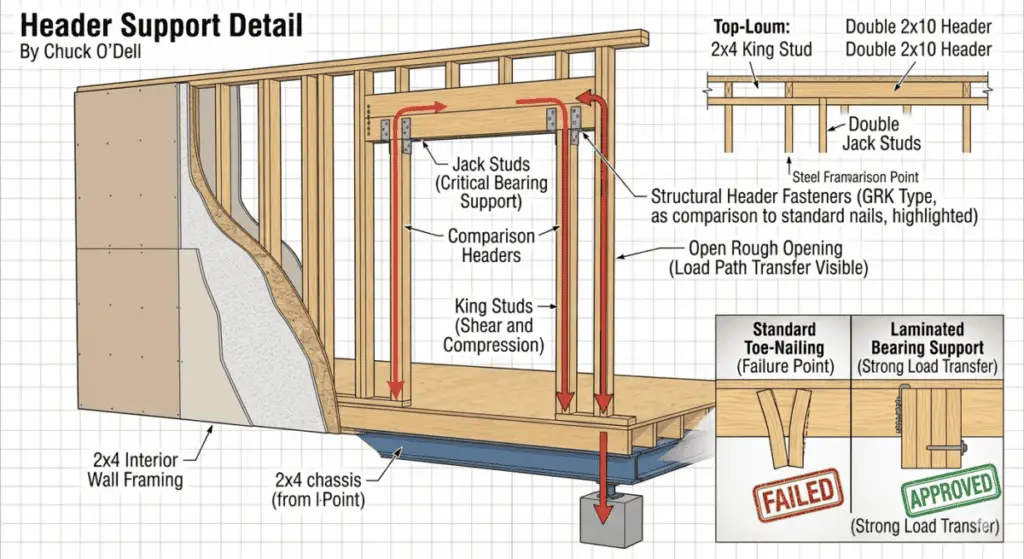
| GRK Structural Screws | Connecting LVL to King Studs | Ultra-High |
| 3-inch Common Nails | General non-load bearing studs | Standard |
ROI/NPV Deep Dive: The Math of Structural Equity
Does removing a wall actually make you money? We look at the Net Present Value (NPV) of the renovation. If you spend $4,000 to remove a wall and install a header, you need to see a corresponding increase in the Exit Cap Rate or the appraised value. In the 2026 market, “Open Concept” adds roughly 8% to 12% to the resale value of a double-wide, but 0% to a single-wide if the bedroom count decreases.
The math is simple: If your mobile home is worth $80,000, a structural wall removal that costs $4,000 must increase the value to at least $85,000 just to break even on your time and risk. However, the real “invisible” ROI is in Structural Integrity. A home with a sagging roof due to a poorly removed wall will see its value drop by 30% to 50% because it becomes “unfinanceable” for FHA or VA loans. In 2026, lenders are scrutinizing Foundation and Structural Certifications more than ever. If you can’t get a structural engineer to sign off, you can’t sell to a buyer using a mortgage. That limits you to cash buyers, who will lowball you every time.
We use the Modulus of Elasticity calculations to ensure that our new header doesn’t just “hold” the roof, but prevents creep (the slow sagging over years). By using a slightly oversized LVL beam, we ensure the NPV of the home stays positive for the next 20 years. Structural logic isn’t just about safety; it’s about protecting your biggest investment from the physics of gravity and the reality of the market.
2026 Actionable Checklist: Before You Swing the Hammer
- Check the Marriage Line: Is the wall supporting the seam where the two halves of a double-wide meet? If yes, stop. You need an engineer.
- Inspect the Ceiling: Do the ceiling panels change direction at the wall? This often indicates a change in truss direction and a load-bearing point.
- Verify the Foundation: Is there a pier directly under the wall? If so, that pier is there to transfer a point load to the ground. That wall is load-bearing.
- Magnet Test: Use a strong magnet to see if the wall contains a steel support column. Some modern homes use hidden steel posts.
- Review the 2026 HUD Data Plate: Check the wind zone and snow load rating. High-load zones require more interior shear walls.
Internal Resources
- Understanding Mobile Home Structural Logic
- 2026 Foundation Leveling & Pier Adjustment Guide
- Top 5 Renovations That Actually Increase Mobile Home ROI
Summary
Removing a wall in your mobile home is a great way to modernize a cramped space, but it is not a “weekend warrior” project to be taken lightly. By understanding the engineering physics of your chassis and the legal requirements of the 2026 housing market, you can avoid the “sagging ceiling” trap. Stick to the data, respect the load-bearing marriage line, and always use high-quality materials like Plywood over particle board. Your home—and your wallet—will thank you.
Bio: Chuck O’Dell is the founder of MobileHomeFriend.com and a veteran in the manufactured housing industry. With decades of hands-on experience in mobile home repair, leveling, and site management, Chuck provides first-principles logic to help homeowners save money and avoid common industry pitfalls. His mission is to provide transparency in a market often clouded by high costs and complex regulations.
Chuck O’Dell has personally supervised over 100 mobile home structural remodels since 2003.