
Table of Contents
Introduction
If you are looking at a mobile home built between 1978 and 1995, stop looking at the kitchen cabinets and start looking under the sink. If you see gray pipe, you don’t have a plumbing system. You have a ticking time bomb.
I’ve flipped over 100 mobile homes in the last 20 years. I have crawled through mud, insulation, and things I’d rather not identify to fix plumbing disasters that could have been avoided with a simple five-minute inspection. Plumbing is the vascular system of your mobile home. When it fails, it rots your floors, ruins your insulation, and drains your wallet faster than a casino slot machine.
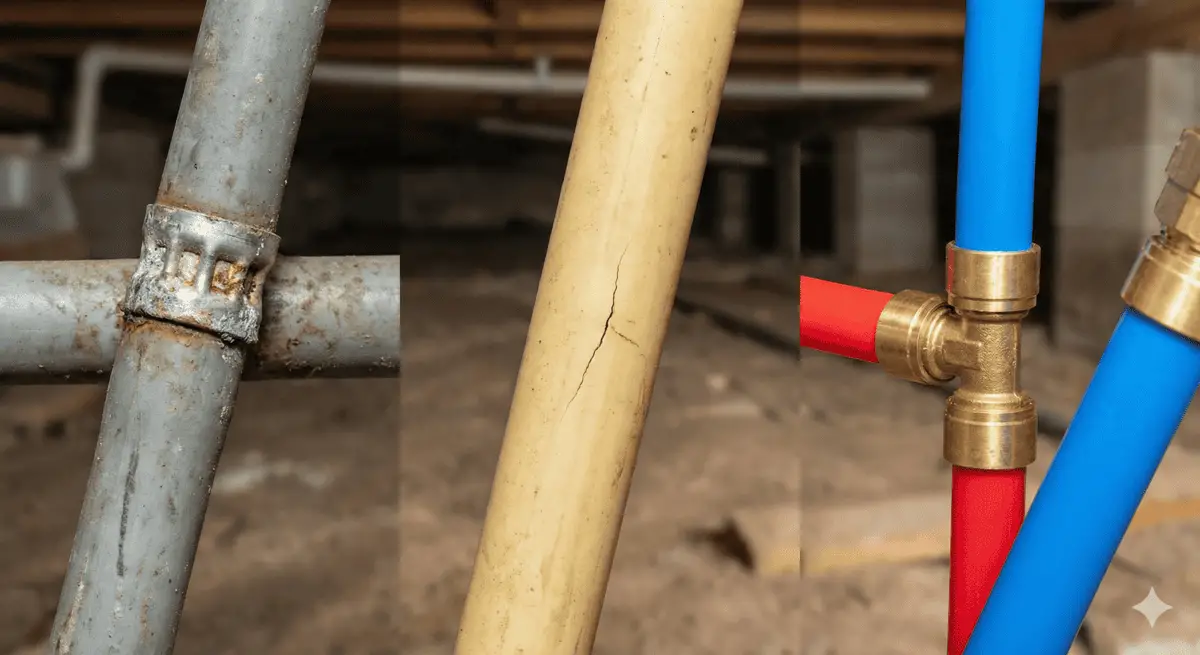
You need to know exactly what material was used during the year your home was manufactured. This guide is the culmination of two decades of tearing out bad pipe. We are going to look at the “Gray Ghost” (Polybutylene), the brittle “Middle Child” (CPVC), and the modern “Gold Standard” (PEX).
Video Guide Overview
Affiliate Disclosure
I am an affiliate for some of the products listed below. If you buy through my links, I may earn a commission at no extra cost to you. I only recommend tools and materials I have personally used on my own flips. If it breaks on the job site, it doesn’t make this list.
The “Short” Answer: Your Plumbing Timeline Cheat Sheet
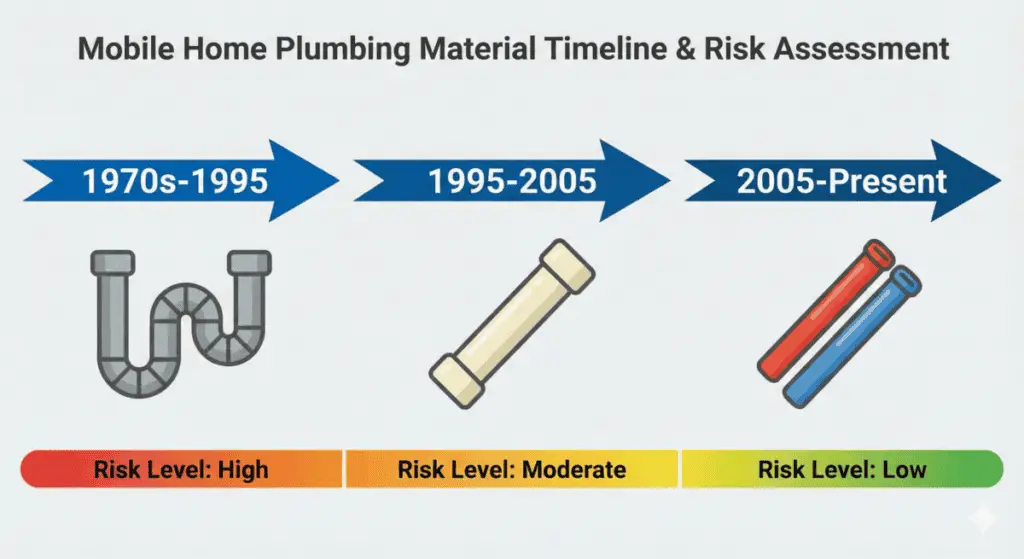
If you are standing in a mobile home right now and need a quick answer, check the HUD plate (data plate) for the year of manufacture and consult this list.
- 1978 – 1995: Polybutylene (The Danger Zone). Gray plastic pipe. Highly prone to failure from chlorine degradation. Verdict: Replace immediately.
- 1996 – 2005: Mixed Bag (CPVC / Early PEX / Leftover Poly). Mostly CPVC (cream/yellowish plastic) or white PEX. Caution: Some 1996 models still used leftover Polybutylene stock. Verdict: Inspect connections closely.
- 2005 – Present: PEX (The Standard). Red (hot) and Blue (cold) flexible tubing. Frost resistant and durable. Verdict: Safe.
Deep Dive: The Gray Ghost (Polybutylene)
Years: 1978 – 1995
Polybutylene is the asbestos of the plumbing world. It was hailed as a miracle material in the late 70s because it was cheap and easy to install compared to copper. Manufacturers loved it. The problem? It couldn’t handle the real world.
The Failure Mechanism:
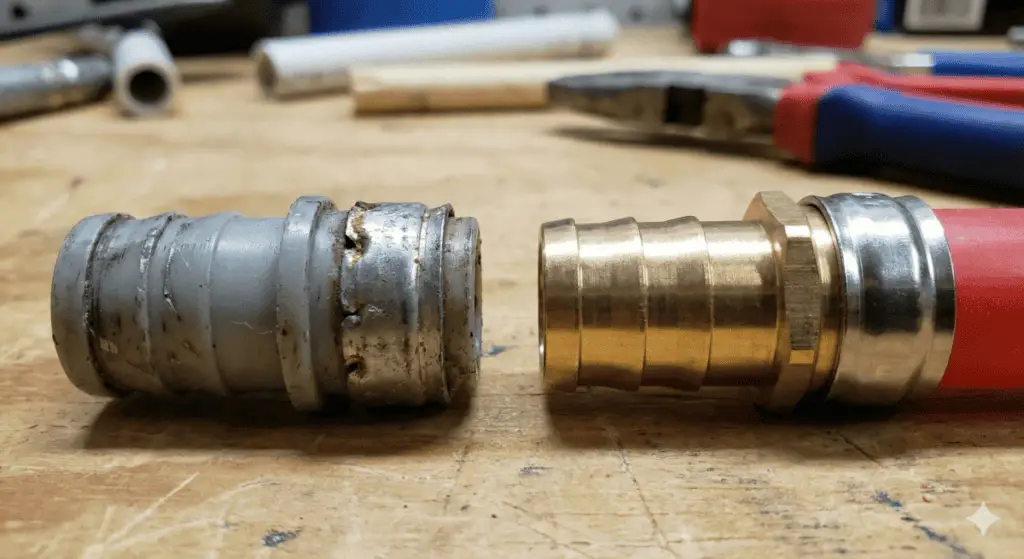
Polybutylene reacts with water-soluble oxidants (like chlorine, which is in almost all municipal water). Over time, the chlorine eats away the chemical bonds inside the plastic, making it flaky and brittle from the inside out. You might look at a pipe and think it looks fine, but the interior wall is deteriorating. Eventually, it cracks under pressure.
How to Identify It:
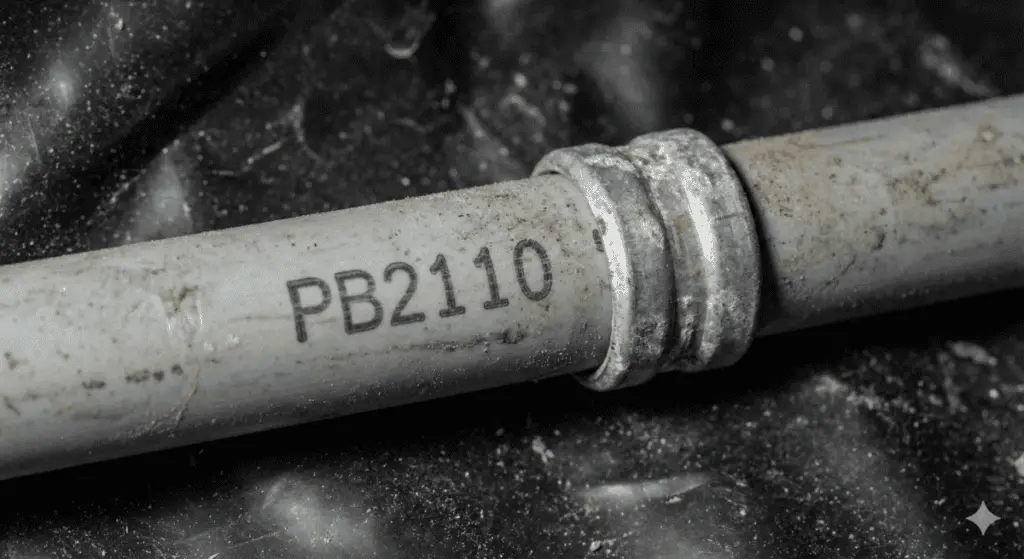
Look for a matte gray pipe, usually 1/2″ or 3/4″ diameter. It will be stamped with codes like “PB2110”.
Pro Tip: Check the crimp rings. Aluminum crimp rings were common on early Poly and they are notorious for leaking. Later installations used copper rings, which are slightly better but don’t solve the rotting pipe issue.
The Shell Oil Lawsuit:
This isn’t just my opinion. There was a massive class-action lawsuit (Cox vs. Shell Oil) that resulted in a billion-dollar payout. That money is long gone, but the pipes remain in millions of homes. If you buy a 1985 single-wide today, you are buying that liability.
The Brittle Middle Child (CPVC)
Years: 1990s – Early 2000s
When Polybutylene started getting sued into oblivion, manufacturers switched to CPVC (Chlorinated Polyvinyl Chloride). It’s the cream-colored, rigid plastic pipe you often see in site-built homes.
The Problem with CPVC in Mobile Homes:
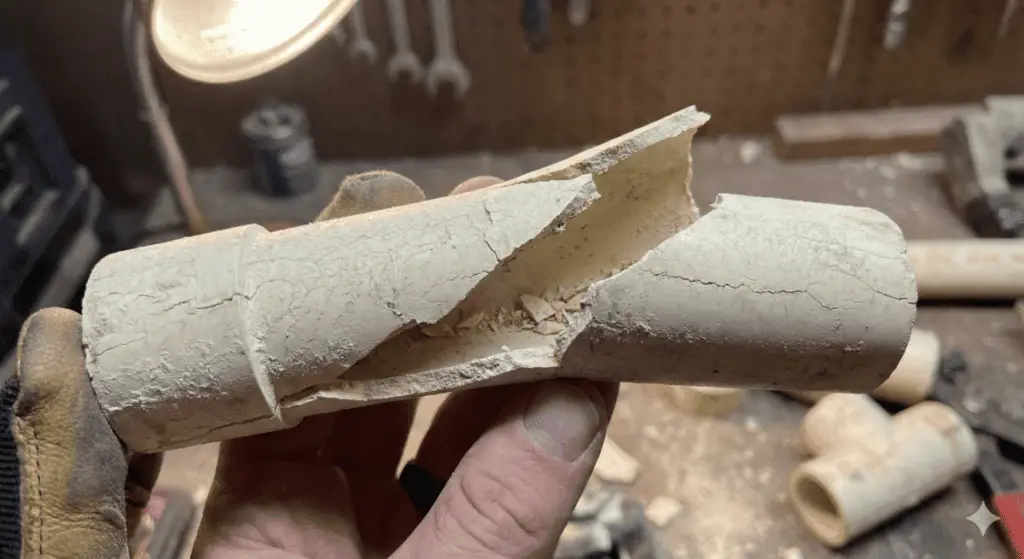
Mobile homes move. They settle, they shift, and they vibrate during transport. CPVC is rigid. It does not like to move. Over time, CPVC becomes extremely brittle. I have been under a 1998 double-wide where I simply bumped a CPVC water line with my shoulder and it snapped clean off, spraying water into my face.
If you have CPVC, you don’t necessarily need to rip it all out immediately like Polybutylene, but you need to be careful. Do not stress the pipes when making repairs. If you are freezing in winter, CPVC will shatter while PEX will expand.
The Gold Standard (PEX)
Years: 2000s – Present
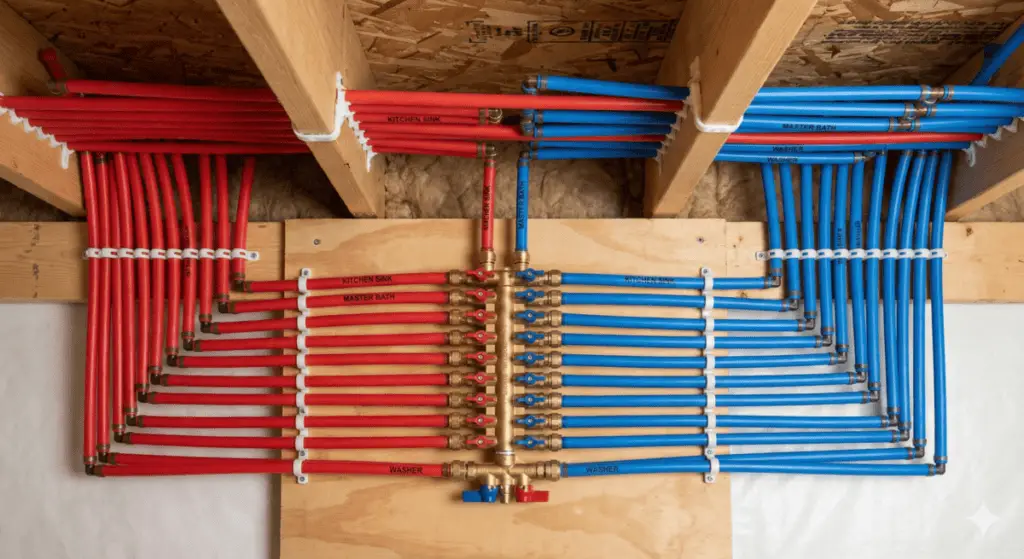
PEX (Cross-linked Polyethylene) is the best thing to happen to mobile home plumbing. Period. It is flexible, durable, and color-coded (Red for hot, Blue for cold). If you are replumbing a mobile home in 2026, you are using PEX.
Why PEX Wins:
- Freeze Resistance: PEX can expand up to 15% of its diameter before bursting. In a mobile home with a vented crawl space, this is a lifesaver during a hard freeze.
- Fewer Joints: You can run a single line of PEX from the manifold to the faucet. Fewer joints mean fewer places to leak.
- Cost: It is significantly cheaper than copper and easier to install than rigid PVC.
Types of PEX:
You will see PEX-A, PEX-B, and PEX-C. For most mobile home owners, PEX-B is the sweet spot of cost and performance. It uses the standard crimp rings you can buy at any hardware store.
Cost Transparency: Replumbing Estimates (2026)
So, you found the gray pipe. How much is this going to hurt? Prices have risen, but labor remains the biggest variable. Here is what you can expect to pay in 2026 to replumb a standard 14×70 single-wide mobile home.
| Expense Category | DIY Cost (Materials Only) | Pro Contractor Cost |
|---|---|---|
| PEX Tubing (Hot/Cold) | $300 – $450 | Included in labor bid |
| Fittings & Manifolds | $250 – $400 | Included in labor bid |
| Tools (Crimper/Cutter) | $80 – $120 | N/A |
| Labor | $0 (Just your sweat) | $2,500 – $5,000+ |
| TOTAL ESTIMATE | $630 – $970 | $3,500 – $6,000+ |
Note: These prices assume accessible plumbing (under the home). If your plumbing runs through the ceiling or walls (rare in older units but possible), double the labor cost.
Chuck’s Essential Tool Kit
You cannot do this job with a pair of pliers and hope. You need the right tools. These are the exact items I keep in my truck for plumbing jobs.
| Product | Why I Use It | Get It Here |
|---|---|---|
| iCrimp PEX Clamp Tool | Forget the huge bolt-cutter style crimpers. This one is compact, works in tight crawl spaces, and handles the stainless steel cinch clamps which are far more forgiving than copper rings. | Check Price |
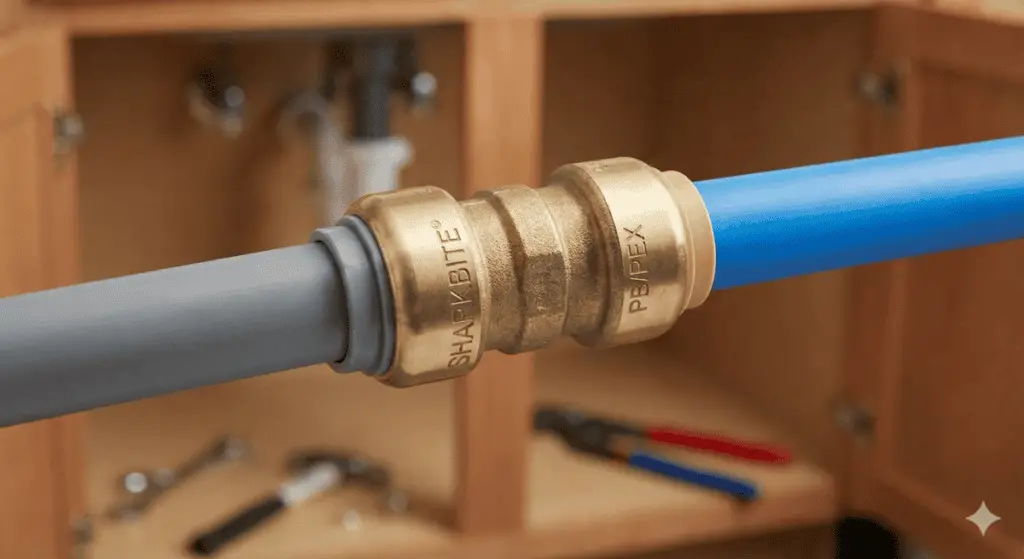
| SharkBite Deburring & Depth Tool | If you are using push-to-connect fittings for emergency repairs, you must deburr the pipe. This cheap plastic tool prevents you from slicing the O-ring and causing a slow leak inside your wall. | Check Price |
| Govee WiFi Water Leak Detector | After a replumb, I leave these under the sinks and water heater. If a fitting drips, my phone buzzes immediately. It’s cheap insurance against a rotten subfloor. | Check Price |
Actionable Checklist: Evaluate Your Plumbing Now
Don’t wait for a flood. Go do this right now.
- Locate the Water Heater: This is the easiest place to see exposed pipe. Is it gray? Cream? Red/Blue?
- Check the Fittings: If you see gray pipe, look at the joints. Are they plastic or metal? (Plastic fittings on Polybutylene are the #1 failure point).
- The “Flex” Test: If you have cream-colored pipe (CPVC), gently tap it. Does it feel solid or brittle? Do not bend it.
- Inspect the Underbelly: If your mobile home skirting is loose, peek underneath. Look for sagging belly board (insulation barrier). A sagging belly usually means a water leak has filled the insulation with water.
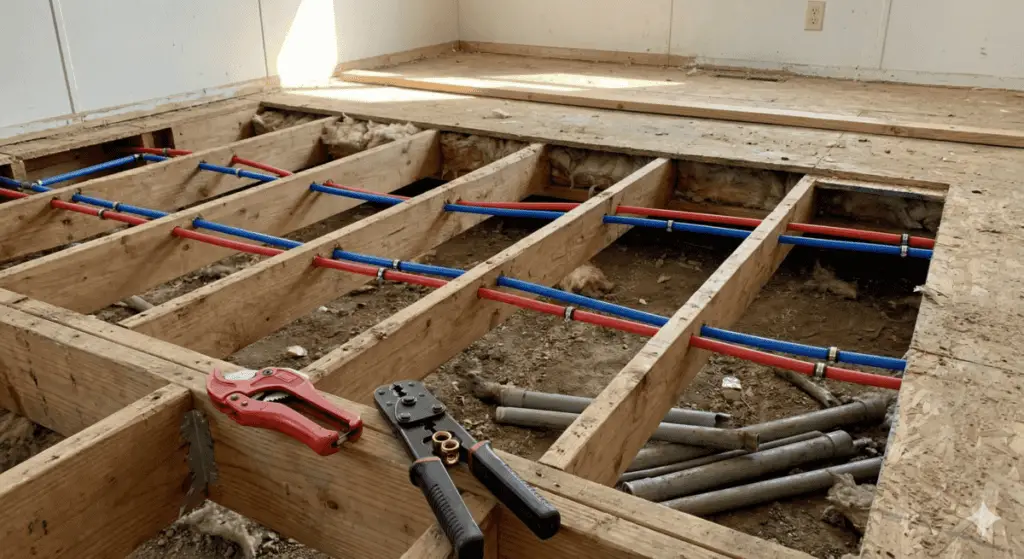
- Plan the Swap: If you found Polybutylene, start saving $100 a month specifically for a PEX replumb. It’s not “if” it breaks, it’s “when.”
Internal Resources
Plumbing is just one part of the beast. If your plumbing has already leaked, you probably have floor damage. And if your home isn’t level, your drains won’t flow right anyway.
- Floors Soft? Read my Complete Guide to Subfloor Repair and Replacement.
- Drains Backing Up? It might not be a clog. Check out How to Level a Mobile Home Yourself.
- Keep Pipes from Freezing: Learn about Mobile Home Skirting Options to Insulate Your Plumbing.
Summary
Mobile home plumbing isn’t a mystery; it’s a history lesson. If your home was built between 1978 and 1995, you are living on borrowed time with Polybutylene. If it’s a late 90s model, treat that CPVC like glass. And if you are lucky enough to have PEX, buy yourself a beer and relax.
The best investment you can make is replacing old gray pipe with PEX before it fails. It increases the resale value of your home and lets you sleep at night without listening for the sound of dripping water.
About Chuck O’Dell
Chuck O’Dell is a real estate investor and mobile home expert based in Arizona. With over 20 years of experience and 100+ mobile home flips under his belt, Chuck specializes in high-ROI renovations and solving the unique structural challenges of manufactured housing. He believes in doing the job once and doing it right.
With over two decades of experience remodeling vintage mobile homes, Chuck O’Dell has personally replaced thousands of feet of failing Polybutylene and brittle CPVC with modern, durable PEX systems.