
By Chuck O’Dell
Owner, MobileHomeFriend.com
Table of Contents
Introduction
I have bought, renovated, and sold over 100 mobile homes in the last 20 years. I have seen every type of disaster you can imagine. I have seen roofs peeled back like sardine cans. I have seen floors rot out from undetected leaks. I have seen fires level a single-wide in fifteen minutes flat.
But the biggest disaster I usually see happens after the smoke clears. It happens when the owner calls their insurance agent and finds out the policy they have been paying for does not cover the damage they are staring at.
Mobile home insurance is not the same as standard stick-built homeowner’s insurance. The risks are different. The construction is different. And the fine print is different. If you own a mobile home or invest in them like I do, you need to understand exactly what protections you are buying and, more importantly, which ones you are missing.
Video Guide Overview
Affiliate Disclosure
MobileHomeFriend.com is a participant in the Amazon Services LLC Associates Program. As an Amazon Associate, we earn from qualifying purchases. This comes at no extra cost to you and helps us keep the lights on.
The “Short” Answer
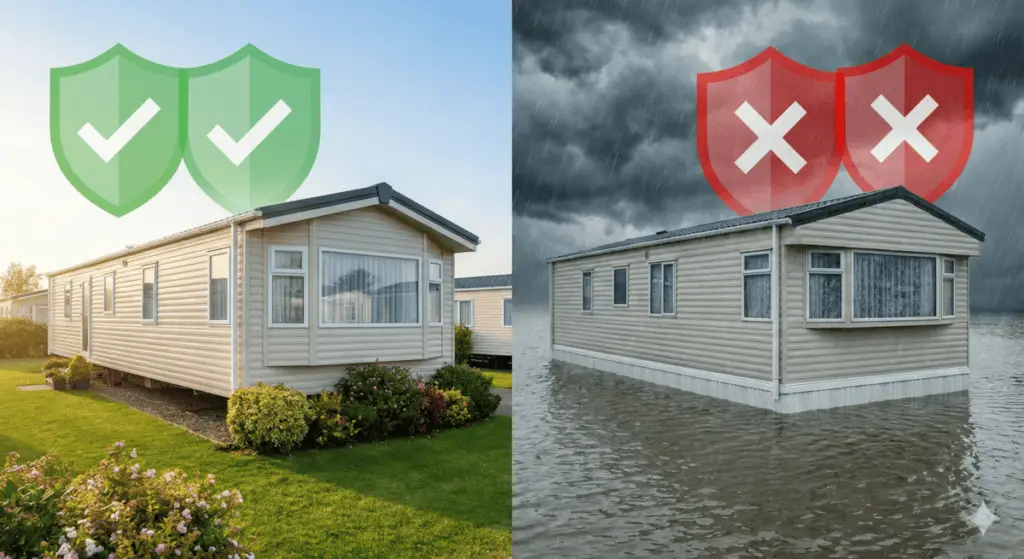
Standard mobile home insurance (often called a Manufactured Home policy) covers sudden and accidental physical damage. This includes fire, wind, hail, vandalism, and falling objects (like trees). It also includes liability protection if someone gets hurt on your property.
It almost never covers flooding (water rising from the ground), earthquakes, wear and tear, or damage that occurs while moving the mobile home. Perhaps the most critical distinction for older homes is whether you have Replacement Cost coverage (pays for new materials) or Actual Cash Value (pays only the depreciated value). If you have a 1995 single-wide with an ACV policy, a total loss might only net you a check for $5,000.
Deep Dive: The Core Protections
When you buy a policy, you are generally looking at a package that includes four main buckets. I review these every single time I close on a new park model or double-wide.
1. Dwelling Coverage
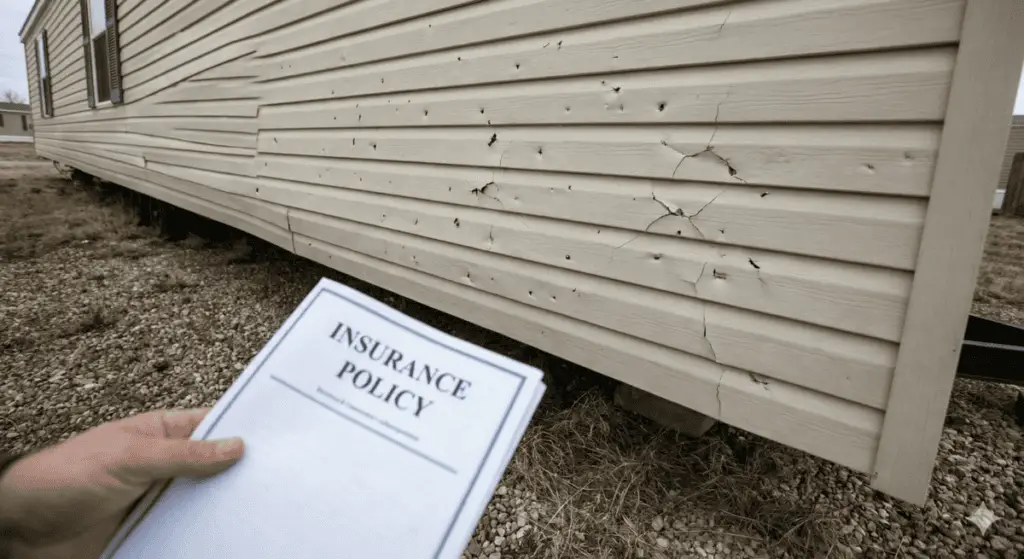
This is the structure itself. It covers the roof, the walls, the floor, and built-in appliances like the water heater or furnace. If a tornado rips the siding off, Dwelling Coverage pays to fix it. Be aware that for mobile homes, “attached structures” like carports, decks, and awnings are sometimes grouped here, but often have lower limits. You must verify that your specific carport is listed on the policy.
2. Other Structures
This covers unattached structures. If you have a shed, a detached garage, or a fence, this is where that coverage lives. In my experience, standard policies offer very low limits here, sometimes only 10% of the dwelling coverage. If you have a $50,000 shop next to a $20,000 mobile home, you likely need a specific endorsement to cover that shop.
3. Personal Property
This covers your stuff. Clothes, electronics, furniture. If your home burns down, this pays to replace your sofa. A critical detail here is that high-value items like guns, jewelry, or cash usually have strict caps (e.g., $1,000 total) unless you schedule them separately.
4. Liability
This is the lawsuit shield. If a delivery driver trips over a loose step on your porch and sues you for medical bills, this kicks in. For investors renting out homes, this is non-negotiable coverage.
The “Big Three” Exclusions
This is where I see people lose money. These three perils are almost always excluded from standard mobile home policies.

1. Flood Damage
Do not confuse “water damage” with “flood damage.” If a pipe bursts under your kitchen sink, that is water damage. It is usually covered. If a creek rises and water enters your home from the outside, that is a flood. It is not covered.
Mobile homes are often placed in low-lying areas or parks with poor drainage. You must buy a separate flood insurance policy (usually through FEMA’s National Flood Insurance Program) if you want protection from rising water.
2. Earth Movement
This includes earthquakes, but more importantly for us, it includes settling. Mobile homes sit on piers. Over time, the ground shifts. The piers sink. The home goes out of level. This causes cracks in the drywall, doors that won’t close, and roof leaks.
Insurance will not pay to re-level your home. They view this as maintenance. If your home being unlevel causes the roof to crack and leak, they might deny the leak claim too, citing negligence.
3. Transit / Trip Collision
Moving a mobile home is risky. It is essentially a mild earthquake that lasts for three hours. Standard policies stop covering the home the moment it is lifted off the blocks.
If you are moving a home, you need “Trip Collision” coverage. This is a temporary endorsement that covers the unit while it is on the road. Without it, if the driver flips the rig on the highway, you get zero dollars.
The Depreciation Trap: ACV vs. Replacement Cost
This is the single most important financial detail in your policy. You have two ways to insure the value of the home.
Actual Cash Value (ACV)
ACV pays you what the home is worth today, not what it costs to build it. Mobile homes depreciate. If you bought a home in 2000 for $40,000, its “book value” might only be $10,000 today.
If you have an ACV policy and that home burns down, the insurance company writes you a check for $10,000 (minus your deductible). You cannot buy a new home for that. You probably cannot even clean up the debris for that.
Replacement Cost Value (RCV)
RCV pays what it costs to buy new materials and labor to repair or replace the home, regardless of depreciation. If it costs $60,000 to replace that burned-down 2000 model with a comparable new unit, RCV pays $60,000.
The Catch: Insurance companies hate writing RCV policies for mobile homes older than 15 or 20 years. If you can get RCV, take it. It is worth the higher premium.
2026 Cost Transparency Table
Insurance rates have climbed aggressively since 2024. Based on current market trends and the 8% to 10% projected hikes for 2026, here is what you can expect to pay annually. These numbers assume a standard single-wide or double-wide in average condition.
| Region / Risk Level | 1976-1999 Model (ACV) | 2000-2026 Model (RCV) | Notes |
|---|---|---|---|
| Low Risk (e.g., Ohio, Wisconsin) | $600 – $900 | $900 – $1,300 | Wind/Hail deductibles are rising. |
| Medium Risk (e.g., Arizona, Tennessee) | $900 – $1,300 | $1,400 – $1,900 | Expect higher rates for rural areas (fire risk). |
| High Risk (e.g., Florida, Texas, Louisiana) | $1,600 – $2,800+ | $2,500 – $4,500+ | Many carriers are pulling out; coverage is hard to find. |
Tools to Lower Your Risk (And Premiums)
Insurers like proactive owners. Installing safety devices can sometimes lower your premiums, but more importantly, they prevent the claim from happening in the first place. These are three products I use in my own rentals.
| Product | Why I Use It | Est. Cost |
|---|---|---|
| Govee WiFi Water Leak Detectors | Water damage is the #1 claim. These sensors scream at you and send a phone alert the second a pipe drips or a water heater fails. Essential for particle-board floors. | Check Price |
| Ring Spotlight Cam Pro (Battery) | Vandalism and theft are common in vacant flips. This camera has built-in lights and sirens. It needs no wiring, which is perfect for older mobile homes with questionable electric. | Check Price |
| Tie Down Engineering Strap Gauge | Loose tie-downs mean lost coverage. This simple tool lets you check the tension on your anchors to ensure you are ready for wind season. | Check Price |
Actionable Checklist
Do not wait for a disaster to check your paperwork. Do this today:
- Verify the Data Plate: Find your HUD data plate inside the home. Take a picture. Your agent needs the exact serial number and HUD number to insure you correctly.
- Check for “ACV” Language: Look at your Declarations Page. If it says “Actual Cash Value,” ask your agent for a quote on “Replacement Cost.”
- Inventory High-Value Items: Walk through your home with your phone and record a video of every room. Open drawers and closets. Save this video to the cloud.
- Certify Tie-Downs: If you are in a wind zone (like Florida), get a fresh engineering certification for your tie-downs. Some insurers require this every few years.
- Inspect Skirting: Ensure skirting is vented but secure. Animals getting under the home cause damage that is rarely covered.
Internal Resources
For more details on maintaining your investment and staying compliant, check out these guides on MobileHomeFriend.com:
- HUD Compliance: Identifying the Data Plate
- Re-Leveling Your Mobile Home: DIY vs Pro
- Skirting Options That Last
Summary
Mobile home insurance is a tool, not a magic wand. It works best when you understand its limits. Remember that the age of your home determines your payout (ACV vs RCV), and your location determines your premiums. Do not assume flood or movement is covered. It almost never is. Be proactive, keep your tie-downs tight, and document everything.
About the Author: Chuck O’Dell
Chuck O’Dell is a real estate investor with over 20 years of experience specializing in mobile and manufactured homes. He has flipped over 100 properties, navigating the complex regulations of HUD codes, park approvals, and insurance requirements. Through MobileHomeFriend.com, he shares no-nonsense advice to help homeowners and investors avoid costly mistakes.
With decades of hands-on experience renovating and investing in mobile homes, Chuck O’Dell breaks down the fine print of insurance policies to help you avoid costly coverage gaps.