
Table of Contents
Introduction: The 1996 Phoenix Thermal Crisis
I have spent 20 years flipping over 100 properties. I have seen every shortcut, every “builder-grade” disaster, and every failed “budget” solution that homeowners regret five years later. If you own a home in Phoenix built around 1996, you are at a critical junction. The original aluminum-framed, double-paned windows installed during that era were designed for a fifteen-year lifespan at best. They were installed during a massive housing boom where speed and cost-reduction were the primary drivers. By now, those windows are not just inefficient; they are actively degrading your quality of life.
You are likely experiencing the classic symptoms: “failing” seals that have turned your view into a foggy haze, weather stripping that has disintegrated into dust, and frames that allow the Sonoran heat to radiate into your home like a space heater. You are about to make a massive financial commitment. This is not the time for a “sales brochure” overview. This is the time for a deep-dive into material science and structural engineering. I am going to explain exactly why Marvin Infinity windows—made from Ultrex pultruded fiberglass—are the only logical choice for a permanent, high-ROI upgrade in the Arizona desert.
Video Guide Overview
Affiliate Disclosure
I believe in total transparency. This guide contains affiliate links to professional-grade tools and maintenance products that I personally use on my job sites. If you purchase through these links, I may receive a small commission at no extra cost to you. I only recommend products that meet my strict standards for durability and performance in the high-UV environment of the Southwest.
The “Short” Answer: The Physics of Thermal Expansion
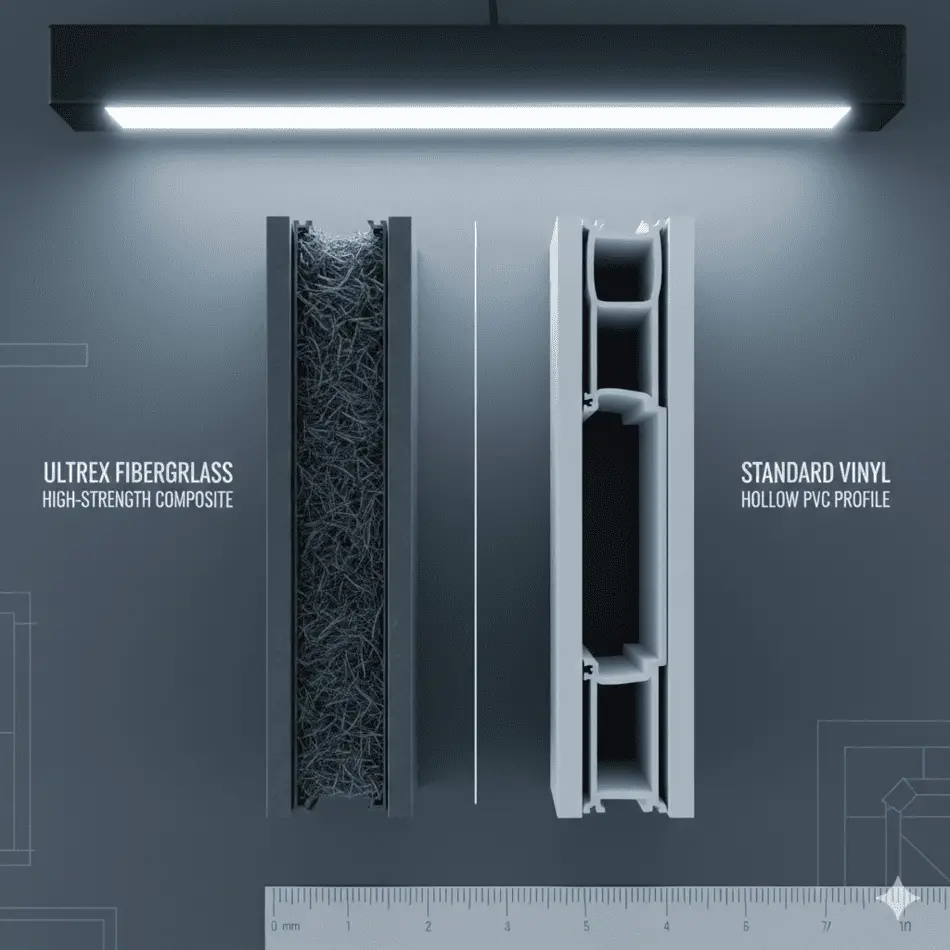
In the Phoenix climate, the single biggest enemy of your windows is not just the heat, but the expansion and contraction cycles. Every day, your windows endure a temperature swing that can exceed 60 degrees. Most windows fail because the frame material and the glass expand at different rates. Vinyl (PVC) expands at a rate 7 times greater than glass. This constant “tug-of-war” shears the seals of your Insulated Glass Unit (IGU) and warps the frame. Ultrex fiberglass expands at virtually the same rate as glass. Because they move as one unit, the seals stay tight, the frame stays square, and the window operates smoothly for decades. It is a solution dictated by physics, not marketing.
The War of Materials: Why Vinyl Fails in Arizona
If you have talked to window contractors, you have heard the pitch for “Premium Vinyl.” In many parts of the country, vinyl is a fine product. In Phoenix, it is a liability. To understand why, we have to look at the molecular differences between Thermoplastics and Thermosets.
1. Thermoplastic vs. Thermoset Physics
Vinyl is a thermoplastic. This means it is a material that can be melted and reshaped repeatedly. When a vinyl window is manufactured, it is “extruded” through a die. Because it is a thermoplastic, it remains sensitive to heat throughout its life. On a 115-degree Phoenix afternoon, a dark-colored vinyl window frame can reach surface temperatures of 165 degrees or higher. At these temperatures, the vinyl begins to soften and lose its structural “memory.”
Ultrex is a thermoset material. During the pultrusion process, the resin undergoes a chemical reaction that creates cross-linked molecular bonds. Once it is cured, it is “set” forever. It cannot be melted or reshaped. It can withstand temperatures up to 285 degrees Fahrenheit without any loss of structural integrity. While a vinyl frame is bowing and “smiling” under the weight of the glass in the Arizona sun, Ultrex remains as rigid as the day it was installed.
2. Tensile Strength and Frame “Smiling”
Strength matters because modern windows are heavy. High-performance, double-paned glass with Low-E coatings and Argon gas is significantly heavier than the single-pane glass of the past. Ultrex is 8 times stronger than vinyl. This high strength-to-weight ratio allows Marvin to build frames with narrower profiles, giving you more glass area and a cleaner aesthetic without sacrificing rigidity. When vinyl frames soften in the heat, the weight of the IGU causes the bottom rail to sag—a phenomenon known in the industry as “smiling.” This sag creates gaps in the weather stripping, allowing fine desert dust and noise to bypass the window entirely. Ultrex is so strong it is used in bridge construction; it will never sag under its own weight.
3. UV Degradation and Color Retention
The UV index in Phoenix is a constant chemical attack on building materials. Vinyl windows rely on chemical additives (stabilizers) to prevent the plastic from becoming brittle. Over time, these stabilizers “leach” out, leading to “chalking,” yellowing, and eventual cracking. Marvin Infinity windows feature a patented triple-layer bonded acrylic finish. This is not a paint job. It is a finish that is mechanically and chemically bonded to the fiberglass during the pultrusion process. It is up to three times thicker than competitive finishes and offers a diamond-hard resistance to the abrasive sand and silt of the Sonoran desert. You can choose dark colors—like Bronze or Ebony—without fear of the frame absorbing heat and warping, a feat vinyl simply cannot match.
The Build Process: Pultruded Engineering
Most windows are built using “extrusion,” which is a “push” technology. Marvin Infinity is built using pultrusion, which is a “pull” technology. This distinction is critical to the longevity of the product.
The Pultrusion Sequence
The process begins with thousands of high-density glass fibers. These fibers are pulled through a tensioning system and then submerged in a thermoset polyester resin bath. Once saturated, the fibers are pulled through a heated die where the chemical reaction (curing) occurs. Because the fibers are pulled under tension, they remain perfectly aligned and continuous throughout the entire length of the window profile. This alignment is what gives Ultrex its incredible modulus of elasticity. It essentially behaves like a structural steel beam made of glass.
Frame Construction and Mechanical Corner Blocking
The weak point of any window is the corner. In vinyl windows, the corners are “heat welded”—meaning the plastic is melted together. This creates a brittle joint that is the first thing to crack if your home experiences even minor settlement. Marvin Infinity uses a mechanical corner blocking system. Each corner of the frame and sash is reinforced with internal structural blocks and secured with stainless steel fasteners. This ensures that the window remains perfectly square for its entire life. A square window is a window that stays airtight. If the frame racks or twists, the locking mechanisms will bind, and the weather stripping will fail. The mechanical integrity of the Marvin frame is designed to outlast the home itself.
The Insulated Glass Unit (IGU): Your Thermal Shield
While the frame provides the structure, the glass provides the performance. For a Phoenix home, the glass is your primary defense against the radiant heat gain that drives your AC bills into the hundreds of dollars.
Low-E 3 Technology: The Silver Coating
Marvin Infinity windows are standard with Low-E 3 (specifically Low-E 366) glass. This technology uses three distinct layers of microscopic silver coating on the internal surface of the glass. These layers act like a “heat mirror.” They allow visible light to enter your home so you don’t feel like you’re living in a cave, but they reflect the long-wave infrared heat back to the outside. In a 1996 home, the glass absorbs that heat and radiates it into the room. With Low-E 3, the interior pane of glass stays cool to the touch even when the outside temperature is 110 degrees. This lowers your Solar Heat Gain Coefficient (SHGC) to levels that vinyl manufacturers struggle to reach.
Argon Gas and Thermal Breaks
The space between the two panes is filled with Argon gas, which is six times denser than air and provides significantly better insulation. However, a gas fill is only useful if it stays in the window. Because the Ultrex frame expands at the same rate as the glass, the primary seal of the IGU is never subjected to the shearing forces that cause gas leakage in vinyl windows. Furthermore, Marvin uses a warm-edge spacer made of a composite material, unlike the metal spacers found in older windows that ironically conducted heat around the edges of the glass. Every component of the Marvin IGU is a thermal break.

Mechanical Superiority: Engineering for Ease of Use
In many of the 100+ properties I’ve renovated, the most common complaint about old windows is that they are “stuck.” This is usually due to poor mechanical engineering and the buildup of desert silt.
Nickel Bearing Rollers
If you prefer sliding windows, Marvin Infinity uses precision-engineered nickel-bearing rollers. These are not simple plastic wheels. They are high-load bearings designed for silent, effortless operation. Most importantly, these bearings are “self-cleaning.” As you slide the window, the roller pushes dust and grit out of the way rather than grinding it into the track. Even a massive six-foot-wide slider can be operated with one finger, and it will continue to operate that way for decades.
The Weight and Pulley (Block and Tackle) System
For double-hung windows, vinyl manufacturers use “constant force” springs. These are essentially thin metal coils that lose their tension over time, leading to windows that won’t stay open or are impossible to close. Marvin utilizes a refined weight and pulley balance system. By using a system of pulleys and high-tension cords calibrated to the exact weight of the fiberglass sash, the window feels weightless. There is no spring to fail, and the operation remains consistent from the day of installation until the day you sell the house.
Installation: Why “Full-Frame” is Mandatory
This is where I often have to get direct with homeowners. Many contractors will try to sell you on a “Jump Frame” or “Insert” installation because it is faster and cheaper. In a Phoenix stucco home, a jump frame is a mistake. I do not recommend it.
The Failure of Jump Frames
A jump frame install involves leaving the old aluminum frame in your wall, cutting off the fins, and “jumping” a new window into the old hole. This reduces your glass area and, more importantly, it does nothing to fix the deteriorated water barrier of your 1996 home. The original flashing and sealant around your windows are likely cracked and failing. Putting a new window over a failed water barrier is like putting a new engine in a car with a rusted-out frame.
The Full-Frame Process and Stucco Integration
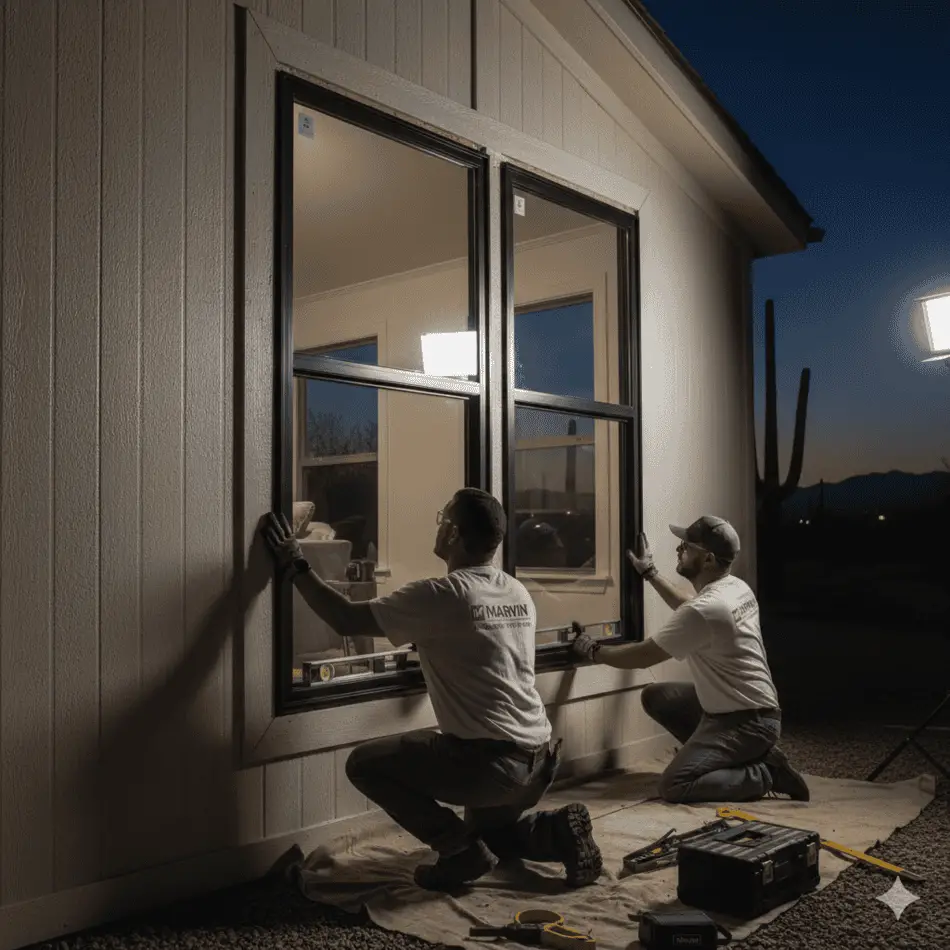
A professional Marvin Infinity installation is a Full-Frame Removal. This process involves:
- Stucco Cutting: We cut back the stucco 3 to 4 inches to expose the original nailing fin.
- Complete Extraction: The old aluminum window is removed entirely, down to the studs.
- Rough Opening Inspection: We check for dry rot or termite damage common in the Valley.
- Modern Flashing: We install a new, high-performance water management system, including sill pans and head flashing.
- Nailing Fin Integration: The new Marvin window is secured directly to the home’s structure via its integrated nailing fin.
- Three-Coat Stucco Repair: We perform a professional stucco patch and texture match.
This method ensures that the window is watertight, airtight, and structurally sound. It eliminates the dust leaks and whistling noises that plague “jump frame” installs. It is a more invasive process, but it is the only way to ensure the window performs as engineered.
2026 Phoenix Residential Window Cost Transparency
The following are 2026 estimates for a full-frame, high-performance installation of Marvin Infinity windows in the Phoenix metro area. These prices include labor, stucco repair, and disposal.
| Window/Door Configuration | Typical Dimensions | Estimated Cost (Installed) |
|---|---|---|
| Standard Horizontal Slider | 48″ x 48″ | $2,300 – $3,100 |
| Large Picture Window | 72″ x 60″ | $3,200 – $4,500 |
| Double-Hung (Premium Balance) | 32″ x 60″ | $2,600 – $3,500 |
| French Sliding Patio Door | 72″ x 80″ | $7,500 – $11,000 |
| Radius/Arched Window | Variable | $3,500 – $5,200 |
Recommended Affiliate Products for Long-Term Maintenance
Even a 30-year window needs basic maintenance to fight the Phoenix silt. These are the specific products I trust for my own properties.
| Product | The Benefit |
|---|---|
| Dry-PTFE Window Lubricant | A dry-film lubricant that keeps nickel bearings gliding without attracting dust. |
| Titan-Flex Urethane Caulk | The only sealant that remains flexible at 160 degrees for stucco-to-fiberglass joints. |
| Micro-Grid Screen Cleaner | Designed to clean fine Phoenix silt out of high-visibility screens without tearing. |
Homeowner’s Actionable Checklist
- Check the Material: Verify your quote says “100% Ultrex Pultruded Fiberglass.” Reject any “composites” or “fiber-vinyl blends.”
- Solar Performance: Ensure your Solar Heat Gain Coefficient (SHGC) is 0.20 or lower. This is non-negotiable for Phoenix.
- Installation Method: Confirm in writing that you are getting a Full-Frame Removal and that stucco matching is included in the price.
- Test the Glide: Ask to feel the nickel-bearing rollers on a floor model. It should move with zero effort.
- Review the Warranty: Ensure the warranty covers glass seal failure for at least 20 years. Because of Ultrex’s expansion rate, Marvin can offer this with confidence.
Internal Resources
Continue your education on high-performance home upgrades:
- The Science of Radiant Barriers in Phoenix Attics
- Stucco Cracks: How to Identify Structural Failure vs. Heat Stress
- Calculating the ROI of Energy Efficient Windows in Arizona
Summary: Why Marvin is the Only Logical Solution
Your 1996 home is an asset. But like any asset, it requires high-quality reinvestment to maintain its value. Vinyl windows are a “commodity” product—they are designed to be cheap and replaceable. Marvin Infinity windows are an “engineered” product. From the molecular stability of the Ultrex frame to the precision of the nickel-bearing rollers and the thermal performance of Low-E 3 glass, every part of the window is designed to solve the specific problems of the Phoenix climate. Do not be tempted by the lower upfront price of vinyl. When you consider the cost of seal failure, frame warping, and energy loss, vinyl is the most expensive mistake you can make. Do it once. Do it right. Choose Marvin.
About the Author: Chuck O’Dell
I am the owner of MobileHomeFriend.com and a professional real estate investor with over 20 years of experience. I have flipped 100+ properties and specialize in high-durability residential construction. I don’t care about brand names unless the engineering backs them up. In the Arizona heat, I only trust Ultrex fiberglass to stand the test of time.
Backed by decades of hands-on industry oversight, Chuck O’Dell provides an insider’s look at why fiberglass outperforms vinyl in the harsh Arizona climate.