
Table of Contents
Introduction
I have spent over two decades in the trenches of the manufactured housing industry. I have flipped more than 100 properties, and if there is one thing I have learned, it is that a mobile home is only as good as the ground it sits on. When a home goes out of level, it is not just a nuisance. It is a slow-motion car crash for your investment. I have seen beautiful double-wides torn apart because the owner ignored a sticky door or a hairline fracture in the drywall. In this guide, I am going to give you the straight truth on how to keep your home flat, stable, and safe.
Video Guide Overview
Affiliate Disclosure
To keep the lights on here at MobileHomeFriend.com, I occasionally recommend products that I have personally used in the field. If you click a link and make a purchase, I may receive a small commission at no extra cost to you. I only recommend gear that can survive a muddy crawlspace and a 12 hour workday.
The Short Answer
Mobile homes should be checked for level every 12 to 24 months. Factors like soil composition, frost lines, and moisture levels dictate how often you need to adjust your piers. If you notice doors swinging open on their own, cracks appearing near the corners of windows, or a distinct “bounce” in the floor, your home is likely out of level. A professional releveling job in 2026 typically costs between $600 and $1,200 for a single-wide and $1,100 to $2,500 for a double-wide, depending on the severity of the settling.
The Mechanics of Settling: Why Homes Go Out of Level
Manufactured homes are designed to be flexible, but they are not invincible. Unlike a site-built home with a deep concrete foundation, a mobile home usually sits on a series of steel I-beams supported by concrete blocks or steel piers. These piers rest on the soil. Soil is a living, moving entity.
Hydrostatic Pressure and Soil Expansion
When the ground gets wet, it expands. When it dries, it shrinks. This constant movement is what causes your piers to sink or shift. If your lot has poor drainage, water will pool under the home. This turns the soil into a soft slurry that cannot support the weight of the I-beams. I always tell my students that 90 percent of leveling issues are actually drainage issues in disguise. If you do not fix the water, you will be leveling the home every six months.
The Frost Line Factor
In northern climates, the ground freezes and thaws. This “frost heave” can literally lift a pier out of the ground. If your footings were not set deep enough or if the ground wasn’t properly compacted, the freeze-thaw cycle will wreak havoc on your chassis. This is why I see way more leveling issues in Michigan and Maine than I do in Florida or Arizona.
Warning Signs You Cannot Ignore
You do not need a laser level to tell you something is wrong. Your home will tell you if you know how to listen. Over my 20 years in this business, I have developed a checklist of “red flags” that indicate a structural shift is occurring.
Doors and Windows
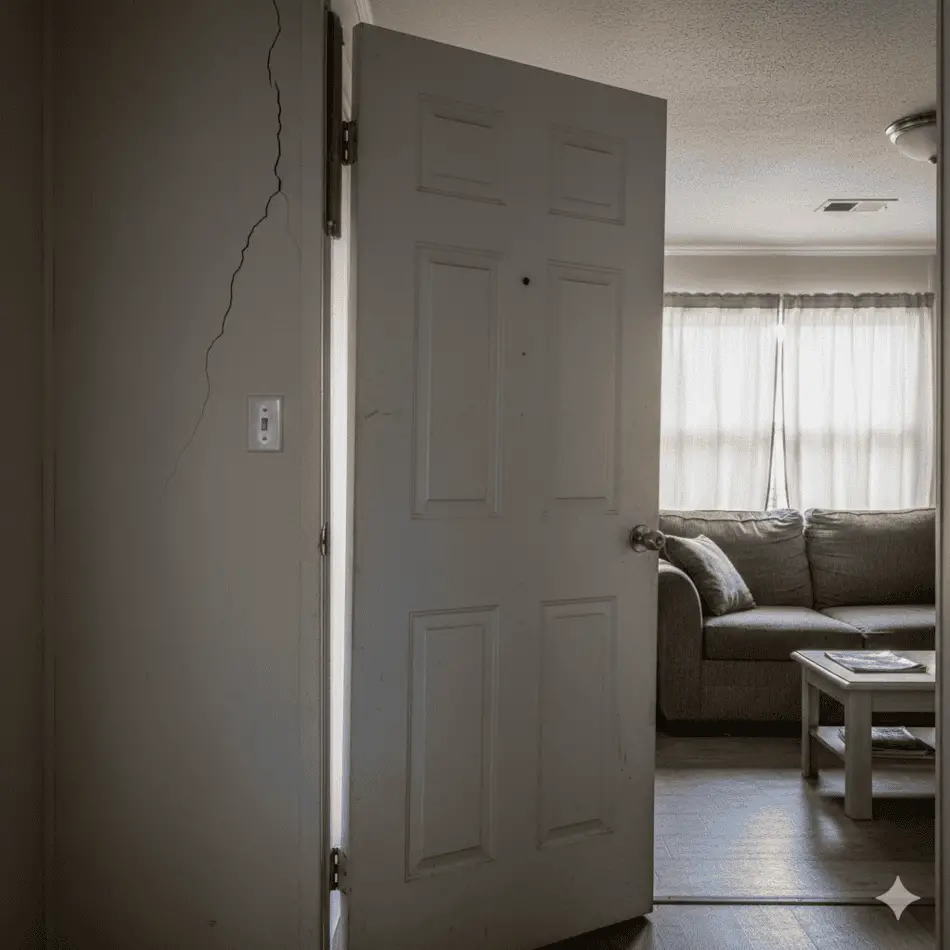
This is the “canary in the coal mine.” If your front door used to latch perfectly but now requires you to lift the handle to lock it, the frame is torqued. If a window suddenly becomes impossible to slide open, the weight of the home is shifting onto that specific opening. Never force a window open; you might shatter the pane or warp the vinyl frame permanently.
Interior Cosmetic Damage
Look at the marriage line on a double-wide. If you see a gap opening up in the ceiling or floor where the two halves meet, you have a major leveling issue. Also, look for “stair-step” cracks in the drywall or panels near the corners of doors. These are signs that the frame is twisting.
The “Water Test”
If you suspect a slope, go to your kitchen or bathroom. Pour a small amount of water on a flat section of the countertop. If it consistently rolls in one direction, you have found your lean. While this isn’t a scientific measurement, it is a fast way to confirm your suspicions before calling a pro.
The Professional Releveling Process
When I go in to relevel a property, I follow a strict protocol. You cannot just crawl under there with a car jack and start pumping. You will buckle the I-beam or crack the marriage line. Here is how a pro does it correctly.
Step 1: The Water Level or Laser Setup
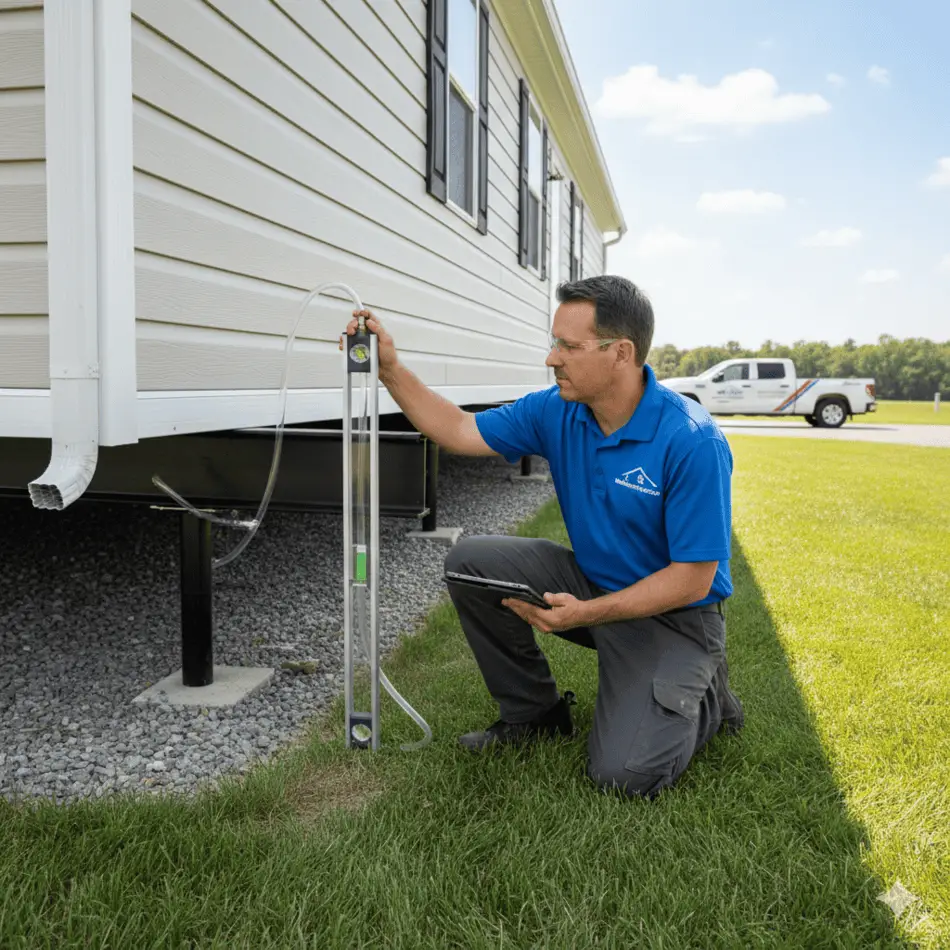
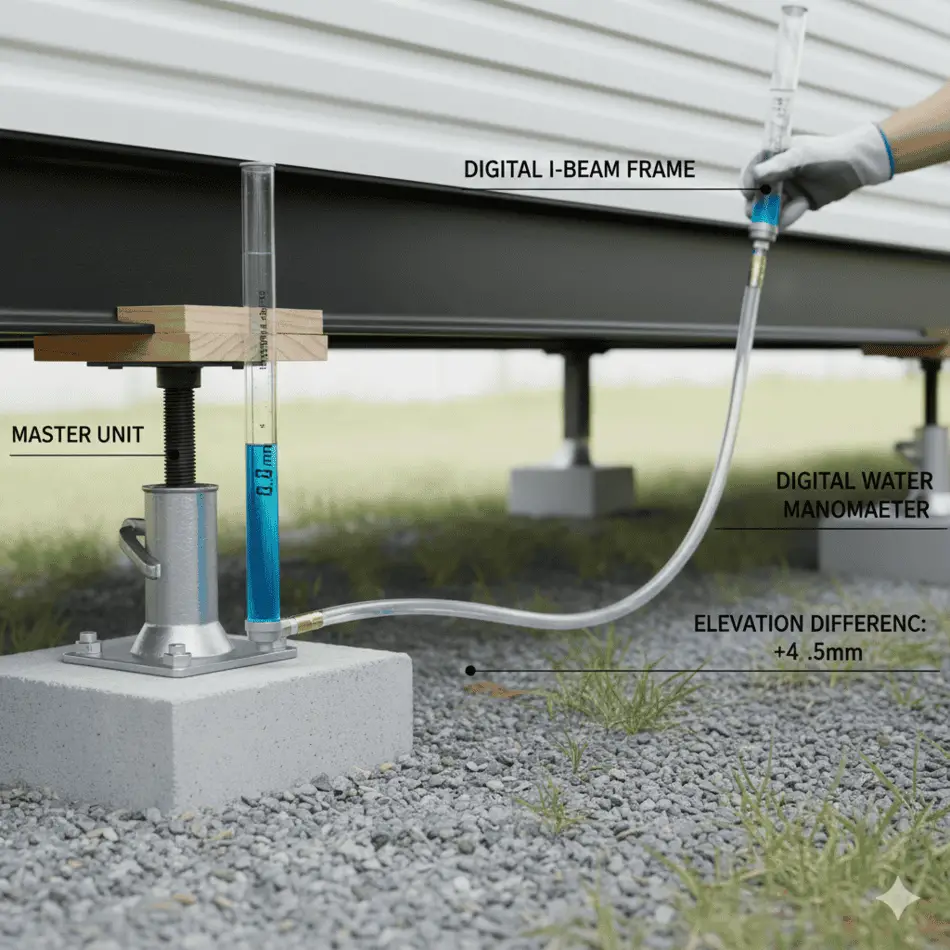
We use a specialized water level (often called a “manometer”) or a high-end rotary laser. We establish a “benchmark” at the highest point of the home. Usually, this is near the center where the weight is most concentrated. Every other point on the frame must be brought up to match this benchmark.
Step 2: Inspecting the Piers
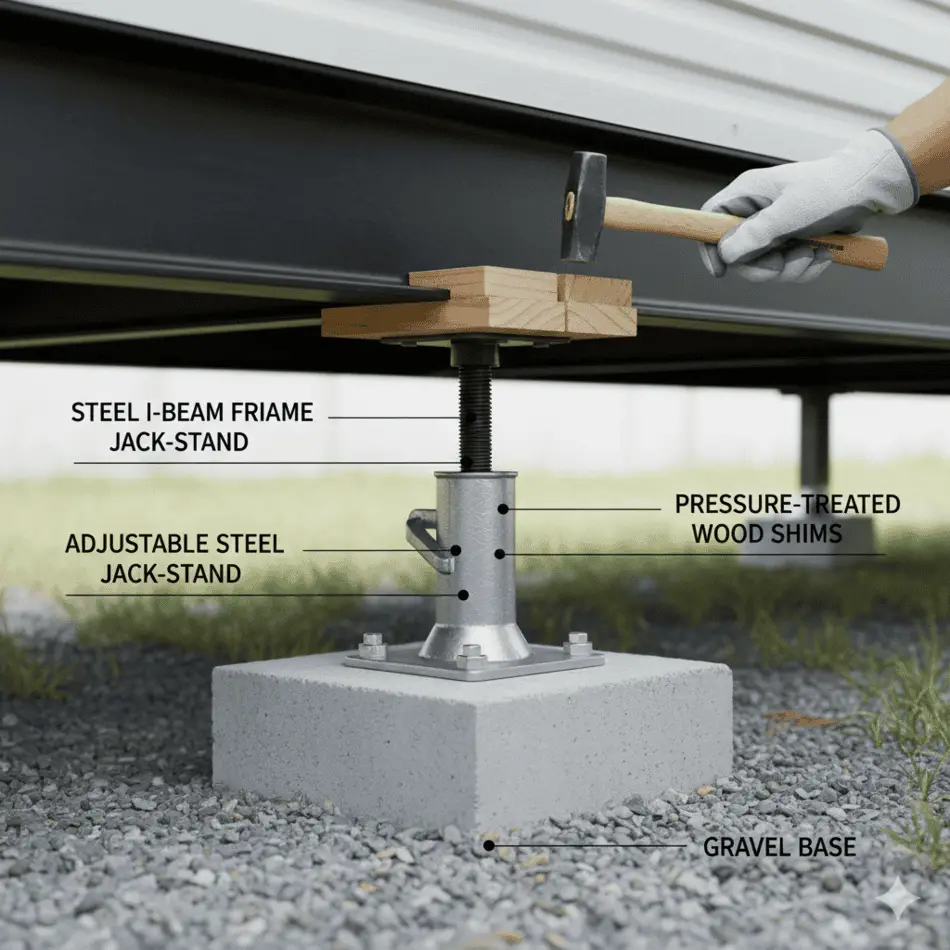
Before lifting, we check the integrity of the concrete blocks and wood shims. If the blocks are cracked or “spalling,” they must be replaced. I never reuse rotted wood shims. We also check the tie-downs. If a home has shifted significantly, the tie-down straps might be dangerously tight or completely loose.
Step 3: The Incremental Lift
We use 12 ton or 20 ton hydraulic jacks. The key is to lift in small increments. If the home is down two inches, we don’t lift it two inches at once. We lift a half-inch at a pier, move to the next, and work our way around the home. This gives the home time to “settle” into its new position without snapping the interior finishes.
2026 Cost Transparency Table
Prices have stabilized somewhat since the volatility of the early 2020s, but labor remains the biggest variable. Below are the estimated costs for a standard releveling job in the current market.
| Service Type | Single-Wide Cost | Double-Wide Cost |
|---|---|---|
| Basic Relevel (Minor Adjustments) | $550 – $800 | $900 – $1,400 |
| Major Relevel (Pier Replacement) | $900 – $1,600 | $1,800 – $3,000 |
| Add-on: New Tie-Down Straps | $300 – $600 | $500 – $900 |
Recommended Gear for Homeowners
If you are a DIY enthusiast or just want to monitor your home like a pro, these are the tools I keep in my truck. Quality tools prevent expensive mistakes.
| Product Category | Chuck’s Choice | Why It Matters |
|---|---|---|
| Precision Leveling | Z-Level Pro Digital Manometer | Allows one person to check level across 50 feet with 0.1 inch accuracy. |
| Support Shims | Titan High-Density Polymer Wedges | Unlike cedar, these will never rot, compress, or attract termites. |
| Stabilization | Vector Frame-Clamp Tie-Down Kit | Ensures the home stays on the piers during high winds or minor tremors. |
Actionable Leveling Checklist
- Check Drainage: Ensure the ground slopes away from the home at least 1 inch per foot for the first 6 feet.
- Inspect the Vapor Barrier: A ripped ground cover allows moisture to soften the soil under your piers.
- Clear the Skirting: Ensure skirting vents are clear to prevent humidity buildup that rots floor joists.
- Test Doors: Open every interior door to a 45 degree angle. If it swings shut or wide open, that section is out of level.
- Examine Piers: Look for leaning stacks of blocks. If a pier is not perfectly vertical, it is a structural failure waiting to happen.
Internal Resources
For more specialized information on maintaining your manufactured home, check out these deep dives on our site:
- The Complete Mobile Home Skirting Guide: Insulation and Aesthetics
- Foundation Repair vs. Releveling: Knowing the Difference
- Crawlspace Encapsulation for Mobile Homes: Is It Worth It?
Summary
Leveling is not a “one and done” task. It is a part of the standard maintenance cycle for any manufactured home. Do not wait for a window to shatter before you act. By checking your level every two years and keeping water away from your foundation, you can easily double the lifespan of your home. If you hire a pro, ensure they use a water level and provide a written guarantee of their work. A level home is a happy home, and more importantly, it is a home that retains its resale value.
About the Author: Chuck O’Dell
Chuck O’Dell is the founder of MobileHomeFriend.com and a veteran real estate investor with over 20 years of hands-on experience. Having managed the renovation and sale of over 100 mobile homes, Chuck specializes in structural integrity, park management, and cost-effective maintenance strategies. He lives by the philosophy that common sense and first-principles engineering can solve 99 percent of housing problems.
With over 20 years of hands-on experience in the manufactured housing industry, Chuck O’Dell has overseen hundreds of releveling projects, ensuring homes remain safe, stable, and structurally sound.